
 EN

SX440 AVR: Installation and Troubleshooting Guide
The SX440 AVR is one of the most widely deployed automatic voltage regulators in the brushless generator market. Whether you are procuring replacement parts for a wholesale inventory or specifying components for a branded genset lineup, understanding how the SX440 AVR works — and how to install and maintain it correctly — directly affects generator uptime and sourcing decisions. This guide covers the core operating principle, model comparison, wiring procedure, and a structured fault-diagnosis approach for technicians and procurement professionals alike.
What Is the SX440 AVR and How Does It Work?
The SX440 AVR is a half-wave phase-controlled thyristor type automatic voltage regulator that forms part of the excitation system for a brushless generator. Its primary function is to sense the generator's output voltage and adjust the excitation current supplied to the main field winding to keep the output within a tightly controlled range — typically ±1% under steady-state conditions.
The SX440 AVR samples the generator's terminal voltage through a dedicated sensing input. When the output drops below the set point because load suddenly increases, the thyristor firing angle shifts to allow more current into the exciter stator, raising rotor flux and restoring output voltage. This closed-loop correction happens in milliseconds, keeping voltage stable even under rapid load transients.
Within the power electronics industry, this thyristor-based half-wave design remains a reliable and cost-effective choice for mid-range generator sets where fully digital control adds unnecessary complexity. Replacement is also straightforward when a unit fails, provided the replacement is properly matched to the alternator's excitation specification.
SX440 AVR vs. Other Common AVR Models
Procurement teams and maintenance engineers frequently need to choose between several AVR models for the same power segment. The table below outlines key differences between the SX440 and four other common models:
| Model | Type | Typical Power Range | Sensing Voltage | Key Feature |
|---|---|---|---|---|
| SX440 | Half-wave thyristor | 20 kW – 500 kW | 95–264 V AC | Compact, wide sensing range, widely compatible |
| SX460 | Half-wave thyristor | 5 kW – 200 kW | 170–264 V AC | Smaller footprint, lower excitation power output |
| AS440 | Half-wave thyristor | 20 kW – 500 kW | 95–264 V AC | Enhanced stability control, improved soft start |
| R120 | Full-wave thyristor | 5 kW – 150 kW | Configurable | Digital display, field current feedback |
| R450 | Full-wave thyristor | 200 kW – 2000 kW | 95–264 V AC | High-power alternator applications, PF control |
For generator sets in the 30 kW to 150 kW range, the SX440 AVR and the AS440 are the most common interchange candidates. Both share the same form factor and wiring pin layout, but the AS440 adds a soft-start ramp that reduces excitation overshoot on startup — something worth considering if end-users frequently report voltage spikes at initial load pick-up. For a smaller 5kw avr application, the SX460 is a more appropriately sized option. For larger diesel sets above 150 kW, the Universal Generator AVR SX440 for 150KW diesel Generator provides a direct-fit solution that matches the excitation current requirements of higher-capacity alternators.
For R120-type AVRs using full-wave rectification, confirm that the alternator's excitation winding supports this output type before installation. The AVR for Power Generator R120 circuit diagram helps verify this compatibility in the field.
Procurement Considerations for Wholesalers and Brand Buyers
For wholesale buyers building generator parts inventory, a few practical points reduce total replacement cost and stocking risk:
- Excitation voltage compatibility: Confirm whether the target alternator specifies a 110 V or 120 V AC sensing input. An SX440 AVR wired for the wrong sensing range will produce chronically low or high output voltage even if the unit itself is undamaged.
- Connector and pin layout: Genuine SX440-spec boards use a standardized 12-terminal layout. Universal aftermarket replacements, including brushless AVR variants like the GAVR-12A Brushless AVR, are designed to match this footprint but verify terminal labels before installation.
- Replacement cost vs. service life: The SX440 AVR is a consumable-grade component in high-cycle environments. Brands buying for their own labeled gensets often carry 2–3 spare units per 10 sets in the field to ensure rapid swap capability without depending on local lead times.
- Batch consistency: For brand buyers, consistent manufacturing quality across batches matters. A single batch variation in thyristor firing thresholds can cause subtle instability that is difficult to diagnose in the field.
In the generator gas regulator context, a failing SX440 AVR can produce feedback-loop symptoms that resemble fuel-side governor faults. Separating voltage control diagnosis from governor diagnosis early avoids misidentification and saves field time.
SX440 AVR Installation: Wiring and Setup
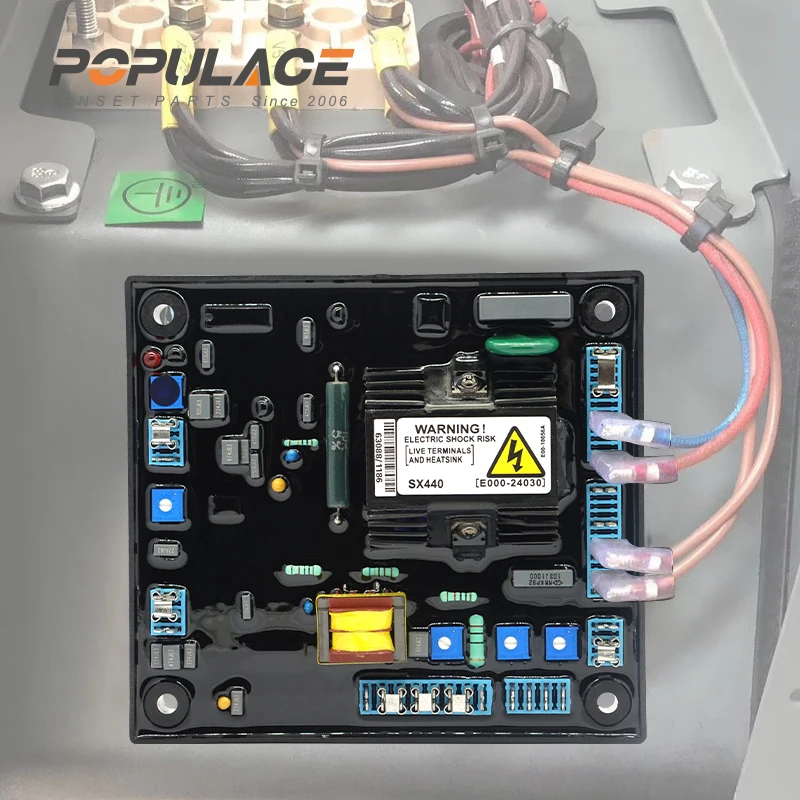
Once alternator compatibility is confirmed, the SX440 AVR installation follows a repeatable commissioning sequence. The steps below cover a standard no-load setup:
- Confirm terminal assignment: Locate terminals E+/E– (exciter stator), F+/F– (main field), and the voltage sensing input (typically terminals 1 and 2 for single-phase sensing). Verify these match your alternator's wiring diagram before connecting any power.
- Set voltage potentiometer to mid-range: Before first start, set the VOLTS trimmer to approximately mid-position. This prevents the AVR from driving excitation to an extreme before you have a baseline reading.
- Connect at no load: Start the generator at rated speed with no connected load. Measure terminal voltage with a calibrated meter. Adjust the VOLTS trimmer until output matches the rated voltage (e.g., 400 V AC for a 50 Hz three-phase set).
- Check stability under load: Apply a step load of approximately 25% rated capacity and observe voltage response. If the output oscillates before settling, adjust the STABILITY trimmer clockwise in small increments until the response is critically damped.
- Record final trimmer positions: Document both trimmer positions for future reference. This baseline is invaluable when troubleshooting after a partial failure.
One pitfall worth flagging from field experience: voltage rating mismatches are more common than they appear. An SX440 AVR intended for a 110 V sensing configuration will under-excite when connected to a 120 V sensing circuit, producing output roughly 8–10% below setpoint. The board itself reads as functional during bench testing, which makes this fault genuinely easy to miss at incoming inspection.
Common SX440 AVR Faults and How to Troubleshoot Them
The majority of SX440 AVR faults in service fall into three categories:
1. No Output Voltage at Start-Up
Check residual magnetism in the exciter core first. If the generator produces zero voltage on starting, perform a flash test by briefly applying 12 V DC to the F+/F– terminals. If output voltage appears after flashing and then stabilizes, the residual magnetism was lost — a normal occurrence after extended storage or a deep discharge event.
2. Chronic Voltage Drift or Instability
AVR voltage drift observed during steady-state operation usually points to a degraded sensing capacitor or a loose sensing input connection. Check all terminal torque values and inspect for oxidation on the sensing input terminals. If instability persists after mechanical checks, the STABILITY trimmer should be recalibrated from the baseline position. A stability adjustment that was correct when new may need updating after the AVR has been in service for more than 12–18 months in high-humidity environments.
3. Overexcitation Leading to High Voltage
Overexcitation typically indicates a shorted thyristor within the SX440 AVR. A shorted thyristor causes uncontrolled conduction into the exciter, driving output voltage above setpoint regardless of trimmer position. This fault requires component-level replacement or board swap. Verify by measuring exciter field voltage with the AVR disconnected — if exciter voltage is present without any AVR drive signal, the fault is in the alternator exciter winding, not the SX440 AVR itself.
Installation environment also affects fault frequency. Boards mounted in poorly sealed terminal boxes in high-humidity coastal or marine installations show higher failure rates from conformal coating delamination. In those conditions, specifying an AVR with additional protective coating on the PCB is worth the marginal sourcing cost.
Sourcing the SX440 AVR from a Reliable Supplier
Consistent supply of the SX440 AVR matters as much as initial quality for wholesale and brand buyers. KYGEN Power offers AVR wholesale supply with compatible options across multiple excitation specifications, supported by pre-sales technical compatibility verification to confirm the correct variant before order. For procurement teams managing inventory across multiple generator brands and power segments, consolidating AVR supply with a supplier that covers the SX440, R120, and brushless AVR categories under one source simplifies both ordering and technical support.
Combining technical knowledge with reliable sourcing — from correct installation through fault diagnosis to consistent supply — is what builds dependable generator service operations across the power electronics industry.






