
 EN

What Is the Difference Between a Three Phase Bridge Rectifier and a Half-Wave Rectifier?
A three phase bridge rectifier and a half-wave rectifier both change AC into DC, but they do not use the AC source in the same way. That distinction affects DC smoothness, transformer connections, diode stress, heat management, and the filtering required after the rectifier. For a generator control panel, battery charger, or industrial DC supply, it is worth separating “half-wave” from “three-phase” before selecting hardware.
The short answer is this: a conventional three phase bridge rectifier is a six-diode, full-wave circuit that uses both the positive and negative portions of all three phase voltages. A three-phase half-wave circuit usually uses three diodes and only the positive phase sections, with a neutral return. A single-phase half-wave rectifier is simpler still, but it is not an apples-to-apples substitute for either three-phase topology.
Start with the topology, not the module label
A three phase bridge rectifier, often called a six-pulse bridge, has six diodes: three connected to the positive DC bus and three to the negative DC bus. At any instant, the diode connected to the most positive line feeds the positive bus while the diode connected to the most negative line completes the return path. The load therefore sees line-to-line voltage segments continuously transferred from one diode pair to the next.
By contrast, a three-phase half-wave rectifier has one diode per phase. Each diode conducts when its phase is the most positive relative to neutral. The DC return is tied to the neutral point of a star-connected source. This makes the circuit economical in diode count, but it also makes the neutral conductor and transformer secondary arrangement part of the design decision.
That is why a three phase bridge rectifier cannot be evaluated just by seeing “three phase” on a drawing. Ask whether the source has a usable neutral, whether the DC load requires low ripple, and whether the AC supply and transformer were designed for a bridge input.
Key electrical differences at a glance
| Design point | Three-phase bridge | Three-phase half-wave |
|---|---|---|
| Typical diode count | Six | Three |
| AC voltage used | Both polarities through line-to-line conduction | Positive phase sections relative to neutral |
| Ripple pulses per AC cycle | Six | Three |
| Neutral requirement | No neutral return required for the bridge load path | Requires a neutral return |
| DC quality before filtering | Higher average DC and generally smoother output | More ripple for a comparable supply frequency |
| Common fit | Industrial DC buses, chargers, drives, and high-current supplies | Simple legacy or cost-sensitive circuits with a suitable star source |
On a 50 Hz supply, the ripple from a three phase bridge rectifier occurs at 300 Hz, while the three-phase half-wave output pulses at 150 Hz. On a 60 Hz supply, those figures become 360 Hz and 180 Hz. Higher ripple frequency is useful because a capacitor or inductor has less time between peaks to support the load. It does not remove the need to calculate capacitance, inductance, load transients, or thermal limits, but it usually makes filtering more manageable.
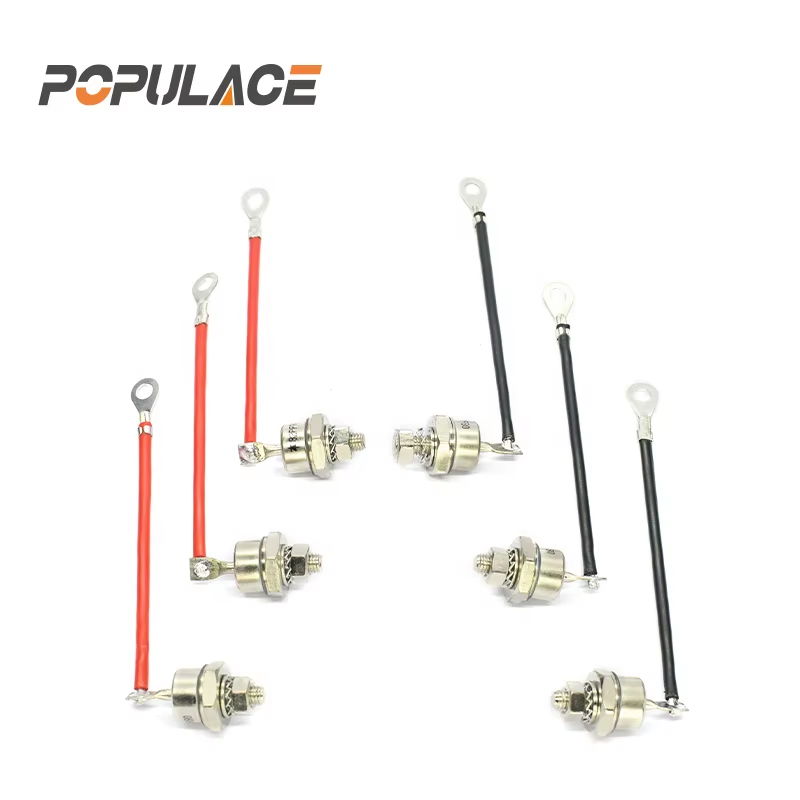
Why the bridge generally produces better DC
The biggest practical difference is utilization of the AC source. A three phase bridge rectifier has a positive-side and a negative-side diode conducting during its normal conduction sequence. It uses the available line-to-line voltage segments rather than leaving an entire polarity unused. The result is a six-pulse waveform with shorter gaps and a higher average DC level than the corresponding half-wave topology.
A half-wave design conducts one diode at a time and transfers the load from phase A to B to C as the phase voltages change. It is valid power electronics, not a defective version of a bridge. Still, its lower pulse count means a larger ripple component and more dependence on a neutral-capable source. For sensitive control electronics, the downstream regulator must also tolerate the ripple and the expected voltage range.
In a three phase bridge rectifier, two diodes share the active current path at any time. That means the forward-voltage loss is the sum of two conducting junctions, not one. However, the comparison cannot stop there: lower ripple, better transformer utilization, and reduced filtering burden may outweigh the added diode path in a system-level design.
What “half-wave rectifier” may mean in a specification
Documentation can be ambiguous. “Half-wave rectifier” sometimes means a single diode on a single-phase AC source. In other documents it means the three-diode, three-phase half-wave circuit discussed here. Before comparing ratings, identify the input as single-phase or three-phase and confirm whether a neutral is available. A three phase diode bridge is normally the six-diode full-wave arrangement, not the three-diode half-wave arrangement.
This distinction matters when replacing a module. A 3 phase bridge rectifier module may have AC terminals marked for three lines and DC terminals marked + and −. It should not be connected as though it needs a neutral. Conversely, replacing a neutral-return half-wave assembly with a bridge can change DC voltage, current paths, fusing requirements, heat dissipation, and the design of the downstream circuit.
How to choose for generator and industrial equipment
For a generator rectifier 3 phase application, begin with the actual alternator or auxiliary transformer voltage, frequency, and wiring configuration. Then establish the required DC voltage under minimum and maximum input conditions, continuous and surge current, permissible ripple, ambient temperature, and cooling method. Do not choose a rectifier from current rating alone; repetitive surge current, reverse voltage margin, mounting torque, insulation, and thermal resistance also affect reliability.
A three phase bridge rectifier is often the practical choice where the load needs a more stable DC bus, where no neutral is brought out, or where the system is intended for a six-pulse input. A high power bridge rectifier should be specified with a thermal path that matches the enclosure and real duty cycle, not just a catalog headline rating. The heatsink, airflow, wiring, and fuse coordination are part of the rectifier assembly.
Are you sourcing the part as a direct replacement for a unit already in the field, or as inventory for several generator variants? That question changes what must be verified. A maintenance team should compare the existing schematic, line voltage, phase arrangement, terminal layout, isolation requirements, and measured DC output before approving a substitute. Fujian Kaiyue Electronics Co., Ltd. can support buyers who need to clarify generator-part compatibility before purchase, but the final selection should be based on the equipment’s documented electrical requirements.
Practical decision rule
Choose a three phase bridge rectifier when you need full-wave three-phase conversion, lower ripple than a three-phase half-wave circuit, and a line-to-line bridge path without a neutral return. Consider a three-phase half-wave circuit only when the system was designed around a star secondary with neutral and its ripple and DC-voltage characteristics are acceptable.
Once you manage a parts inventory long enough, you stop asking only which rectifier has the lowest unit price and start asking whether the topology, terminal arrangement, and thermal margin match the installed equipment. That verification step is usually far less costly than troubleshooting a mismatched DC supply after commissioning.
FAQ
Is a three phase bridge rectifier the same as a three-phase full-wave rectifier?
Yes. In ordinary diode-rectifier terminology, a three phase bridge rectifier is the three-phase full-wave, six-diode bridge.
Does a three-phase half-wave rectifier need a neutral?
Yes, the standard three-diode three-phase half-wave circuit needs a neutral return from a suitable star-connected source. A bridge does not use that neutral return for its DC path.
Can I replace a half-wave rectifier with a bridge rectifier directly?
Not automatically. Check the transformer wiring, expected DC voltage, filter design, fuses, load limits, terminals, and thermal design first.





