
 EN

What Are the Main Functions of a 4520 Deep Sea Generator Controller?
A 4520 deep sea controller is the decision-making module between a generator set, the utility supply, and the transfer equipment. In a typical automatic-mains-failure installation, it watches the incoming supply, tells the engine when to start, checks whether the alternator is ready, transfers the load at the appropriate time, and reports abnormal conditions. That is more useful than thinking of it as simply a start button: the 4520 deep sea controller coordinates a sequence that protects the set and gives an operator a clear view of what is happening.
As a technical consultant for generator control components, I would first confirm the exact module revision and configuration before specifying functions. A DSE4520-family unit can be configured differently by the generator OEM. Still, the core 4520 deep sea roles below explain what buyers and operators normally expect from an AMF-capable controller.
1. It monitors the utility supply and decides when a backup generator is needed
The defining job of a 4520 deep sea controller in AMF service is to monitor the mains or utility supply. When configured limits show that the supply has failed or moved outside its permitted voltage or frequency range, the controller begins its start sequence. It can also respond to a remote-start input, depending on its setup. This is why a 4520 AMF controller is common in standby systems: it provides the logic that turns a power-quality event into an orderly generator response.
The timing matters. A sensible configuration avoids reacting to a momentary disturbance, yet it should not delay a genuine backup-power requirement. The exact thresholds, delays, and phase-monitoring options belong to the commissioning record rather than a generic article. If your site has frequent short disturbances, the settings should be reviewed by the responsible generator technician.
2. It manages automatic engine starting and stopping
Once a start condition is confirmed, the 4520 deep sea module controls the normal engine-start sequence: it can issue the fuel and crank commands, observe the start attempt, and recognize when the set has reached a usable running condition. After utility power returns and the system has completed its return sequence, the controller can apply a cool-down period before stopping the engine. This automatic start/stop logic reduces the need for someone to be present during a utility failure.
A common misunderstanding is that any 4520 deep sea panel behaves identically after a start signal. In practice, the installed configuration determines details such as starting attempts, safety delays, inputs, and outputs. A deep sea 4520 controller manual for the fitted version is the right source for button actions, terminal assignments, and parameter definitions.
3. It checks generator availability before loading the set
Starting an engine is not the same as supplying a building. The 4520 deep sea controller monitors generator-side conditions so that the load is transferred only when the set is operating within the parameters defined for that installation. Depending on the application and configuration, this includes alternator voltage, frequency, phase conditions, engine speed sensing, and status feedback from switching devices.
This sequencing protects both the load and the genset. It also helps operators see whether the issue is an engine-start problem, a generator-output problem, or a switching problem. Early in a sourcing process, buyers often focus on the display and nominal voltage. After a difficult commissioning, attention usually shifts to sensing inputs, breaker feedback, and the panel connector arrangement—details that determine whether the controller can perform its intended job.
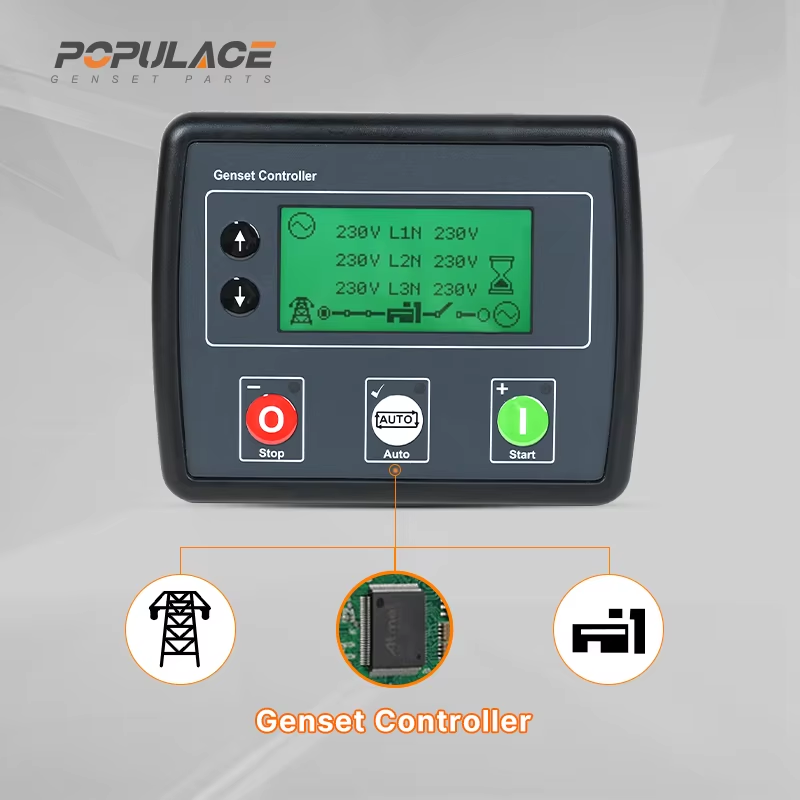
4. It controls load transfer in an AMF system
When a set is ready, a 4520 deep sea controller can command the relevant generator and mains contactors or breakers through its configured outputs. In an automatic-mains-failure application, that means moving the load from an unhealthy utility source to a healthy generator source, then supervising the reverse process when stable utility power is available again. Interlocks and feedback wiring are essential; a controller cannot compensate for incorrect transfer-switch wiring or an incorrectly selected switching device.
For an operator, this function is visible as a simple change from mains to generator. Behind it is a sequence of checks, delays, commands, and feedback. That distinction matters when assessing a generator control module 4520 for a retrofit: confirm what the existing transfer arrangement requires before ordering a replacement.
5. It displays operating information and gives alarms
A 4520 deep sea controller is also the local interface for routine operation. The display and indicators can present controller status, operating mode, electrical measurements, engine-related inputs, warnings, and shutdown alarms as configured. This information helps a maintenance team decide whether an event needs a reset, inspection, or a service call.
Protection is especially important because generator faults should not be treated as ordinary messages. A correctly configured 4520 deep sea panel can alarm or initiate protective action for conditions detected through its sensing and configured inputs. The actual alarm list varies by OEM configuration. Do not assume that every label found online exists on a specific installed module; compare the unit's configuration file and wiring diagram with the site requirements.
6. It supports manual, automatic, and test-oriented operation
Operators need a controlled way to run and verify standby equipment. A 4520 deep sea controller typically provides operating modes that separate manual intervention from automatic response. Manual mode is useful for supervised checks, while Auto permits the controller to respond to a valid mains-failure or remote-start condition. Test behavior is configuration dependent and should be planned so that personnel understand whether the generator will run unloaded or transfer the facility load.
That is also why training should cover the actual panel—not only general descriptions. Before using a deep sea 4520 controller manual, identify the label, firmware generation, wiring scheme, and site change-control requirements. The controller's capability does not remove the need for safe isolation and qualified electrical work.
What to verify before you buy or replace a 4520 controller
Searches for deep sea 4520 price often focus on the module alone, but the lowest purchase price is rarely the full decision. For a replacement or new panel build, collect these details first:
- the exact installed controller model and revision;
- the intended operating role: AMF, remote auto-start, or a site-specific sequence;
- mains and generator sensing requirements, including single- or three-phase arrangements;
- engine interface, speed-sensing method, and available input/output points;
- transfer-switch type, breaker/contactor feedback, and interlocking scheme;
- the existing configuration file, wiring diagram, and alarm requirements.
For wholesale buyers and service companies, documenting those details before requesting a quotation reduces the risk of receiving a physically similar but unsuitable module. Technical compatibility confirmation and clear wiring documentation are often more valuable than a quick model-number match.
Conclusion
The main functions of a 4520 deep sea controller are utility monitoring, automatic generator start/stop control, readiness verification, load-transfer control, alarm and status reporting, and mode-based operation. Together, these functions make a standby generator respond in an orderly way when normal power is unavailable. A sound selection practice is simple: verify the controller's exact configuration and the complete genset/transfer interface before purchase, installation, or parameter changes.





