
 EN

Generator AVR Explained: Types, Functions and Selection
When a generator starts cleanly but its output voltage rises, falls, or wanders as loads change, the gen avr is one of the first components worth understanding. An automatic voltage regulator is the control link between what the alternator produces and the voltage the application receives. For service teams, it is a troubleshooting item. For wholesalers and brand owners, it is also a compatibility and lifecycle-cost decision.
This guide explains what a gen avr does, how the feedback loop works, where familiar AVR families fit, and what should be verified before ordering a replacement. The practical rule is simple: a model name is useful, but it is not a complete specification.
What a gen avr does in a generator
A generator AVR continuously senses alternator terminal voltage, compares it with a target value, and changes excitation current to correct the difference. If a load is added and terminal voltage tends to sag, the regulator increases field excitation. When load is removed and voltage tends to rise, it reduces excitation. This closed-loop action helps an avr generator hold a usable output voltage through ordinary load changes.
The AVR does not replace correct engine-speed control. Frequency is primarily tied to engine RPM, while voltage regulation is primarily tied to alternator excitation. A generator with an AVR can still show poor results if the engine hunts, sensing wires are incorrect, windings are damaged, or the selected regulator does not match the alternator configuration.
Common generator AVR types
Self-excited and shunt-fed regulators
These regulators draw operating power and sensing information from the alternator. They are common in many conventional brushless sets and can be a practical choice when the alternator design supports that arrangement. Confirm the sensing voltage and field-output requirements rather than assuming one self-excited unit is interchangeable with another.
PMG-fed regulators
A permanent-magnet-generator supply gives the AVR a dedicated excitation source. This arrangement can offer stronger excitation support during demanding transients, but it requires a compatible alternator and wiring system. It is not a drop-in substitution for every self-excited setup.
Analogue and digital regulators
Analogue designs are widely used and straightforward to commission when their sensing and stability settings are understood. Digital designs may add configurable protection or adjustment functions. Neither category is automatically better; selection should follow the generator design, required features, service documentation, and the buyer's ability to configure the unit correctly.
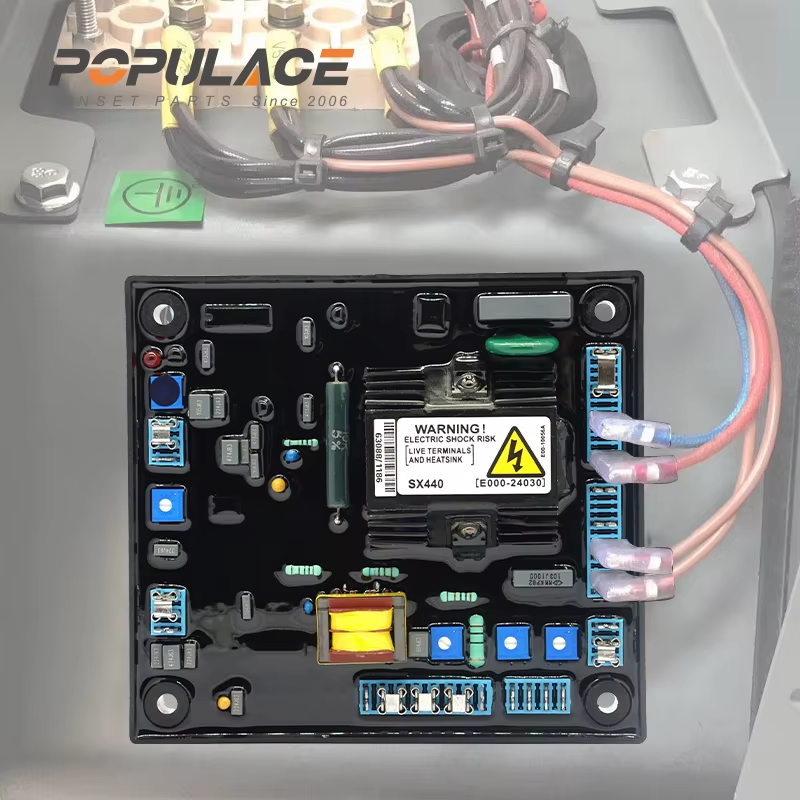
How to compare SX440, SX460, AS440, R120 and R450
Names such as SX440, SX460, AS440, R120, and R450 appear frequently in replacement inquiries. Treat them as model families, not as universal power ratings. Their suitable generator range depends on the alternator, excitation arrangement, sensing phase, field current, and application requirements.
| Family | Useful selection question | Practical buying note |
|---|---|---|
| SX440 / SX460 | Which alternator series and excitation system is installed? | Verify the exact wiring diagram and any replacement or supersession notice. |
| AS440 | Does the alternator require analogue, two-phase sensing and self-excited operation? | Check sensing terminals and the alternator family; do not select from appearance alone. |
| R120 | What are the input, sensing, and field-output requirements? | Use the installed unit label and connector layout for a replacement match. |
| R450 | Which regulation and protection functions are required for the set? | Confirm the matching alternator documentation before a retrofit. |
For example, the AS440 is documented by its manufacturer as an analogue, two-phase-sensing, self-excited AVR for a defined alternator range. That illustrates the broader point: sensing architecture is as important as the model label. A replacement for a generator with avr should be checked against terminal designations, sensing source, excitation supply, field resistance range, rated voltage, frequency, and any droop or stability arrangement.
A procurement checklist for wholesalers and brand owners
- Record the installed unit. Photograph the label, terminals, harness, and alternator nameplate before requesting a quotation.
- Confirm electrical compatibility. Supply voltage, sensing phase, field-output range, frequency, and connection layout should all be reviewed together.
- Ask for wiring and installation documentation. Documentation reduces the chance that a correct regulator becomes a failed installation.
- Compare lifecycle cost, not only purchase price. A low-cost unit that causes a return visit, an extended outage, or a batch claim is rarely the lower-cost option.
- Plan repeat supply. For resale programs, request part-number traceability, batch consistency expectations, and a notice process for model changes.
Populace Electronic focuses on generator control components and can help buyers confirm fit before committing to an order. For a current product example, review the R120 diesel generator AVR alongside the actual alternator information. Other confirmed options include a GAVR-8A automatic voltage regulator and a GAVR-12A brushless AVR. Product pages support the inquiry; final compatibility should be confirmed from the set data.
Installation and wiring checks
Isolate the generator, follow the generator manufacturer's procedure, and have a qualified technician perform electrical work. Before removing the old gen avr, label every lead and compare terminal markings with the approved diagram. Check that sensing leads are on the correct source, field wires are not swapped, plugs are seated, and grounding follows the specified arrangement. After installation, start unloaded, verify rated voltage and frequency, then introduce load in controlled steps while observing stability.
Quick troubleshooting guide
- No voltage build-up: inspect residual magnetism, field circuit continuity, fuses, connectors, and the approved excitation procedure.
- Voltage too high or too low: verify engine speed first, then sensing voltage, AVR adjustment settings, and field connections.
- Hunting or unstable output: check load behavior, loose sensing leads, stability settings, and engine-governor performance.
- Repeated AVR failures: investigate heat, moisture, vibration, wiring faults, incorrect field loading, and transient events before fitting another regulator.
Gen AVR selection FAQ
Is every gen avr interchangeable?
No. A gen avr must match the alternator sensing arrangement, field circuit, input supply, terminal pattern, and required adjustment range. Calling a unit an automatic power regulator does not establish interchangeability. Before purchasing a gen avr, compare the old regulator label with the alternator documentation and approved wiring diagram.
What should be checked on an avr generator before replacement?
On an avr generator, record rated voltage, frequency, phase arrangement, alternator model, field wiring, connector positions, and the symptom that led to replacement. A gen avr is only one part of the control loop. An avr generator with an engine-speed fault or damaged sensing circuit may still have unstable output after a new gen avr is fitted.
Does a generator with avr protect all connected loads?
A generator with avr can regulate its intended output voltage, but it does not make poor wiring, overloads, transient faults, or incorrect frequency harmless. For a generator with avr supplying sensitive equipment, commission the gen avr under controlled load changes and verify voltage, frequency, and stability at the terminals.
Why is a generator voltage stabilizer not selected by price alone?
The expression generator voltage stabilizer is commonly used for an AVR, yet a generator voltage stabilizer must still be matched to its excitation system. A gen avr that appears cheaper can cost more if it requires rewiring, fails at commissioning, or creates a repeat service call. Request a compatibility check, wiring information, and traceable part identification for every gen avr order.
For distributors, a repeatable gen avr intake form is useful: obtain alternator details, old-part photos, voltage and frequency requirements, connector information, and the end-use environment. That same form helps a brand program compare automatic power regulator options without treating an avr generator or a generator with avr as a generic product category. It also makes later generator voltage stabilizer reorders faster and easier to audit.
Choose the right generator voltage stabilizer
An AVR is sometimes described as a generator voltage stabilizer or automatic power regulator, but the useful selection process remains the same: match the regulator to the alternator and the application, verify the wiring, and keep documented records for future replacement. For a gen avr program, that discipline protects voltage quality, reduces replacement risk, and makes wholesale replenishment more predictable.





