
 EN
External AVR for Generator: Upgrade and Wiring Tips
Over the years working with diesel and gas generators across a range of commercial and industrial applications, one pattern becomes clear fairly quickly: voltage instability is rarely a fundamental generator problem. It is typically an AVR problem. When output fluctuates or sensitive equipment keeps tripping, the first component most experienced technicians reach for is the automatic voltage regulator. Choosing and fitting the right external AVR for generator systems is often the most direct fix, and the process is less complicated than it looks.
Compatibility, though, is where things get complicated. The external AVR for generator applications that worked fine on your previous alternator may not suit the next unit, and that kind of mismatch is one of the more costly mistakes in the replacement parts category. This article covers the core function of external AVRs, how to match models to power ranges, what to consider when sourcing in volume, and how to handle wiring and common fault diagnosis.
What an External AVR for Generator Systems Actually Does
An external AVR for generator equipment connects to the exciter winding of a synchronous alternator and continuously adjusts the field current to maintain a stable AC output voltage. Regulation accuracy depends on the model, but most fall within ±1% to ±2.5% of set point. When load increases and voltage starts to drop, the AVR detects the drop through its sensing circuit and increases excitation. When load drops and voltage rises, it reduces excitation accordingly.
The "external" designation means the regulator is a separate, field-replaceable board or module mounted outside the alternator housing. This makes it possible to upgrade regulation performance or swap a failed unit without sending the alternator for full service. For rental fleets, standby power installations, and similar applications where downtime carries real cost, the ability to replace an external AVR for generator maintenance without major disassembly is practically valuable.
Choosing the Right External AVR for Generator Power Ranges

Most field questions around external AVR selection come down to five models. Here is how they map to application requirements:
| Model | Sensing | Typical Application Range | Notes |
|---|---|---|---|
| SX440 | Single-phase | Up to ~500 kVA | Widely used in small to mid-range generators; compatible with most brush-type alternators |
| SX460 | 2-phase | UC22/UC27 series alternators | Now obsolete, officially replaced by the AS440; upgrade recommended for new procurement |
| AS440 | 2-phase | Mid-range, replaces SX460 | Improved regulation accuracy; direct drop-in replacement path from SX460 with rewiring |
| R120 | Single-phase | Small to mid-range diesel gensets | Published wiring guide available; terminals labeled E+, E-, sensing, and trimmer ports |
| R450 | Multi-phase | 5 kW to 250 kW installations | Supports LAM (Load Acceptance Module) for improved transient response under sudden load changes |
Whether a specific external AVR for generator use will work on your unit depends on a few variables worth confirming before ordering in bulk: the alternator's excitation type (self-excited vs. PMG), sensing voltage range, and the trimmer adjustment range on the AVR board itself. Confirming those three points upfront prevents the most common compatibility returns.
For brushless alternator applications, models like the GAVR-12A Brushless AVR are designed specifically for brushless excitation systems, where there is no direct field connection and the regulation signal is fed through the rotating diode assembly instead.
Procurement Considerations for Wholesalers and Brand Owners
Once you start managing external AVR for generator procurement at volume, spec sheets and model numbers only get you partway there. The questions that actually drive total landed cost and service liability are different ones.
Price is a reasonable starting point, but the factor that tends to matter more over a 12 to 24 month supply horizon is documentation quality. Suppliers who can provide model-level wiring diagrams, compatible alternator lists, and parameter specs for each SKU reduce after-sales service exposure considerably. Suppliers who ship a board with a photocopied one-pager end up costing more over time.
Replacement cost analysis should also account for the manual vs automatic transfer switch configuration in the end application. When the generator operates with a manual transfer switch, voltage transients during switchover are manageable because the load is disconnected before the unit comes online. In automatic transfer switch installations, the generator meets the load nearly immediately after startup, placing higher transient demands on the AVR's response speed. Units with insufficient bandwidth degrade faster in ATS environments.
In the same vein, installations that include a generator reverse power relay for parallel operation or grid-tie configurations require AVR selection with droop compensation in mind. A single-unit AVR without droop will work against the paralleling relay, causing oscillation or nuisance trips. This is a specification point that gets overlooked frequently in wholesale procurement because it only appears in the detailed data sheet, not the headline product description.
For the R120 Digital Genset AVR, the circuit diagram is available to buyers directly, which helps with both pre-sale evaluation and post-sale technical support. For buyers comparing external AVR for generator sourcing options, that level of documentation support is a practical differentiator.
Wiring an External AVR for Generator Installations: Terminal Connection Basics
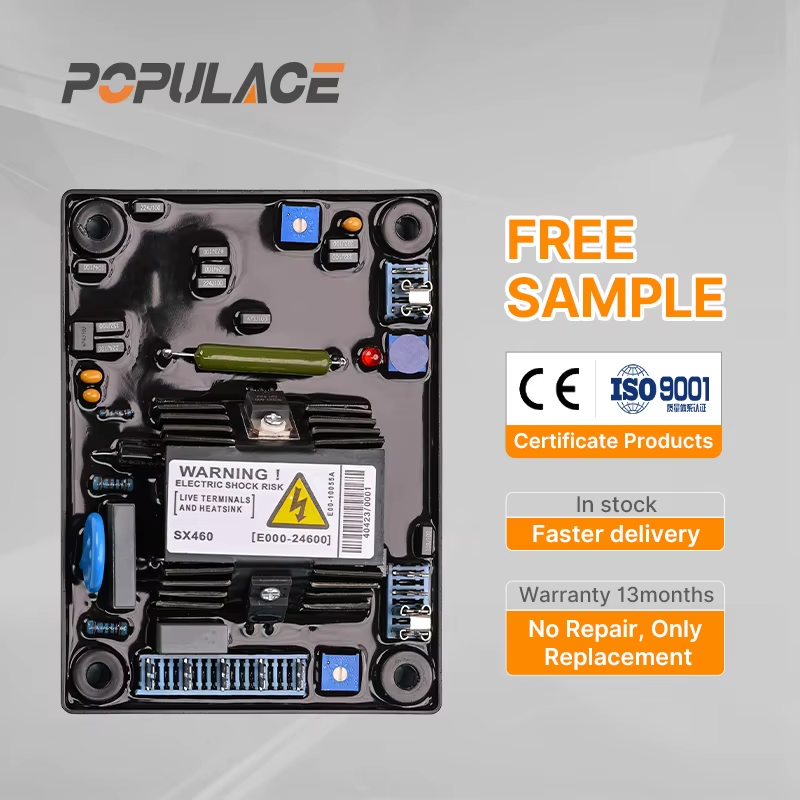
The wiring process for a standard brush-type external AVR for generator service follows a consistent pattern across most models:
- Disconnect the generator from load and de-energize the exciter field winding before removing the existing AVR board.
- Locate the sensing terminals, typically labeled V1 and V2 on older boards or "sensing" on newer designs. These connect to the alternator's output terminals and provide the voltage reference signal.
- Connect the field (exciter) terminals, labeled E+ and E-, to the brushes or slip rings on the rotor. Polarity matters here: reversing the connection stops excitation from building up entirely.
- Set the voltage trimmer to mid-range before applying power. After load-free output stabilizes, typically within 10 to 15 seconds, adjust the trimmer to the target voltage.
- Test under load by stepping through 25%, 50%, and 75% loads and checking voltage recovery time. For most standard AVR models, recovery to within ±2% should take one to two seconds.
For the marathon electric se350 voltage regulator and similar compact single-phase units, the trimmer adjustment range is typically ±10% of nominal. If the output cannot reach set point within that range, the cause is usually an undersized AVR relative to the alternator's excitation requirement, not a failed board.
Common Faults and How to Read Them
External AVR for generator failures in the field tend to fall into three groups:
- No voltage build-up on startup: This usually points to a failed sensing circuit or reversed E+/E- polarity. Check both before replacing the board.
- Voltage oscillation or hunting: The stability trimmer setting is the first thing to adjust. A mismatch between the AVR's gain and the alternator's field time constant is the underlying cause when trimmer adjustment does not resolve it.
- Voltage collapse under load: An undersized AVR is the typical explanation, though a failed output transistor produces similar symptoms. Measuring the AVR's output current at full load and comparing to spec will distinguish between the two.
The sr7 voltage regulator, used in some older Basler Electric applications, is sensitive to ground loop issues when the generator neutral is not properly bonded. If voltage instability is load-configuration-dependent, check the neutral bonding before ordering a replacement board.
For general brushless alternator applications where you need a cost-effective external AVR for generator replacement that works across a range of brands, the Universal GAVR-8A Automatic Voltage Regulator covers a broad compatibility window and is available for prompt dispatch.
Summary
Selecting the right external AVR for generator applications comes down to matching the model to the alternator's excitation type, power range, and system configuration. For wholesale buyers and brand owners, the factors that determine total cost of ownership reach well beyond the unit price: documentation quality, compatibility scope, and the supplier's technical support capacity all contribute to the final figure. Getting those right at the procurement stage reduces after-market service exposure and results in a more reliable installation for the end customer.





