
 EN

Automatic Voltage Regulator Genset: Selection and Setup
Selecting the right automatic voltage regulator genset component is one of the most important decisions for anyone sourcing diesel generator replacement parts. A poorly matched AVR in a genset leads to unstable output voltage, premature alternator failure, or protection trips — all of which translate directly into field complaints and costly returns. This guide covers how automatic voltage regulator genset systems work, how to compare the most common AVR models, what to look for when buying in bulk, and how to get the installation right the first time.
How an Automatic Voltage Regulator Works in a Genset
An automatic voltage regulator genset component is responsible for maintaining a stable AC output voltage regardless of load changes. The core operating principle involves three continuous steps: the AVR measures the alternator's AC output voltage through a sensing circuit, compares it against a fixed reference voltage, and adjusts the DC excitation current fed into the alternator's field winding accordingly.
When load increases and voltage drops, the automatic voltage regulator genset unit raises excitation current to compensate; when load drops and voltage rises, excitation is reduced. This feedback loop keeps terminal voltage within ±1% to ±2.5% under steady-state conditions for the given model.
One thing worth noting from field experience: AVR voltage drift is real, especially in temperature-variable environments. The AS440, for example, specifies thermal drift at 0.03% per °C ambient change. In tropical installations or unventilated enclosures, this can accumulate to a measurable offset over time. Factoring in the operating environment during automatic voltage regulator genset model selection avoids surprises after deployment.
Common Automatic Voltage Regulator Genset Models and Their Applications
The generator AVR market is dominated by a handful of well-established models, each suited to a specific power range and excitation system type. Here is a practical overview for procurement reference when sourcing an automatic voltage regulator genset replacement:
| Model | Typical Power Range | Excitation Type | Voltage Regulation | Notes |
|---|---|---|---|---|
| SX460 | 5–30 kVA | Shunt excitation | ±1% | Low-cost entry model, widely stocked |
| SX440 | 20–100 kVA | Shunt excitation | ±1% | Mid-range, pin-compatible with SX460 in some alternators |
| AS440 | 20–200 kVA | Separate sensing + power | ±1% | Improved sensing stability; soft start ramp time 3 s |
| AVR MX341 | 40–300 kVA | PMG or auxiliary winding | ±0.5% | Better load transient response; suitable for sensitive loads |
| AVR MX321 | 30–250 kVA | Auxiliary winding | ±1% | Compact form factor; compatible with Stamford HC/HCI/HCM series |
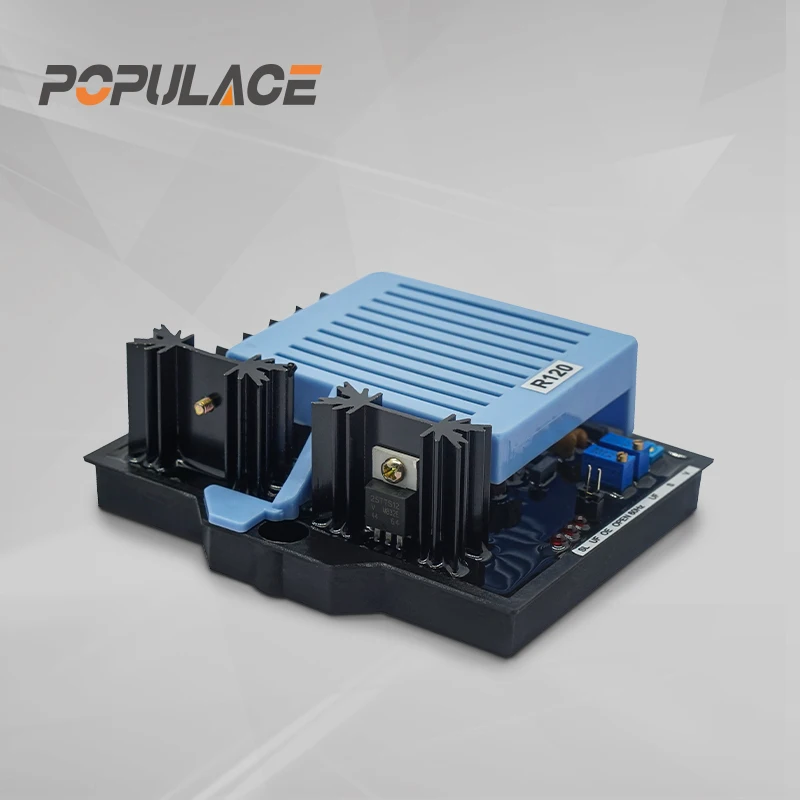
| R120 | 15–150 kVA | Shunt or compound | ±1% | Common in Chinese OEM alternators; circuit diagram available for easy identification |
| GAVR-8A / GAVR-20A | Universal (up to 20 kVA / 60 kVA) | Universal, 90–240V input | ±2.5% | Wide-input universal replacement; suitable for mixed fleet servicing |
AVR MX341 and AVR MX321 — When Tighter Regulation Matters
Among mid-to-large power applications, avr mx341 and avr mx321 are the two most commonly specified automatic voltage regulator genset options for Stamford and compatible alternators. The avr mx341 uses a PMG (permanent magnet generator) or auxiliary winding excitation supply, delivering ±0.5% steady-state regulation — noticeably tighter than the ±1% offered by lower-cost shunt-excited models. This matters in applications where the connected load includes sensitive electronics, variable frequency drives, or uninterruptible power supply (UPS) inputs that are affected by output voltage variation.
The avr mx321 shares a similar auxiliary winding excitation architecture but is more compact, making it suitable when panel space is constrained. Both avr mx341 and avr mx321 require an appropriate auxiliary winding on the alternator — confirming this during specification prevents costly installation mismatches.
Are you managing a mixed fleet with multiple alternator brands? Universal AVR models with wide AC input ranges (90–240V) cover the most ground with a single SKU, reducing your minimum order complexity significantly.
Key Selection Criteria for Wholesalers and Brand Buyers
Specification matching is only the starting point when sourcing an automatic voltage regulator genset replacement. From a wholesale procurement perspective, three factors matter as much as the datasheet: compatibility breadth, replacement cost, and available documentation.
Compatibility Verification Before Placing a Bulk Order
A common pitfall is assuming that same-model AVRs are necessarily cross-compatible. Voltage rating mismatches are a frequent cause of returns — particularly when a 190–240V automatic voltage regulator genset unit is used in a 380–415V system, or when the excitation current capacity doesn't match the alternator's field winding resistance. Confirm excitation voltage, current rating, and sensing terminal configuration before committing to volume.
For automatic voltage regulator genset deployments using dse7310 controller panels, verify that the AVR's under/over voltage protection thresholds are calibrated to align with the dse7310's generator monitoring parameters. The dse7310 provides digital metering of generator voltage, frequency, and fault conditions — AVR threshold misalignment with the dse7310's set points can trigger nuisance shutdowns or mask actual protection events.
Replacement Cost and Supply Chain Depth
Wholesale buyers and OEM brand builders need consistent pricing and stock availability across procurement cycles. The most commonly replaced models — SX460, AS440, and R120 — benefit from high market supply depth, which translates into lower per-unit costs and shorter lead times. Models like avr mx341 and avr mx321 may command a small premium but offer better performance for quality-sensitive applications.
Documentation and Traceability
One of the most underestimated procurement pain points is receiving automatic voltage regulator genset units without installation documentation or circuit diagrams. For technical buyers specifying to installers, documentation is a deliverable in itself. Confirm with your supplier that each shipment includes a wiring diagram and terminal identification label at minimum.
Automatic Voltage Regulator Products for Genset Applications
For buyers looking for factory-direct supply of compatible automatic voltage regulators for gensets, the following products are available from KYGEN Power's manufacturing line:
- AVR for Power Generator R120 — Diesel Generator Circuit Diagram, Digital Genset AVR, Factory Price: Designed as a direct replacement for R120 applications, this unit ships with the circuit diagram, simplifying field identification and installation.
- Universal Generator AVR GAVR-8A — Automatic Voltage Regulator, Exciter Control Unit: Wide-input universal model supporting 90–240V AC input, suitable for mixed-brand fleet servicing and general replacement stocking.
- Generator AVR 20A — GAVR-20A, Universal Brushless Automatic Voltage Regulator: Higher current output version for larger brushless alternators; competitive price point for volume procurement.
Installation and Wiring Basics
Setting up an automatic voltage regulator genset installation follows a consistent terminal logic regardless of model. The main connection groups are: AC sensing input (measures alternator output voltage), excitation output (feeds the field winding), and optional under-voltage protection or parallel operation terminals.
General wiring procedure:
- Identify the AVR terminal labels from the circuit diagram — typically labeled H1/H2 (sensing), F+/F− or E+/E− (excitation), and sensing/power common.
- Disconnect the generator from any load and discharge the residual magnetism if the alternator has not run recently.
- Connect AC sensing terminals to the alternator output terminals that match the rated sensing voltage of the automatic voltage regulator genset unit.
- Connect excitation output terminals to the field winding positive and negative terminals.
- Start the engine at rated speed and adjust the voltage trimmer potentiometer to achieve the target AC output voltage (typically 220V or 400V depending on winding configuration).
- Verify no-load and full-load voltage levels, and confirm stability under load transients.
The most frequent fault in an automatic voltage regulator genset system is voltage hunting — a cyclic fluctuation of output voltage. This is usually caused by incorrect stability potentiometer setting, a damaged sensing circuit, or an excitation connection with loose contact. In most single-phase sensing AVRs, increasing the stability trim slightly will damp oscillation without degrading transient response.
No-output voltage after startup is typically one of three issues: residual magnetism loss (requiring a field flashing procedure), an open-circuit AVR, or a broken rotor field winding. A quick excitation resistance check with a multimeter across the F+/F− terminals isolates whether the AVR or the alternator is the fault source.
For brushless alternator systems using the GAVR-8A or GAVR-20A universal AVR, persistent voltage undershoot under load typically traces back to an excitation current rating mismatch — the AVR's maximum output current is below the field winding demand. Upgrading to a higher-rated automatic voltage regulator genset module resolves the issue more reliably than adjusting trim pots.
Summary
Selecting the right automatic voltage regulator for a genset comes down to matching excitation system type, voltage and current ratings, and documentation completeness — not just model number. For wholesale and OEM buyers, building a stocking strategy around high-compatibility models (R120, GAVR-8A, GAVR-20A) with documented wiring diagrams reduces field installation errors and streamlines after-sale support. When application requirements demand tighter regulation or better transient response, avr mx341 and avr mx321 remain established choices for medium and large alternators, while dse7310-based control panel systems add an additional coordination requirement to any automatic voltage regulator genset specification process.





