
 EN
Industrial Genset Governor: Selection for Heavy Loads
Selecting the right industrial genset governor for heavy-load service involves more variables than most procurement buyers expect. The specification sheet rarely tells the full story. What matters is whether the governor matches the engine variant and actuator interface, whether it handles the load profile the application demands, and whether it performs consistently under the thermal and electrical stress of continuous industrial operation. This article walks through a structured selection framework for procurement engineers choosing industrial genset governor units for heavy-duty fixed and mobile power applications.
How an Industrial Genset Governor Controls Engine Speed
An industrial genset governor regulates diesel engine RPM by adjusting fuel delivery in response to load changes. When electrical load increases, the engine slows; the governor detects the speed drop and opens the fuel rack to restore the target RPM. Put simply: the governor is the feedback controller that keeps engine speed — and therefore generator output frequency — within the required band, typically 50 Hz or 60 Hz depending on the application.
The actuator executes the fuel rack movement commanded by the governor. In electronically governed gensets, a separate external actuator — such as the ADC120, ADC175, or ADC225 types — receives a signal from the electronic control unit and converts it into precise rack movement. The POPULACE external actuator range covers 12V and 24V system voltages, supporting compatibility across common industrial diesel engine families used in heavy-load genset installations.
Mechanical vs. Electronic Governor Types
Are you sourcing an industrial genset governor as a direct replacement for a unit already in the field, or specifying one for a new installation? That distinction changes which governor type deserves the most attention.
Mechanical governors use spinning flyweights and spring tension to sense engine speed mechanically. They are cost-effective and well-suited to stable, predictable load profiles. The d24sf 1bw-type Woodward-style mechanical governors represent this class: reliable for base-load applications where load changes are infrequent and gradual.
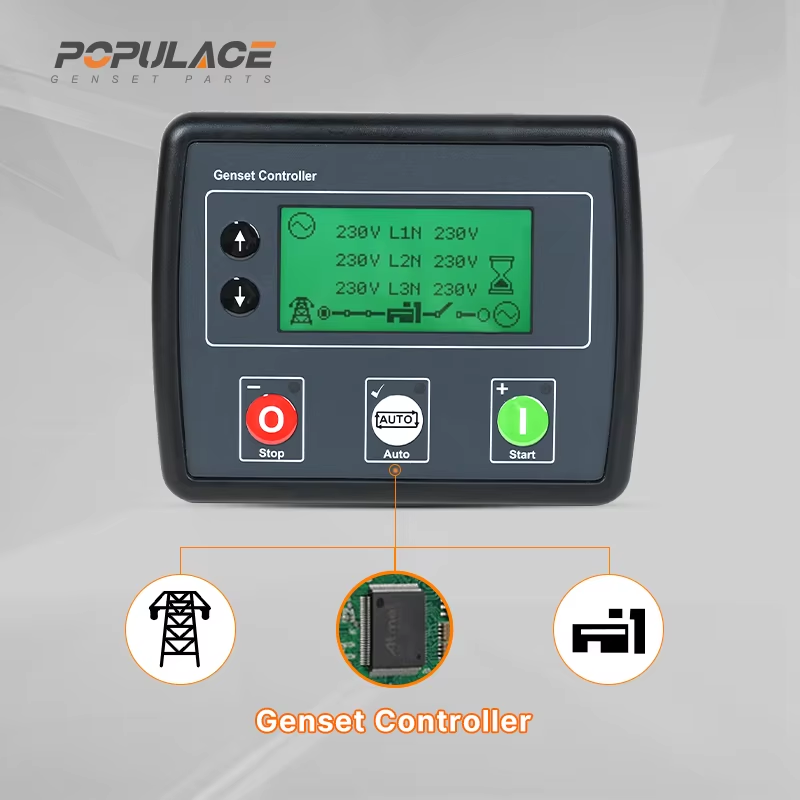
Electronic governors process speed signals from a magnetic pickup sensor and send correction commands to an actuator within milliseconds. Electronic governors respond faster when load changes suddenly; mechanical governors tend to recover more slowly, producing larger transient frequency drops that can trip sensitive industrial loads. For heavy industrial applications with motor loads cycling on and off, electronic governor systems are the appropriate specification for an industrial genset governor installation.
The shift most experienced buyers make is realizing that industrial genset governor selection is not about brand loyalty — it is about matching the droop setting and actuator response range to the specific engine variant and load profile.
Industrial Gensets vs. Mobile Power Stations
Fixed industrial generators — prime power or continuous duty installations in manufacturing facilities or infrastructure applications — operate under sustained, high-load conditions with relatively stable profiles. These applications favor an industrial genset governor with tight frequency regulation (±0.25% or better) and robust EMI resistance appropriate for electrically noisy industrial environments.
Mobile power stations face different demands. Frequent transportation subjects the governor and actuator to vibration and mechanical shock. Load profiles are often irregular, and a mobile generator powering construction equipment sees load steps that a facility generator rarely encounters. In many field installations, the limiting factor for industrial genset governor performance is not the part itself — it is vibration from a poorly isolated mounting bracket that the original specification did not account for. Buyers specifying governors for mobile applications should confirm vibration ratings and connector robustness alongside the standard electrical specifications.
Isochronous vs. Droop Mode: Single-Unit and Parallel Operation
In isochronous mode, the industrial genset governor maintains constant frequency regardless of load. This is the appropriate setting for a single genset operating as the sole source on an island load, where sensitive industrial equipment requires tight frequency regulation.
Droop mode allows frequency to fall slightly as load increases — exactly the behavior needed for stable load sharing in parallel generator configurations. If your application runs at a stable load profile as a single unit, isochronous mode will usually hold reliably. If you have multiple generators paralleled, or if load swings frequently with motor loads cycling on, droop mode is required, and the droop percentage must be matched across all units.
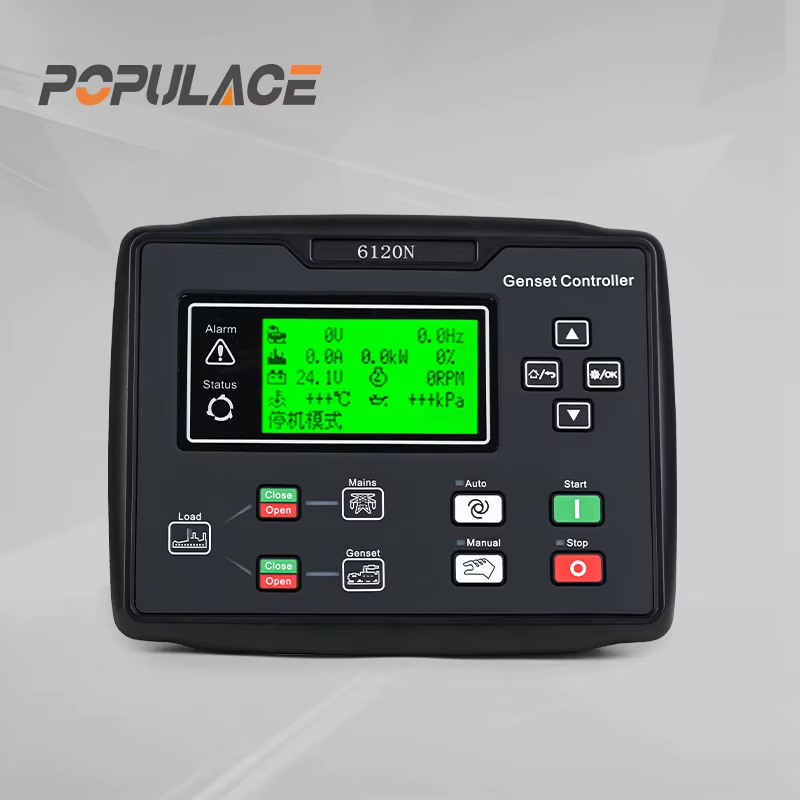
Faster governor response does not automatically translate to better outcomes in every configuration. In parallel-operation gensets with significant reactive load, excessively fast governor response can cause speed overshoot and instability that a more conservative droop setting would avoid. The hgm6120n-type genset controllers used in paralleling applications provide interface adjustments for droop level and stability, requiring coordination between the controller settings and the industrial genset governor gain parameters during commissioning.
Selection Criteria for Heavy-Load Industrial Applications
- Engine model compatibility: Confirm the industrial genset governor and actuator are rated for the exact engine variant — not just the engine brand. Interface pinout, fuel rack travel range, and control signal type vary across production series.
- Load transient response: For heavy loads with sudden load steps (motor starting, welding equipment, industrial compressors), specify electronic governors with actuator response times appropriate for the expected step magnitude.
- Operating mode: Confirm whether the installation is single-unit (isochronous) or parallel (droop), and whether the controller platform supports the required mode switching and load-sharing interface.
- Voltage system compatibility: Match actuator supply voltage (12V or 24V DC) to the genset's control battery circuit. The generator battery charging system must maintain stable voltage to the governor control electronics — a weak or fluctuating charging circuit can produce intermittent hunting symptoms easily misdiagnosed as industrial genset governor failure.
- Thermal and environmental rating: Verify the governor's operating temperature range against actual installation conditions, particularly for enclosed generator rooms or mobile units in high-ambient regions.
Governor Adjustment and Calibration
Correct installation is only the starting point. An industrial genset governor requires calibration to the specific engine, load profile, and operating mode. The parameters that matter most for heavy-load service are speed reference, gain, droop percentage, and transient response settings on electronic units.
Governor hunting — oscillating frequency that trips sensitive loads — is rarely caused by a faulty governor alone. More often it traces back to incorrect gain settings or a worn fuel rack linkage. When calibrating for heavy-load applications, start with conservative (lower) gain settings and increase in small increments while observing frequency response under step loads before finalizing. A supplier who cannot provide wiring diagrams and calibration guidelines for their industrial genset governor product is a signal worth taking seriously at the sourcing stage.
Product Options for Industrial Genset Governor Applications
For buyers sourcing electronic speed governor units for industrial diesel gensets, two options from KYGEN Power address common heavy-load requirements:
The S6700H Governor Speed Controller provides electronic speed regulation with support for both isochronous and droop modes, making it compatible with single-unit prime power installations and parallel operating configurations for demanding industrial genset applications.
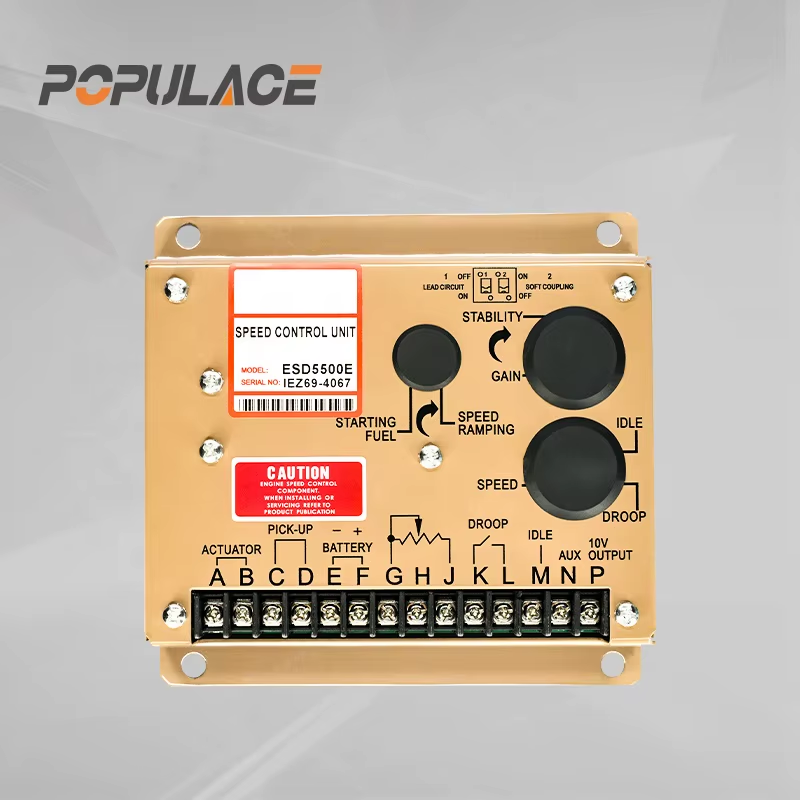
The ESD5500E Speed Governor provides a cost-efficient replacement path with documented compatibility for common industrial diesel engine variants. Both products are available through KYGEN Power's B2B supply channel, with pre-sales compatibility support for buyers confirming engine model and actuator interface specifications before ordering.
Before placing an order for any industrial genset governor, confirm engine model compatibility, operating mode requirements, actuator voltage and battery system match, environmental ratings, and calibration documentation availability. These are the checks that catch the most common installation failures before they happen in heavy-load industrial service.






