
 EN
Governor in Diesel Generator: Function and Types
The governor in diesel generator systems controls engine speed — and knowing how it works directly affects which type you source, how you configure it, and how you troubleshoot it when problems arise. As a technical consultant who regularly works with generator control components, the question I hear most often is: "What does the governor do, and does the type really matter?" The answer is yes, and the explanation is worth understanding before you source a replacement or plan a new installation.
What Does a Governor Do in a Diesel Generator?
The governor in a diesel generator regulates engine speed by controlling fuel delivery to the engine. When electrical load increases, the engine slows; the governor detects this and opens the fuel rack to restore speed. When load decreases, the governor reduces fuel supply to prevent overspeed. Without a functioning governor in a diesel generator, output frequency becomes unstable — a 50Hz system drifts, and sensitive equipment on the bus suffers or trips.
The governor is the feedback mechanism that keeps the diesel engine running at the speed the alternator needs for stable voltage and frequency. Everything connected to the generator depends on this stability — including the generator cooling fan circuit and control cards like an SE350 AVR or Stamford AVR SX440 that regulate output voltage in parallel.
How a Governor Controls Engine Speed
The control loop is simple in principle. The governor continuously monitors engine RPM, either mechanically through a flyweight sensing element or electronically through a magnetic pickup sensor. It compares actual speed against the target setpoint and drives an actuator that repositions the fuel injection rack, increasing or decreasing fuel flow as needed. Response time and correction accuracy differ significantly between governor types.
The most practically relevant specification when evaluating a governor in diesel generator applications is the combination of sensing method, actuation speed, and gain settings, as these determine how quickly and smoothly the engine recovers from a load change. A common misunderstanding is that faster governor response necessarily means better performance. In practice, excessive gain in a set with significant reactive load causes speed overshoot and hunting — the opposite of stability.
Types of Governor in Diesel Generator Systems
Modern diesel generators use one of three main governor types, each suited to different engine generations and application requirements.
Mechanical Governors
Mechanical governors use centrifugal flyweights attached to the engine's rotating shaft. As engine speed increases, the flyweights swing outward and compress a spring, repositioning the fuel control linkage to reduce fuel supply. When speed drops, spring tension moves the linkage to increase fuel flow. The mechanism is self-contained and requires no external power supply.
Mechanical governors are well-proven in older generator fleets and some agricultural or industrial engines. Their limitation is response precision: speed droop under load change is typically fixed at 3%–5% and cannot be easily adjusted without physical modification. For applications where load changes are gradual and frequency tolerance is wider, this is acceptable. For parallel operation or sensitive electronic loads, it usually is not.
In many field installations, the limiting factor for mechanical governor performance is not the part itself — it is vibration from a poorly isolated mounting bracket or wear in the fuel linkage that the original specification did not account for.
Electronic Governors
Electronic governors use a magnetic pickup to measure engine speed as a frequency signal and a dedicated speed controller module to calculate the required correction. The controller output drives an electrical actuator that repositions the fuel rack electronically, allowing the gain, droop percentage, and stability settings to be adjusted without mechanically altering the hardware.
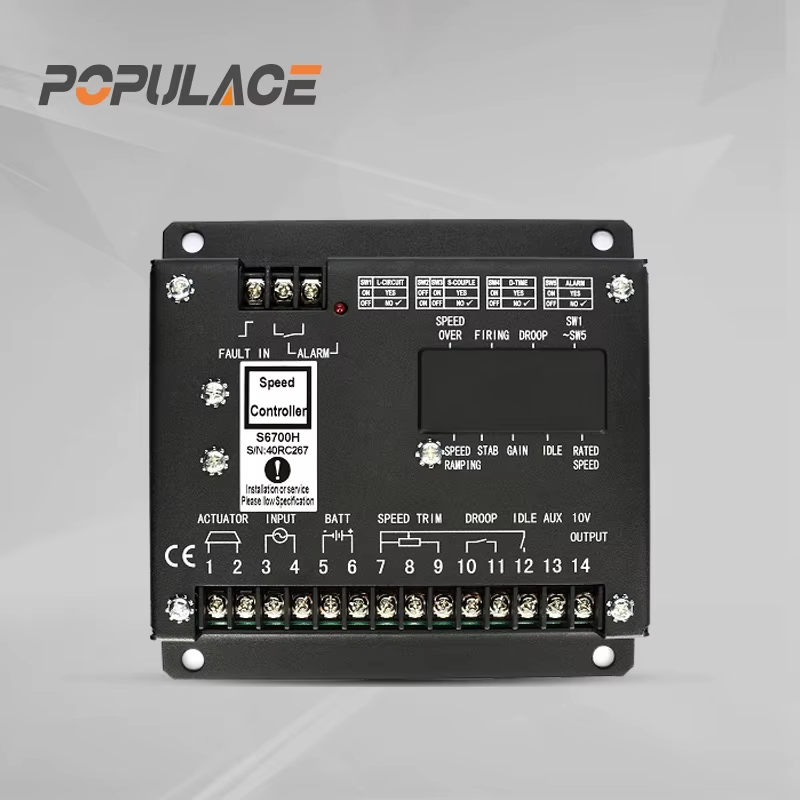
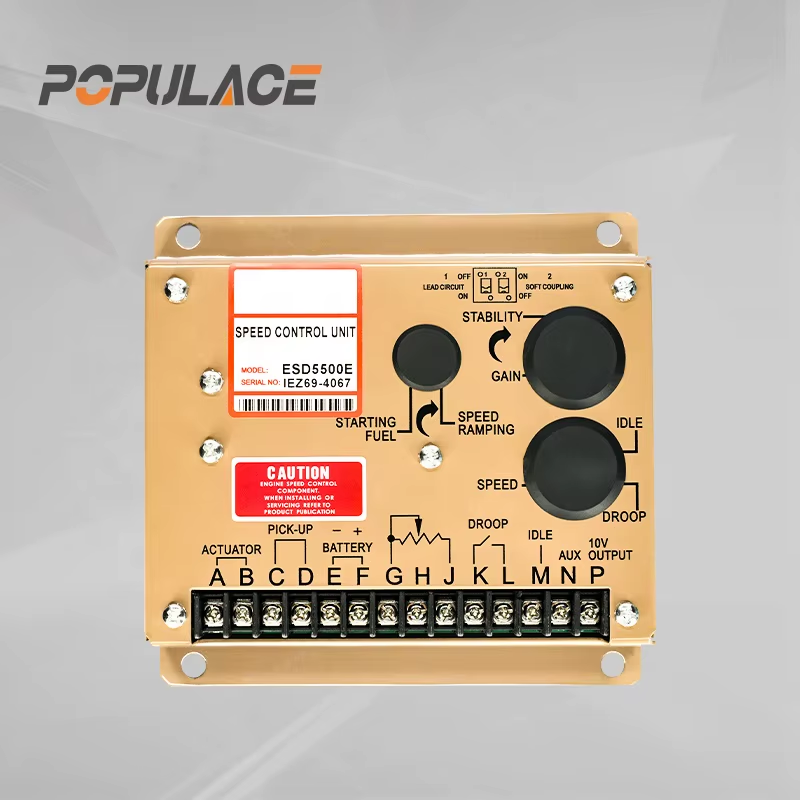
The precision and adjustability of electronic governors make them the standard choice for industrial gensets that require tight frequency regulation. The S6700H Governor Speed Controller Diesel Engine Generator Speed Control Unit provides proportional-integral-derivative (PID) control with adjustable gain for a wide range of diesel engine configurations. The ESD5500E Speed Governor Generator Speed Control Unit is widely used where stable idle, load response, and droop adjustment are required from a single unit.
ECU-Based Governors
Newer generator engines use an integrated Electronic Control Unit that manages fuel injection, emissions control, and speed regulation from a single module. In ECU-governed engines, the governor function is embedded in software and communicates with the engine management system over a data bus. These are not field-configurable in the same way as stand-alone electronic governors and are common in Tier 4 Final and Stage V emission-compliant engines.
Isochronous vs. Droop Mode
The governor operating mode determines how a diesel generator responds to load changes — and selecting the wrong mode is one of the most common commissioning errors.
In isochronous mode, the governor maintains engine speed at its nominal setpoint regardless of load — typically 1500 RPM for 50Hz systems or 1800 RPM for 60Hz systems. This is the correct mode for single-generator operation where frequency must remain stable under variable loads.
In droop mode, the governor intentionally allows speed to fall proportionally as load increases — typically 3%–5% from no-load to full-load. This creates natural load sharing between parallel generators: the faster unit takes on more load, slowing it down, while the slower unit unloads and speeds up. Without droop, parallel generators fight each other for load, causing instability or breaker trips.
Industrial vs. Mobile Power Station Applications
Industrial gensets — large prime power or standby units at facilities — require precise frequency regulation and parallel operation support. Electronic governors with adjustable droop and external actuator compatibility are standard. The actuator converts the governor's electrical output into mechanical fuel rack movement; choosing the correct actuator interface is as important as the governor module itself. The POPULACE Diesel Generator Engine Parts External Actuator (ADC120, ADC175, ADC225) is compatible with 12V and 24V governor in diesel generator systems in both industrial and mobile configurations.
Mobile power stations — trailer-mounted or skid-mounted gensets used in construction or emergency response — prioritize portability, vibration tolerance, and field repairability. Mechanical governors remain common in smaller mobile units. For larger mobile units where output quality matters, electronic governors with sealed enclosures are preferred.
Calibration and Selection Guidance
After installing a replacement governor in a diesel generator, adjustment is typically required. The standard sequence for an electronic governor involves setting gain (sensitivity), stability (damping), and droop percentage — adjusting one parameter at a time before moving to the next.
The compatibility check that prevents repeat mismatch events involves verifying the engine model, actuator interface type, and governor input voltage range against the supplier's compatibility chart before every order. For generators running SE350 AVR or Stamford AVR SX440 components, the governor and AVR interact: the governor controls speed and frequency, while the AVR controls output voltage. Adjusting one without considering its effect on the other can introduce instability that appears to be a governor in diesel generator problem but is actually a feedback loop issue between the two circuits.
When selecting a governor in diesel generator applications, the decision framework should cover: engine model and actuator interface compatibility, operating mode (isochronous or droop), adjustment range for your load profile, and input voltage availability. Sourcing from a supplier who provides pre-sales technical compatibility verification reduces the risk of receiving a unit that cannot be calibrated to your engine's fuel system. Fujian Kaiyue Electronics Co., Ltd. (brands: Populace, Doopser) supplies governor components to wholesale and brand buyers in Asia, Europe, and North America — contact [email protected] or visit kygenpower.com.






