
 EN
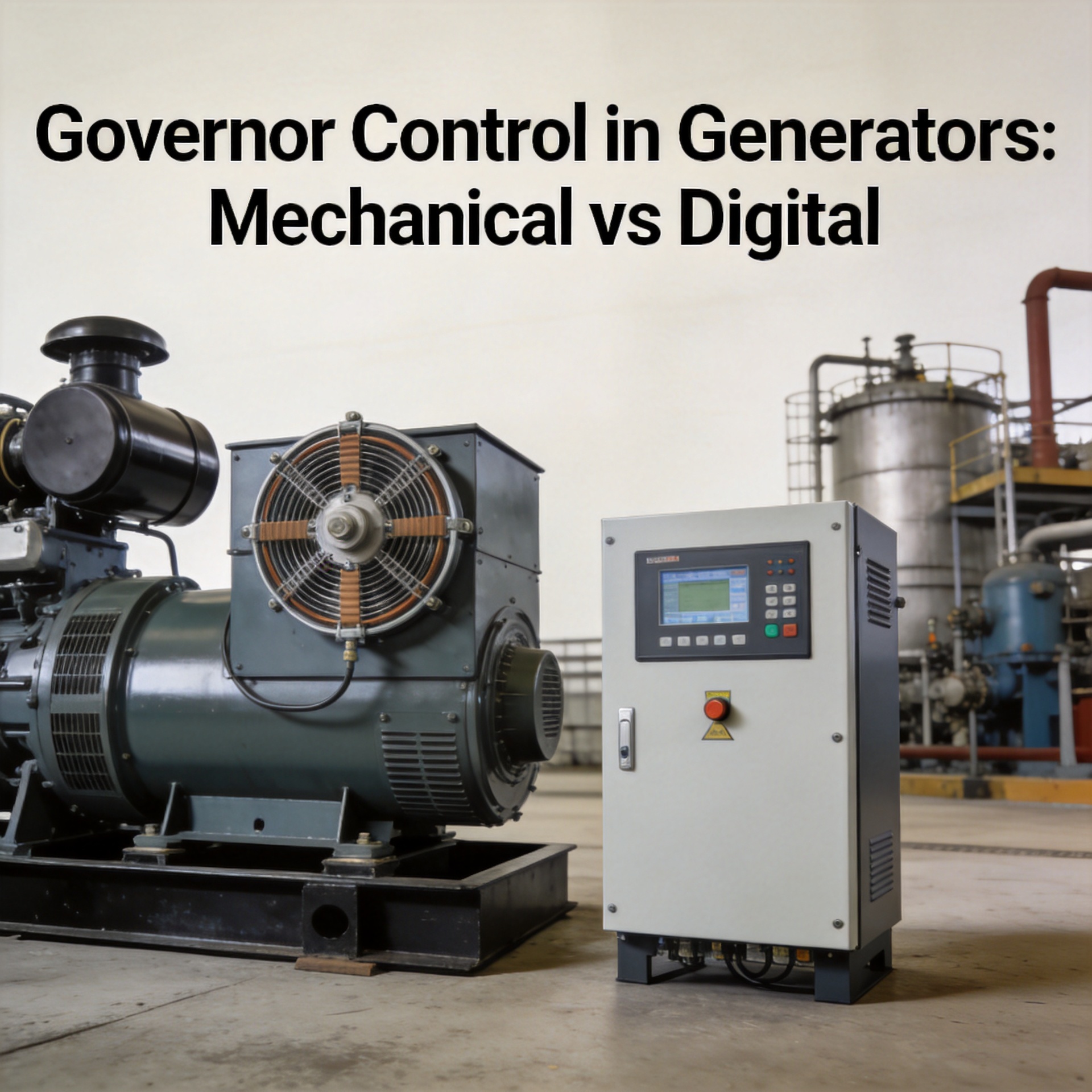
Governor Control in Generators: Mechanical vs Digital
When a diesel generator picks up a block load (for instance, a motor starting under full amperage), the engine speed will dip. What happens next depends entirely on how governor control in generator systems is configured. A well-tuned governor catches that speed drop within fractions of a second, trims the fuel rack, and restores stable RPM before the frequency deviation reaches the load. A poorly matched or worn governor lets the speed hunt, and the voltage and frequency instability that follows can damage sensitive equipment downstream.
The shift most experienced buyers make is realizing that governor selection is not about brand loyalty — it is about matching the droop setting and actuator response range to the specific engine variant and load profile. This article examines how mechanical and digital governor control in generator systems differ, where each type excels, and what procurement professionals and maintenance engineers should know when specifying or replacing a governor control unit.
How Governor Control Works in a Generator
A governor is a feedback control device. Its job is to sense actual engine speed, compare it against a set reference, and then adjust the fuel supply to eliminate the difference. In a diesel generator set, this means keeping the crankshaft — and therefore the alternator — turning at the target RPM regardless of how much electrical load is connected to the bus.
Simpler version: if the load increases, the engine wants to slow down. The governor detects the speed drop and opens the fuel rack to add more energy. If the load drops, the governor closes the rack to prevent over-speeding. This loop runs continuously while the generator is on line. What separates mechanical from digital governor control in generator applications is how that sensing and actuation loop is implemented.
Mechanical Governor Control in Generator Systems
Mechanical governors use centrifugal flyweights mounted on a rotating shaft. As engine speed changes, the flyweights move in or out under centrifugal force, and this mechanical displacement is transmitted directly through linkages to the fuel injection rack. No electronics, no external power supply — the governor is entirely self-contained within the engine's mechanical system.
This simplicity is both the strength and the limitation of mechanical governor control in generator applications. With stable, predictable loads, mechanical governors perform reliably for years with minimal maintenance. They hold up well in harsh environments, are immune to electrical interference, and can be adjusted with basic tools. For older generator fleets, portable diesel generators in field applications, or installations where electronic infrastructure is unavailable, mechanical governors remain a practical choice.
The limitation shows up under rapidly varying loads. Centrifugal mechanisms have inherent response delays — the flyweights need time to physically reposition, and the linkages introduce friction that limits how quickly the fuel adjustment can occur. Speed regulation accuracy is typically ±2–5% of rated speed, which is adequate for many general-purpose applications but insufficient for load-sensitive equipment.
Digital Governor Control in Generator Systems
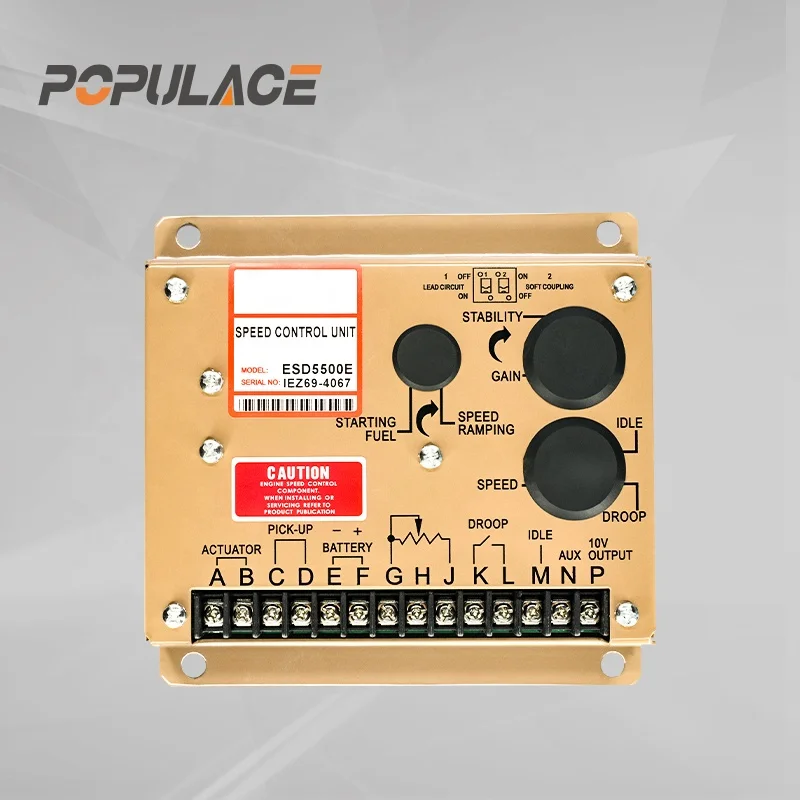
Digital (electronic) governor control in generator systems replaces the centrifugal mechanism with an electronic speed sensor, typically a magnetic pickup on the flywheel ring gear, and a dedicated control module that processes the speed signal and drives an electric actuator. The actuator adjusts the fuel rack through a linear or rotary mechanical output, but the control decision is made electronically rather than mechanically.
This architecture delivers significantly faster response. Where a mechanical governor may take 100–300 milliseconds to begin correcting a speed deviation, an electronic controller can initiate actuator movement within 20–50 milliseconds. The control module also allows precise calibration of gain, stability, droop percentage, and ramp rates — without the mechanical drift that affects flyweight-type governors over time.
Faster governor response does not necessarily translate to better outcomes, however. In generator sets with significant reactive load or motor starts, excessively fast governor response can cause speed overshoot and instability that a more conservative gain setting would avoid. The right calibration depends on the specific engine and load bank characteristics, not on maximizing response speed.
Isochronous vs Droop Mode: Choosing for Your Application
Whether governor control in generator operation uses isochronous or droop mode has a direct impact on how the genset behaves — and the right choice depends on whether you are running a single unit or paralleling multiple generators.
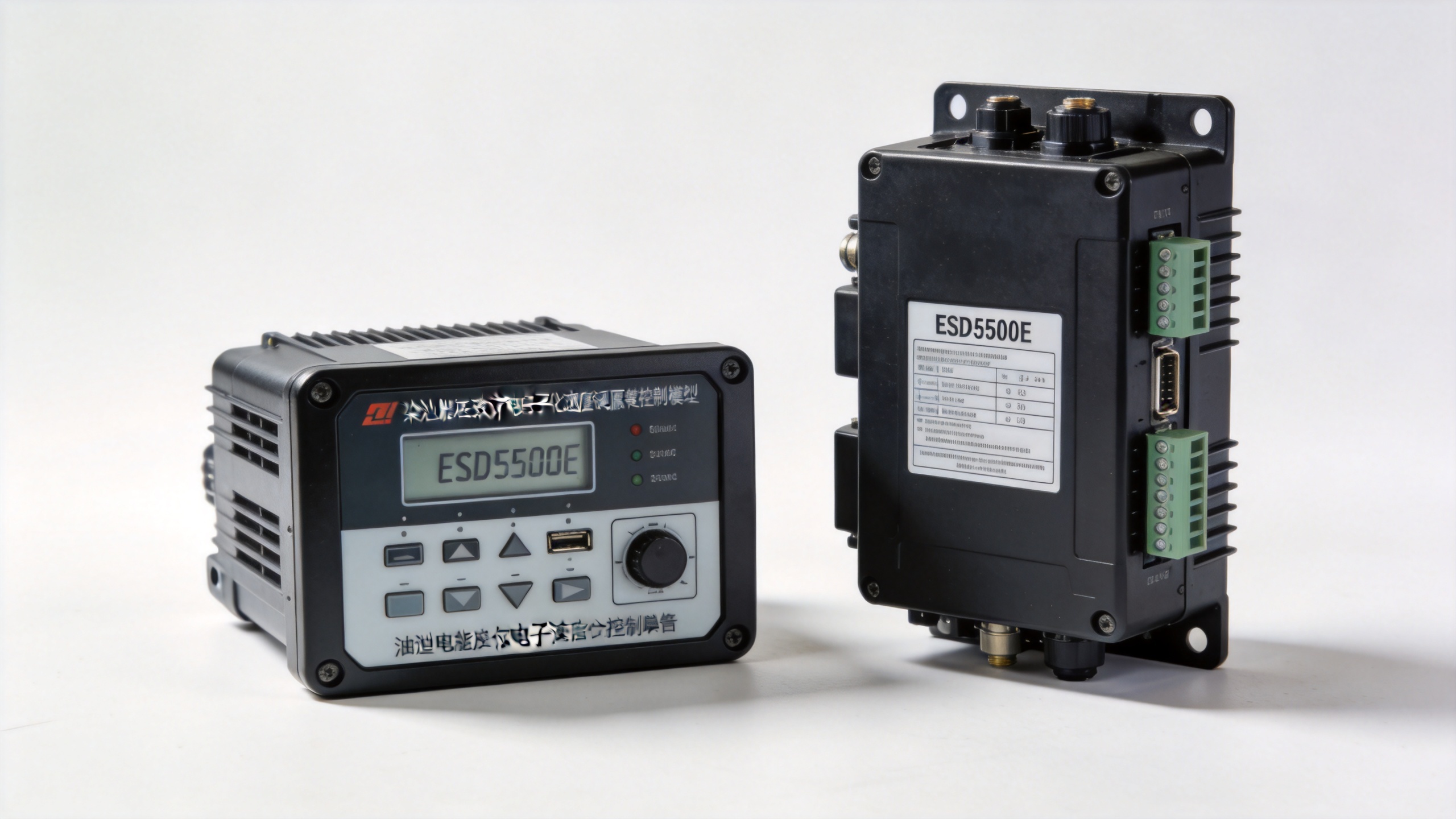
In isochronous mode, the governor holds engine speed precisely at the setpoint regardless of load. Frequency remains constant as long as the engine has available power margin. This is the correct mode for a standalone generator supplying an isolated grid or a single-facility load. The ESD5500E Speed Governor Generator Speed Control Unit supports isochronous operation and is designed for stable single-generator applications across a wide range of diesel engine configurations. ESD5500E Speed Governor Generator Speed Control Unit
In droop mode, the governor intentionally allows a small speed decrease as load increases — typically 2–5% from no-load to full-load. This enables two or more generators to share load in proportion to their ratings when operated in parallel. Without droop, two generators in isochronous mode on the same bus will fight each other for load dominance. Droop mode is also required when synchronizing to the utility grid. The S6700H Governor Speed Controller offers adjustable droop settings for both standalone and parallel configurations. S6700H Governor Speed Controller Diesel Engine Generator Speed Control Unit
Industrial vs Mobile Generator Applications
The requirements for governor control in generator applications differ meaningfully between stationary industrial installations and mobile or portable generator sets.
Industrial gensets (data centers, hospitals, process plants) demand tight frequency regulation for sensitive electronic loads and typically require parallel operation capability. Digital governors with adjustable droop and support for load-sharing controllers are the standard specification. When combined with voltage regulation systems — the AVR Stamford MX321, AVR MX321 Stamford in smaller frames, and AVR MX341 Stamford for higher-output alternators, as well as ABB Unitrol 1020 for large synchronous machines, digital governor control in generator paralleling allows coordinated speed and voltage management across multi-unit systems.
Mobile generator sets often favor mechanical simplicity over electronic precision. Mechanical governors require no external power supply, are field-serviceable with basic tools, and tolerate vibration and contamination that can affect electronic sensors. Where mechanical governor control does become inadequate — for example, on a mobile rental generator running variable tool loads — upgrading using an external actuator such as the ADC120 or ADC175 series can achieve digital-level response without replacing the engine's internal governor components. POPULACE External Actuator ADC120 ADC175 ADC225 for Generator Speed Governor
Calibrating Governor Control in Generator Applications
For mechanical governors, proper spring and linkage adjustment will usually hold the set speed without further intervention on stable loads. If the load swings frequently, especially with motor loads cycling on, verify the droop response handles it, and consider whether an electronic upgrade is warranted.
For digital governors, the key calibration parameters are: gain (how aggressively the governor responds to speed error), stability (damping to prevent overshoot), droop percentage (the intentional speed roll-off across load), and speed reference (the target RPM). These are adjusted through trimmer potentiometers on the control module while running under representative load. Confirm actuator full stroke limits before committing to a final gain setting — an actuator that reaches mechanical end-stop at partial governor output will behave like an on/off switch rather than a proportional control.
Buyers who have dealt with installation failures tend to reassess governor control in generator compatibility — between the control module, actuator interface, and engine fuel system — as a primary evaluation criterion rather than an afterthought. Specifying engine model, actuator type, and voltage supply at the inquiry stage prevents the majority of compatibility issues.
Choosing Between Mechanical and Digital: A Practical Guide
The choice between mechanical and digital governor control in generator applications is a question of application requirements, operating environment, and acceptable performance tolerance — not a quality question in itself.
- Choose mechanical if: the load profile is stable, no parallel operation is required, the installation environment is harsh or remote, and simplicity of maintenance is a priority.
- Choose digital if: load varies rapidly, parallel operation or grid synchronization is required, tight frequency tolerance is needed, or the existing mechanical governor has degraded beyond reliable adjustment.
- Consider an actuator upgrade path if: you have a working mechanical governor control architecture but need improved response — an external electric actuator retrofitted to the existing fuel linkage can provide digital-level performance without replacing the engine's internal governor components.
For procurement teams sourcing governor components, specification-confirmed compatibility before the purchase order prevents most downstream problems. A supplier who can confirm actuator interface type, voltage requirements, and droop adjustment range against your engine serial number is worth engaging before the price comparison begins.






