
 EN
Genset Governor: Types and Performance Comparison
When evaluating a genset governor, the key question is not which brand to source. What matters is whether the governor type, operating mode, and actuator interface match the engine model and load profile. That match determines frequency compliance. Commercial installations must meet NFPA 110 frequency and voltage regulation standards, which means the controller type is a compliance decision, not just a parts substitution.
A genset governor regulates engine RPM under varying load conditions. When load increases and engine speed drops, the controller detects the deviation and adjusts fuel delivery to restore target speed. Without proper speed regulation, output frequency falls outside acceptable limits — a problem that affects everything from sensitive electronic equipment to generator protection relays.
Mechanical vs. Electronic Genset Governors
Speed controllers divide into two fundamental types: mechanical and electronic. Each suits different applications, and comparing them on the same criteria is more useful than a general description.
Mechanical Genset Governors
A mechanical controller uses spinning flyweights driven by centrifugal force. As engine speed rises, the flyweights expand and mechanically adjust the fuel rack to reduce fueling. The belt driven engine governor is one of the most common mechanical configurations — flyball weights on a shaft driven by a belt from the crankshaft pulley. This belt driven engine governor requires no external power supply and can be serviced in the field without electronic test equipment, which suits remote or low-maintenance deployments well.
Mechanical designs typically produce speed droop of 2% to 5% from no-load to full load. This is inherent to flyball mechanics and acceptable for single-unit standalone applications where ISO Class 1 frequency performance is sufficient.
Appropriate use cases for mechanical controllers:
- Older diesel gensets in remote environments where the belt driven engine governor can be field-serviced without specialist equipment
- Portable and construction-site generators where simplicity is the priority
- Marine generators where electronic moisture exposure is a concern
- Standby units where ISO Class 1 frequency tolerance applies
Electronic Genset Governors
An electronic genset governor uses a magnetic pickup sensor to read RPM digitally, processes the signal through a control board, and drives an electro-hydraulic actuator. This architecture delivers faster response and tighter frequency regulation, and allows operating mode switching between isochronous and droop via software rather than mechanical adjustment.
A counterintuitive point: faster response gain does not guarantee better performance. On a genset with significant reactive loads, excessive gain causes speed overshoot and hunting. A conservative droop setting often outperforms maximum response. An electronic unit makes that calibration easy to adjust without any mechanical disassembly.
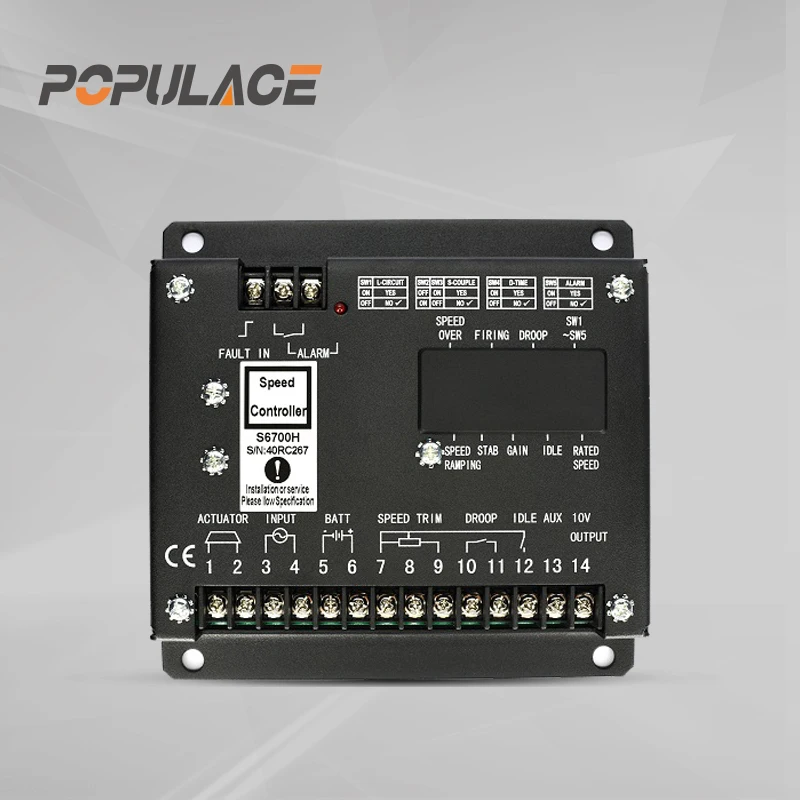
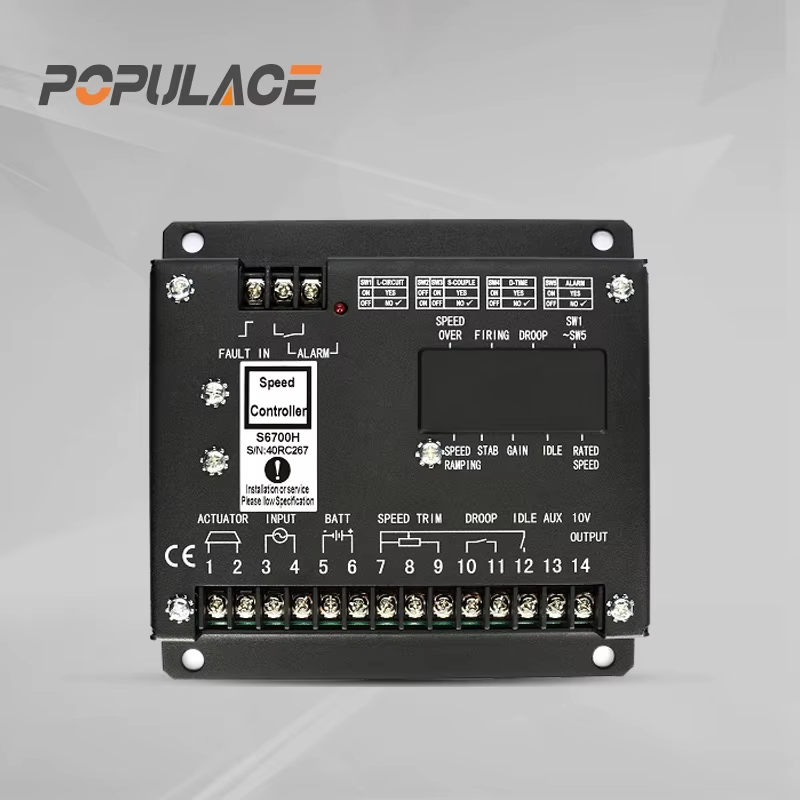
Electronic speed controllers like the S6700H Governor Speed Controller and the ESD5500E Speed Governor are designed as drop-in-compatible units for a wide range of diesel engine gensets. Both accept magnetic pickup inputs with configurable gain, stability, and droop settings, working in standalone and parallel configurations.
Required application types for electronic controllers:
- Commercial standby and prime power installations at ISO Class 2 performance
- Parallel generator systems (two or more units sharing load)
- Natural gas gensets sensitive to governor response characteristics
- Data centers, hospitals, and facilities requiring NFPA 110 compliance
Operating Modes: Isochronous vs. Speed Droop
Whether mechanical or electronic, all speed controllers operate in one of two fundamental modes. For parallel operation, mode selection is as critical as controller type.
Isochronous Mode (Constant Speed)
In isochronous mode, the genset governor holds engine speed constant from no-load to full load — zero droop. For stable load profiles, this mode maintains accurate frequency. It is the standard configuration for standalone commercial installations and the default expectation for electronic speed controllers out of the box.
Droop Mode (Speed Droop)
Droop mode allows engine speed to decrease proportionally as load increases. For a standalone unit, this reduces precision. For parallel operation, droop is the mechanism that enables automatic load sharing — each unit's controller senses load and reduces speed proportionally, creating an equilibrium without requiring active communication between generators.
The key insight for parallel operation: selecting a genset governor for a multi-unit system means matching the droop setting and actuator response range to the overall system design, not optimizing one unit's individual performance in isolation.
Application Scenarios: Industrial vs. Mobile Gensets
Industrial gensets in facilities — hospitals, data centers, manufacturing plants — require an electronic genset governor operating in isochronous mode. Rapid load shifts demand fast response, and ISO Class 2 performance is the operational baseline. Mechanical flyball designs do not meet this standard.
Mobile power stations — construction equipment, portable event generators, trailer-mounted units — favor field serviceability and lower replacement cost. A belt driven engine governor suits these applications well; mechanical simplicity is an operational advantage when electronic service support is unavailable on-site.
In generator control system sourcing, the speed governor handles frequency regulation while the automatic voltage regulator (AVR) manages voltage. Buyers specifying a kirloskar avr replacement or an avr sx 440 voltage regulator alongside a new genset governor benefit from sourcing both components from the same supplier. A kirloskar avr or avr sx 440 paired with a compatible speed controller from one source simplifies compatibility verification and reduces pre-purchase documentation exchange.
The POPULACE ADC120/ADC175/ADC225 External Actuator is a mechanical interface component compatible with electronic speed control systems, available in 12V and 24V configurations for common diesel generator actuator interfaces.
Genset Governor Calibration: Key Steps
Basic calibration knowledge reduces dependency on specialist contractors for standard commissioning of an electronic genset governor:
- Magnetic pickup gap: Confirm the sensor-to-ring-gear gap is within specification (typically 0.5–1.5 mm). An incorrect gap produces unstable RPM signals that cannot be corrected by gain adjustment alone.
- Rated speed: With the engine unloaded, set the speed potentiometer to target RPM (1500 RPM for 50 Hz, 1800 RPM for 60 Hz). Use a tachometer for verification.
- Gain: Start at midpoint, increase until hunting appears, then reduce 10–15%. Speed hunting signals excessive gain — reduce it rather than compensating with other settings.
- Droop: Set to zero for single-unit isochronous operation; 3–5% for parallel systems per the design specification.
- Documentation: Record potentiometer positions and test load conditions. Undocumented settings create recurring commissioning problems across maintenance intervals.
In field installations, the limiting factor for controller performance is often not the unit itself. Vibration from a poorly isolated mounting bracket or a worn fuel rack linkage can undermine governor performance regardless of how carefully the settings are adjusted.
Selecting the Right Genset Governor
The core selection criteria for a genset governor are engine model and actuator interface compatibility, required operating mode (isochronous vs. droop), ISO Class performance standard, and single-unit vs. parallel operation. KYGEN Power supplies electronic speed controllers and compatible actuator components for diesel generator applications, with pre-sales technical support for compatibility confirmation before purchase commitment.






