
 EN
Genset Governor Price: Cost Factors Explained
When buyers start comparing genset governor price across suppliers and product listings, the numbers can look surprisingly scattered — anywhere from under $50 for a basic unit to well over $500 for a branded electronic controller. That range isn't arbitrary. As a generator parts technical consultant who works with distributors and procurement teams sourcing control components, I can tell you that understanding the specific cost factors behind those numbers matters more than chasing the lowest quote. This article breaks down what actually drives price in this product category and what you should weigh against each dollar.
1. Governor Type Is the Primary Price Driver
The most fundamental split in genset governor price comes down to whether you're buying a mechanical or electronic unit. Mechanical governors — centrifugal flyweight designs — are simpler, more durable in high-vibration environments, and easier to service in the field. Basic mechanical governors for 5–25 kW engines typically fall in the $45–$85 range. Fewer components, no external wiring beyond a physical linkage to the fuel rack, and predictable failure modes make them a practical fit for many applications.
Electronic governors use an electronic control module, a magnetic pickup sensor, and a proportional actuator. Entry-level electronic units start around $220 for the controller alone; you'll typically add $35–$65 for a compatible speed sensor. The higher cost reflects faster response times (often under 100 ms), tighter speed regulation (±0.25% or better on quality units), and adjustable gain settings. If your application involves sensitive electronic loads, frequency-dependent equipment, or parallel operation, the electronic type earns its price premium. For a single-engine, resistive-load standby set, a mechanical governor may serve just as well at a fraction of the cost.
2. Application Context: Industrial Genset vs. Mobile Power Station
What the generator is actually doing should drive your decision on which genset governor price tier makes sense. Industrial stationary generators running 24/7 prime power face different demands than mobile generator trailers used on construction sites. Industrial gensets typically justify more spend on a governor with higher operating temperature tolerance, better electromagnetic interference rejection, and longer MTBF specifications. Mobile power stations tend to favor mechanical durability and simpler field serviceability over precision regulation.
Marine and offshore gensets occupy their own price bracket — panels from marine-focused suppliers routinely run $673–$1,496 or more per unit due to ingress protection requirements, redundancy, and relevant certifications. If you're sourcing for a land-based diesel genset without special certification requirements, marine-grade pricing isn't the right reference point. Matching the product tier to the application is the most direct way to avoid overpaying for unneeded specs, or underpaying and creating a field reliability problem later.
3. Operating Mode: Isochronous vs. Droop and Its Price Effect
One of the less visible but genuinely significant cost factors in electronic governor price is operating mode support. Isochronous mode holds engine speed constant regardless of load — it's the standard for single-genset installations where frequency stability matters. Droop mode introduces a deliberate speed reduction as load increases; it's used specifically in parallel multi-genset configurations to enable stable load sharing between units without hunting.
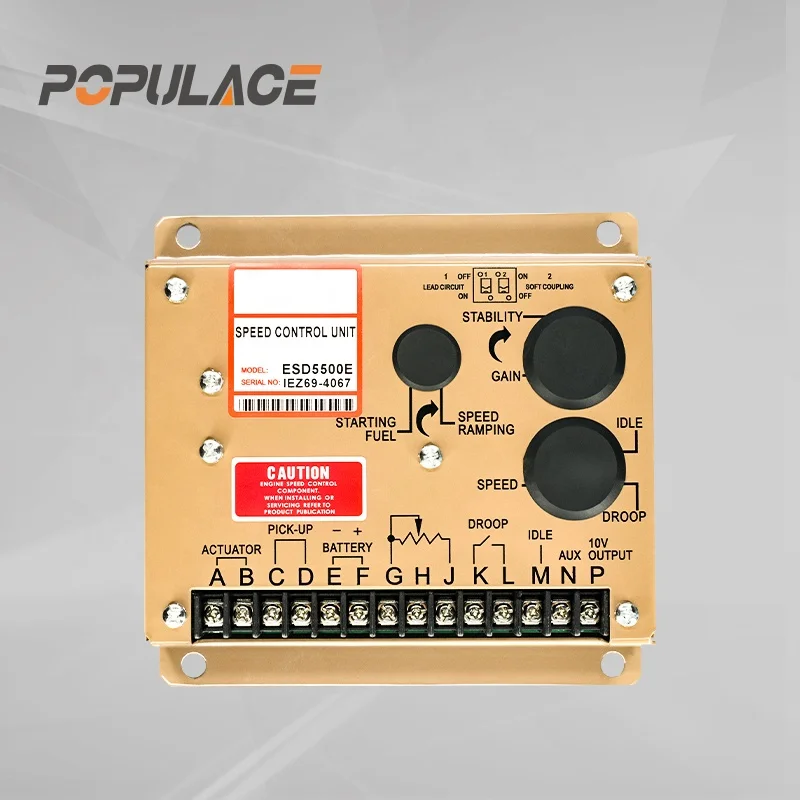
A governor that supports only droop operation typically costs less than one that supports both isochronous and droop modes via a mode-select switch or software setting. Common market pricing on the ESD5500E series puts droop-mode units at around $304, while isochronous-capable variants in the same series typically start at $511. If you're running a single generator, you may not need to pay for isochronous capability — though that depends on your load profile. The ESD5500E Speed Governor Generator Speed Control Unit supports both isochronous and droop modes and is compatible with a wide range of diesel engines, making it a practical option for sites that may eventually expand to parallel operation. Buyers referencing the esd5500e speed control manual or speed control unit esd5500e manual will find mode-select configuration steps documented in the unit's technical guide.
4. The Electronic Governor Actuator: Included or Additional Cost?
Many buyers look at a governor controller listing and assume it includes everything needed for installation — then find out the electronic governor actuator is a separate line item. Proportional actuators (ADC-type mechanical actuators, linear actuators, rotary actuators) are what physically move the engine's fuel rack in response to the governor's output signal. Their cost depends on the output force required by the engine, the operating voltage (12V DC vs. 24V DC), and whether the actuator is a standard configuration or an OEM-matched unit.
When sourcing an electronic governor package, confirm explicitly whether the actuator is bundled or priced separately. For applications using an ADC120, ADC175, or ADC225 format, the POPULACE External Actuator 12V 24V ADC120 ADC175 ADC225 is a compatible option for generator speed governor actuator replacements. Factoring in actuator cost from the start gives you a more accurate total installed cost comparison — especially when contrasting a bundled Chinese-manufactured package against a separately quoted OEM assembly.
5. Brand Tier and Channel: Where the Price Gap Comes From
A $42.89 commodity electronic governor and a $511 branded GAC ESD5500E series unit may both claim to do the same job. The practical difference is this: the branded unit carries documented specifications, tested accuracy, field-validated compatibility data, and a warranty that holds up in practice. The commodity unit offers a lower initial number with less certainty about consistency across production batches.
Higher price doesn't automatically mean a better fit for your engine, but it tends to mean more predictable behavior and better documentation — which matters when a service team needs to calibrate the unit after installation. The S6700H Governor Speed Controller Diesel Engine Generator Speed Control Unit sits in the mid-range tier and is designed for compatibility across a broad range of diesel engines. As a factory-direct product from a specialized generator parts manufacturer, it represents a cost-performance balance that works for technical buyers who want documented specifications without paying top-tier OEM pricing.
The esd5111 speed control unit also appears frequently in technical procurement comparisons. The ESD5111 is an older-generation electronic governor that supports basic isochronous control; whether it fits your budget depends on whether the target engine's response characteristics are compatible with its gain range and whether you need the updated capabilities of the ESD5500E series.
6. Calibration and Total Cost Beyond Unit Price
One cost that rarely shows up in a supplier quote is calibration labor. Electronic governors typically require on-site gain tuning — adjusting the Gain, Stability, and Droop potentiometers on analog units — to match the specific engine's fuel system response. If that work requires a service call, the cost can exceed the difference between a low-priced and a mid-priced controller. Requesting a governor that comes with a pre-calibration setup for your engine family, or at minimum a clear procedure and starting-point recommendations, reduces that hidden cost.
The real total cost equation for genset governor price includes: the controller unit, the actuator (if separate), the magnetic pickup sensor, installation labor, calibration time, and expected service interval. When you frame it that way, saving $80 by choosing a lower-tier unit can look different against a documented, serviceable option your technician can set up from a known baseline.
Summary: What to Evaluate Before You Request a Quote
- Determine whether you need mechanical or electronic control based on load type and regulation accuracy requirements.
- Confirm whether isochronous mode, droop mode, or both are needed based on your genset installation configuration.
- Clarify whether the quoted price includes the electronic governor actuator or whether it's a separate line item.
- Compare specifications directly — accuracy, operating voltage, actuator output current, and temperature rating — rather than relying on brand name alone.
- Account for calibration and setup support as part of the total cost, not just the unit price.
Genset governor price reflects governor type, operating mode support, actuator inclusion, and the supplier's documentation quality. Asking these questions before you request a quote is what separates a well-matched procurement decision from a replacement order six months down the road.






