
 EN
Genset Governor Board: Electronic Control Overview
When a standby generator fails to hold frequency under load, the first component worth examining is the genset governor board. It is the electronic brain that keeps engine speed — and therefore output frequency — within acceptable limits as load conditions change. Understanding how that board actually works, and where it differs from older mechanical speed control systems, is what separates a systematic diagnosis from a guessing exercise.
What a Governor Board Does: The Control Loop
A genset governor board operates on a closed-loop feedback principle. The control sequence works like this: the board reads actual engine speed from a magnetic pickup sensor or tachometer signal, compares it to a programmed speed reference, calculates the error, and adjusts the fuel actuator output to correct that error. The board then measures the result and repeats the cycle — typically several hundred times per second on a modern electronic unit.
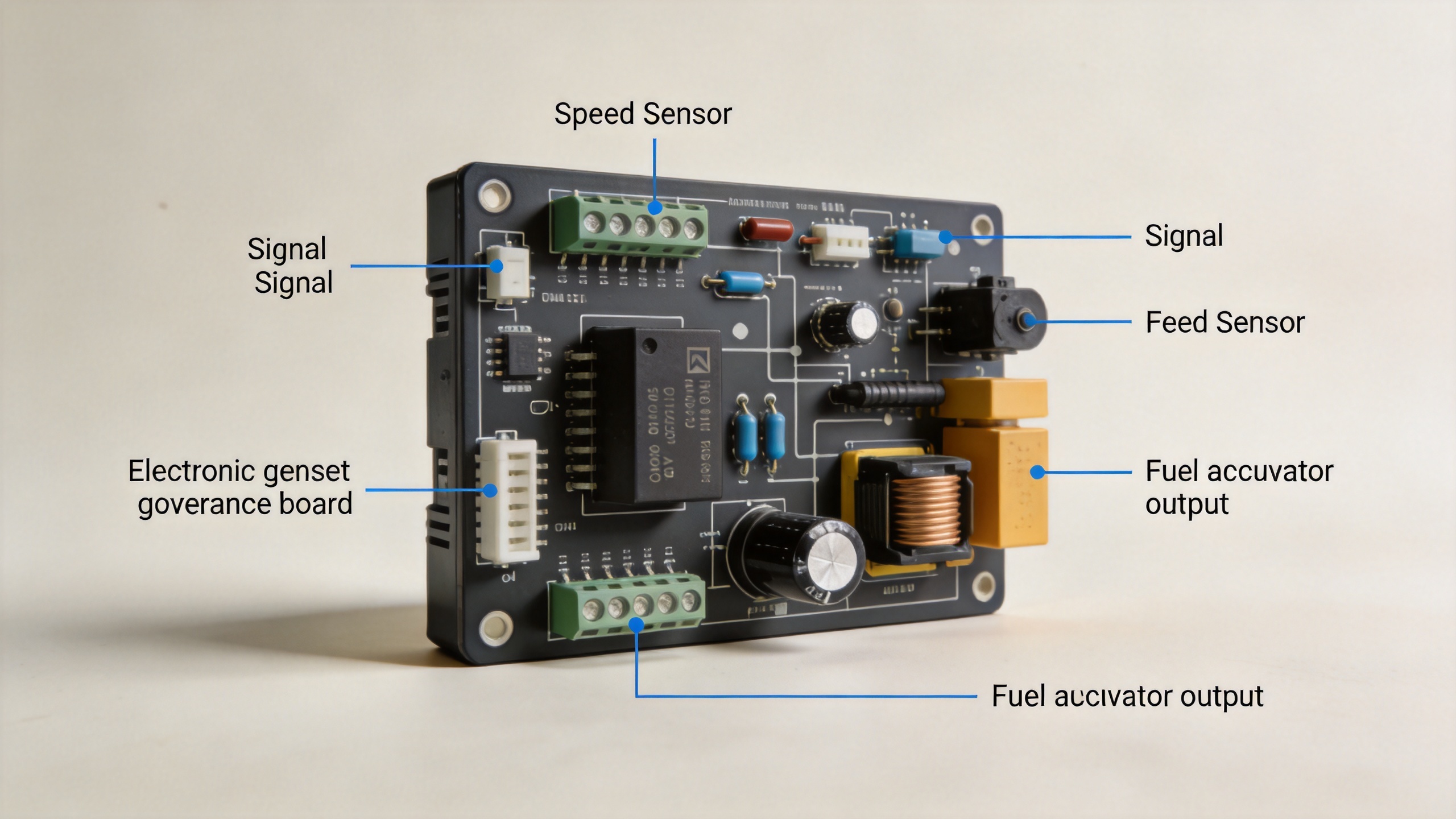
In practice, the governor board runs this loop continuously — making small fuel adjustments to compensate for load fluctuations. Add a large motor load, and the engine momentarily slows. The board detects the speed drop within milliseconds, increases the actuator signal, and returns to the target RPM before the frequency deviation becomes visible to sensitive loads.
That covers the basic mechanism. Now, here is where it gets more important for anyone sourcing or specifying a replacement board: the governing loop has several tunable parameters — gain, derivative response, and reset rate — and a board that is misconfigured for the engine and actuator combination it is driving will hunt, overshoot, or respond sluggishly even if the hardware is otherwise serviceable.
Mechanical Governors vs Electronic Governor Boards
Older diesel gensets used mechanical-hydraulic governors — flyweight assemblies, speeder springs, and hydraulic servo pistons that translated mechanical speed changes into fuel rack movement. Modern replacements use an electronic genset governor board that integrates sensing, processing, and actuation in a single PCB-based unit. These systems were robust but had limited transient response and no programmability. The shift most experienced engineers make is realizing that the governor type is not about era preference — it is about whether the speed regulation accuracy and transient response range match the application's frequency tolerance requirements.
A dynamic speed governor board replaces or supplements the mechanical components with electronics: a microcontroller reads the speed sensor, runs the PID control algorithm, and drives an electronic or electro-hydraulic actuator. The result is tighter frequency regulation, easier calibration via potentiometer or software, and the ability to add features like remote setpoint adjustment, soft-start ramp control, and parallel operation load sharing.
The trade-off to be aware of: a faster governor response does not necessarily translate to better outcomes. In generator sets with significant reactive load — motor starting loads, for instance — excessively fast governor response can cause speed overshoot and hunting that a more conservative derivative setting would avoid. Configuring the gain too high creates instability, while configuring it too low produces sluggish recovery. This is why calibration steps matter as much as board selection.
Isochronous Governor Operation vs Droop Mode
One of the more practically significant choices a governor board provides is the operating mode: isochronous or droop.
In isochronous governor operation, the board maintains a constant engine speed regardless of load — zero steady-state speed droop. This is the preferred mode for a single-generator system where you want tight frequency regulation. The board continuously corrects any deviation, so the output frequency stays on target whether the generator is at 10% or 90% load.
Droop mode introduces a deliberate speed offset as load increases — typically expressed as a percentage of rated speed over the full load range. Standard droop settings for diesel gensets run between 2% and 5%. Simpler version: as load goes up, speed is intentionally allowed to fall slightly, and that relationship is what makes stable load sharing possible when multiple generators run in parallel.
For parallel genset operation, putting two or more isochronous-controlled units on the same bus without a load sharing interconnect creates a conflict — each board tries to absorb all the load independently, causing instability. Droop mode provides natural load sharing by proportioning the load between units based on their speed-droop characteristics. Alternatively, some electronic governor boards support isochronous load sharing through a dedicated communication link, which requires compatible boards across all parallel units.
Industrial Genset vs Mobile Power Station Applications
The governor board requirements differ between a fixed industrial generator and a mobile power unit. Industrial prime power applications typically run at continuous high load, which means the governor board needs stable performance across extended runtime hours and elevated ambient temperatures. The sensitivity of the load — whether it is purely resistive, has motor loads, or includes sensitive IT equipment — determines how tight the frequency tolerance needs to be.
Mobile gensets, by contrast, face more variable load profiles and often need faster transient response because loads connect and disconnect abruptly. They are also more likely to operate in harsh environments where vibration and temperature cycling stress the electronic components. For these applications, a board with robust input filtering and a wider operating temperature specification is worth verifying before selection.
Genset Governor Board Calibration and Adjustment
Calibrating a replacement genset governor board is a process worth doing methodically rather than rushing. The sequence for most electronic boards follows this order: set the speed reference to match the rated RPM at no load, verify the magnetic pickup signal level is within specification, then adjust the gain and derivative trimmers while applying stepped load increments. The target is the fastest recovery to rated speed without visible overshoot on a tachometer or frequency meter.
One calibration detail that often gets missed: the actuator linkage adjustment affects the governor's effective authority range as much as the board settings do. A governor board that appears sluggish may simply have insufficient actuator travel — confirming full actuator mechanical stroke before tuning the electronic parameters prevents misdiagnosis.
Are you sourcing a board as a direct replacement for an existing installation, or selecting one for a new configuration? That distinction changes which specification receives the most attention. For a drop-in replacement, the magnetic pickup compatibility, actuator output voltage and current range, and power supply requirements should match the original. For a new installation, the control algorithm range and the availability of isochronous load sharing communication become more relevant.
Selecting a Governor Board: Practical Considerations
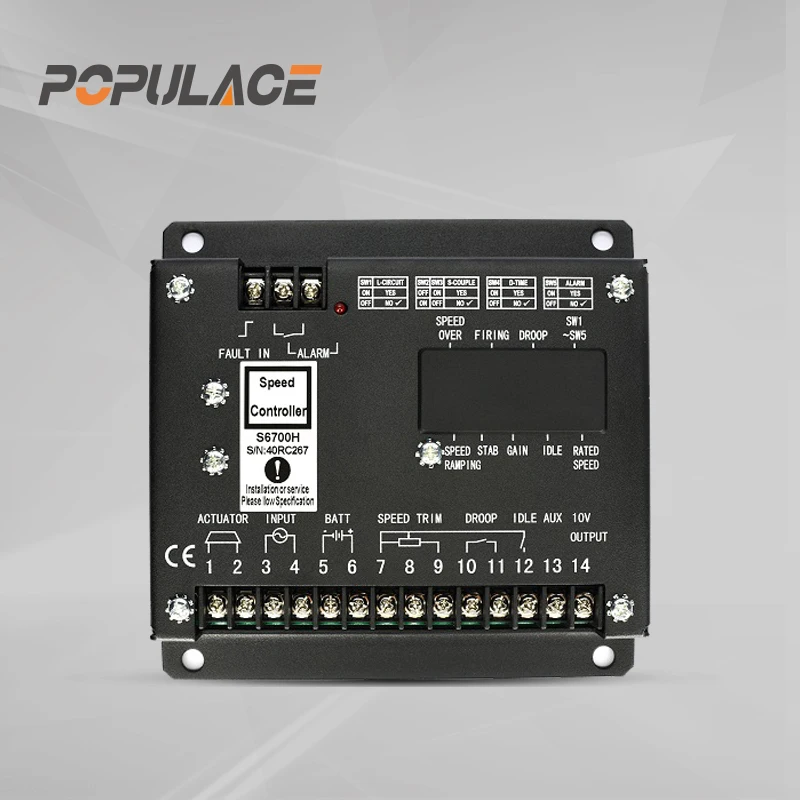
The compatible governor board range for industrial diesel gensets covers units like the S6700H Governor Speed Controller Diesel Engine Generator Speed Control Unit, which is designed for diesel engine genset applications with adjustable speed reference and droop settings. For applications requiring broad compatibility with common diesel engines, the ESD5500E Speed Governor Generator Speed Control Unit covers a range of diesel genset configurations and provides straightforward calibration access.
For installations where an external actuator is part of the fuel control system, actuator compatibility with the governor board output signal is a prerequisite. The POPULACE External Actuator 12V 24V ADC120 ADC175 ADC225 for Generator Speed Governor Actuator is designed for external actuator configurations on diesel gensets, and confirming voltage compatibility before ordering prevents the most common installation mismatch.
If your application runs at a stable resistive load profile, the standard droop setting on a conventional governor board will usually hold. If the load swings frequently — especially with motor loads cycling on — verifying the droop response and transient recovery time against the application's frequency tolerance is the step that determines whether the installation performs reliably or generates recurring callbacks.
Final Assessment
The genset governor board is not a consumable component — it is a precision control device whose performance depends on correct selection, compatible actuator interface, and proper calibration to the specific engine and load. Treating the genset governor board as a generic drop-in leads to the most common failure mode: a technically functional board that performs poorly because the configuration does not match the system it is controlling. Treating it as a generic part leads to the most common failure mode in governor replacements: a technically functional board that performs poorly because the configuration does not match the system it is controlling.
Understanding the control loop mechanism, the difference between isochronous and droop operation, and the adjustment sequence for the genset governor board gives maintenance engineers and procurement specialists the foundation to make better decisions at the specification stage — before a mismatched board creates a commissioning delay.






