
 EN
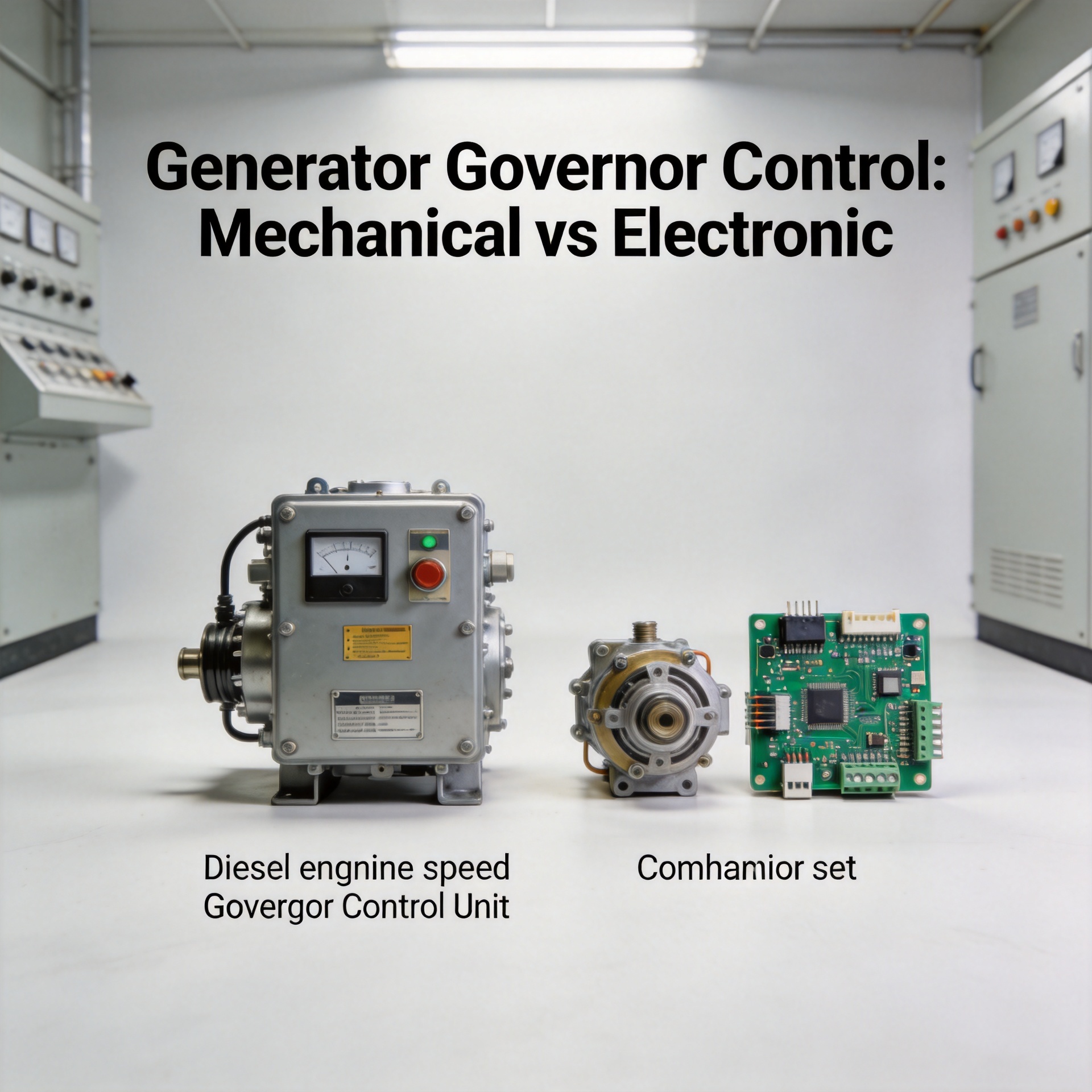
Generator Governor Control: Mechanical vs Electronic
Generator governor control keeps a diesel engine running at stable speed and, by extension, keeps output frequency at the rated value under changing load conditions. The difference between mechanical and electronic generator governor control determines which option fits your application, whether you are sourcing replacement parts, evaluating electronic speed controllers, or specifying components for a parallel generation system.
As a technical consultant in generator control components, the most important question is not which brand is better; it is which governor type fits the application. That distinction starts with understanding how each type of generator governor control works.
How Generator Governor Control Works
The governor monitors engine shaft speed and adjusts fuel delivery to maintain the target RPM as load changes. When load increases, the engine slows slightly; the generator governor control system senses this deviation and increases fuel flow. When load decreases, the engine speeds up; the governor reduces fuel accordingly. This feedback loop operates continuously in real time. The difference between governor types lies in how that sensing and adjustment is performed — mechanically or electronically.
Mechanical Governor: Operating Principle
A mechanical governor uses centrifugal flyball weights rotating on the engine's camshaft or governor drive shaft. As engine speed increases, centrifugal force causes the flyweights to move outward, compressing a spring and repositioning the fuel rack to reduce fuel delivery. The entire feedback loop is purely mechanical: no sensors, no electronics, no signal processing.
Mechanical generator governor control systems are simple, durable, and proven. They require no electrical power to operate and tolerate harsh environments well. Their limitation is response speed: the mechanical linkage introduces inherent lag between a load change event and the corrective fuel adjustment. Under sudden or heavy load swings, this lag produces larger frequency deviations before the system recovers. Mechanical governors suit stationary applications with gradual load changes, older fleet models requiring original compatibility, and sites where electronic maintenance is impractical.
Electronic Governor: Operating Principle
An electronic governor uses a magnetic speed sensor to measure engine RPM electronically. The signal feeds into a microcontroller-based control unit that compares actual speed against the setpoint and outputs a correction signal to an electronic actuator, which converts it into mechanical fuel rack movement.
Electronic generator governor control responds faster to sudden load changes than mechanical designs. Mechanical governors recover more slowly, causing larger frequency deviations during transient load conditions. For applications with sensitive electronic loads, including telecommunications, medical, or data equipment — tighter frequency regulation is not optional. Electronic governor control also offers programmable setpoints, allowing technicians to configure speed, droop percentage, and gain settings precisely for the engine and load profile. This makes electronic generator governor control the default choice for modern industrial generator sets and any application involving parallel generator operation.
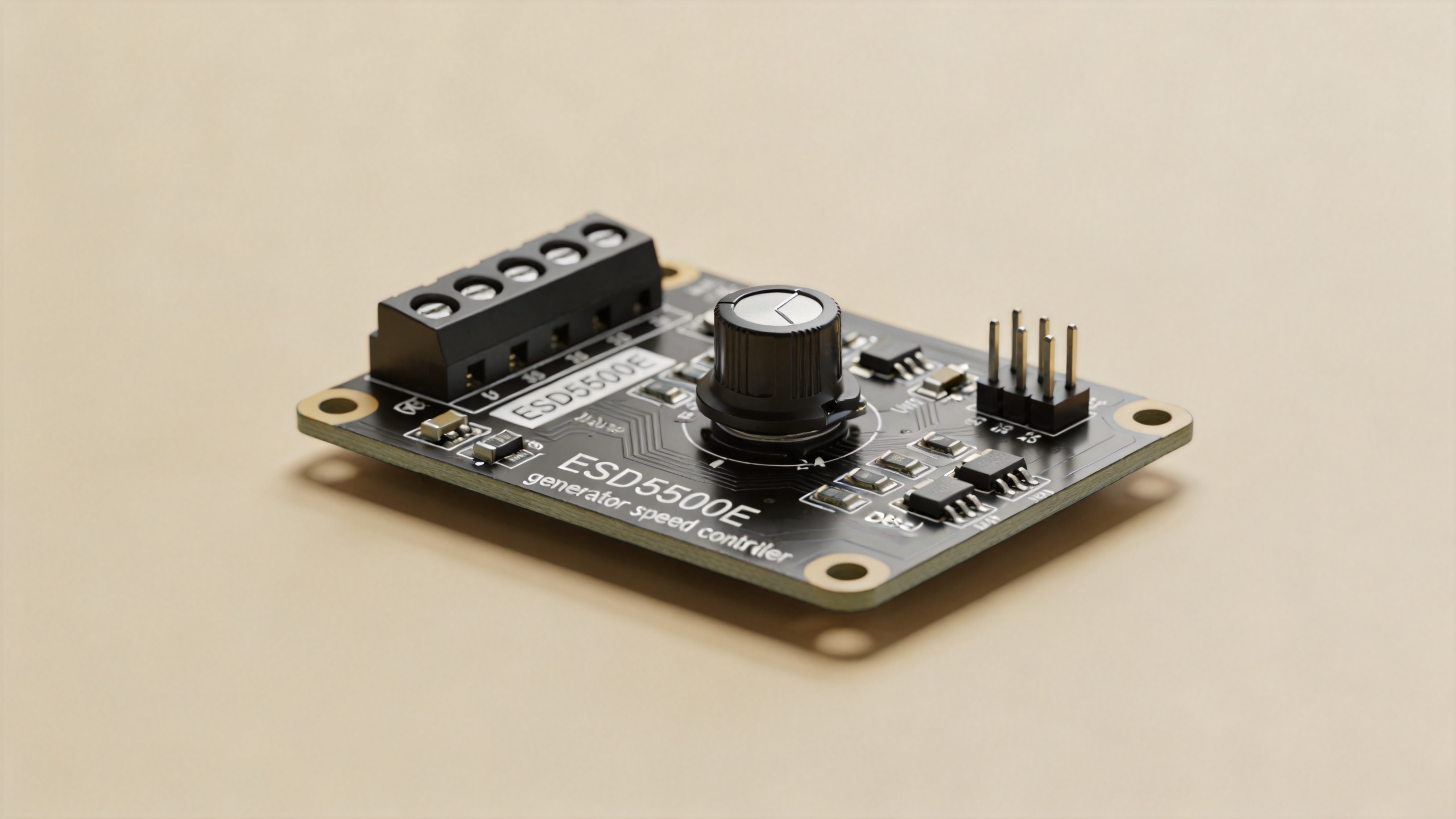
The ESD5500E Speed Governor Generator Speed Control Unit is a widely used electronic governor that interfaces with diesel engine fuel actuators to provide stable, programmable generator governor control. For tighter response performance, the S6700H Governor Speed Controller is designed for diesel engine generator sets where variable load and parallel operation demand more precise governor response.
Mechanical vs Electronic: Key Differences
| Feature | Mechanical Governor | Electronic Governor |
|---|---|---|
| Speed sensing | Centrifugal flyball weights | Magnetic speed sensor / electronic pickup |
| Response speed | Slower — mechanical lag | Faster — electronic processing |
| Frequency accuracy | ±2–3% typical | ±0.5–1% typical with proper tuning |
| Configuration | Limited — spring preload adjustment | Programmable setpoints, gain, droop |
| Parallel operation | Limited | Full — configurable droop and load sharing |
| Initial cost | Lower | Higher |
Faster generator governor control response does not necessarily translate to better outcomes. In generator sets with significant reactive load, excessively fast electronic governor response can cause speed overshoot and instability that a more conservative droop setting would avoid. Selecting gain and droop parameters requires matching the control response to the specific engine's mechanical inertia and load profile.
Isochronous and Droop Modes in Generator Governor Control
Isochronous mode maintains constant engine speed regardless of load. The generator governor control system continuously adjusts fuel delivery to hold the frequency setpoint precisely — 50 Hz or 60 Hz depending on configuration. Isochronous mode is appropriate for a single generator operating in isolation, where the governor is the only frequency reference in the circuit.
Droop mode allows engine speed — and therefore output frequency — to decrease proportionally as load increases. The droop percentage determines how much frequency variation is permitted from no-load to full load. A 4% droop setting allows roughly a 2 Hz drop on a 50 Hz system at full load. Droop mode is essential for parallel generator operation: when two or more generators share a common bus, each unit's output adjusts automatically according to its droop setting, enabling stable load sharing without circulating currents between units. Running multiple generators in isochronous mode on a shared bus causes instability, as each unit attempts to hold its own frequency reference, creating conflicting fuel demands.
Industrial Generators vs Mobile Power Stations
Industrial stationary generators — used in data centers, hospitals, manufacturing plants, and infrastructure projects — operate at a fixed site with a predictable load profile. These applications support the wiring and calibration requirements of electronic generator governor control systems. When running in parallel to share large loads, electronic governors with configurable droop settings are a practical requirement, not just a preference.
Mobile power stations and trailer-mounted generators operate in variable site conditions, subject to vibration, temperature variation, and field installation. In these environments, simpler mechanical governor control reduces misconfiguration risk. Electronic options with pre-set factory parameters are increasingly common for mobile units that still require tighter frequency regulation.
For applications where electronic generator governor control interfaces with an external actuator, the actuator type is as important as the governor model selection. The POPULACE ADC120, ADC175, and ADC225 external actuators are compatible with 12V and 24V generator governor control systems, providing the mechanical interface between the electronic speed controller and the engine's fuel delivery mechanism.
Governor Control and AVR: Coordinated Generator Output Quality
Generator governor control manages frequency and speed stability. Automatic voltage regulation manages output voltage stability. Both systems operate simultaneously, and mismatches between them produce output quality issues that can appear symptomatic of either component. In many generator sets, the AVR sensing circuit monitors the three phase rectifier output voltage from the exciter winding. An unstable governor causing speed hunting will also produce voltage fluctuations that the AVR cannot fully compensate on its own.
Common AVR models used alongside electronic governor installations include the Stamford SX440 (avr stamford sx440), MX341 (avr mx 341), and Marelli M16FA655A (avr m16fa655a). When replacing or calibrating a generator governor control unit on a generator using these AVR models, confirm that both control systems are within specification before and after the governor adjustment as standard commissioning practice.
Governor Calibration and Adjustment Steps
For procurement buyers and maintenance engineers, understanding calibration helps evaluate supplier support capability and confirm that replacement units arrive correctly configured for the target application.
- Speed setpoint verification: At no load, measure output frequency. Adjust the speed setpoint potentiometer until frequency matches the rated value. Record no-load frequency before and after adjustment.
- Droop setting confirmation: Apply full rated load and measure frequency drop. Adjust the droop potentiometer within the specification band. For single-generator operation, use low droop or isochronous mode. For parallel operation, typical droop settings range from 3% to 5%.
- Gain and stability tuning: On electronic governor control units, adjust gain in small increments with load applied. Too high causes speed overshoot and hunting; too low causes slow recovery. Observe frequency stability before recording final values.
- Actuator response verification: Confirm the actuator moves smoothly across its full travel range. Restricted actuator movement from linkage wear is a common cause of governor instability that is often misdiagnosed as a generator governor control fault.
In actual operation, engine speed hunting is rarely caused by a faulty governor alone. More often it traces back to a worn fuel rack linkage or an air leak in the inlet manifold that is easy to overlook during a visual inspection. Before replacing any generator governor control component on a hunting engine, confirm that fuel system components are operating correctly and that the actuator linkage is within tolerance.
Selecting the Right Generator Governor Control for Your Application
The choice between mechanical and electronic generator governor control is a question of matching the governor type to the application's load profile, operating environment, and system configuration. If your application runs at a stable load profile in a fixed installation, a well-maintained mechanical governor will usually hold. If the load swings frequently, particularly with motor loads cycling on — electronic generator governor control with configurable response parameters handles transient conditions more reliably.
Confirming the actuator interface type, supply voltage (12V or 24V), and whether the application runs in single-generator or parallel configuration prevents the most common ordering errors in generator governor control procurement.






