
 EN
Engine Generator Controller: Auto Start Module Types
Choosing the right engine generator controller for a genset installation comes down to understanding the different auto start module types available and matching them to operational requirements. AMF, ATS, and manual start configurations each serve a distinct set of use cases — and digital controllers have added a new capability layer on top of those base modes. For wholesale distributors and brand builders, knowing what separates these module types is the foundation of a coherent product range and reduces specification errors at the distribution level.
What an Engine Generator Controller Does
An engine generator controller handles three core functions: starting and stopping the engine under defined conditions, monitoring real-time operating parameters (output voltage, frequency, oil pressure, coolant temperature, battery charge), and triggering protection shutdowns when a threshold is breached. Advanced digital units add event logging, remote communication, and load management on top of these basics.
Module type determines how those functions are triggered and how much operational data is accessible afterward. That's where AMF, ATS, and manual auto start configurations diverge.
AMF Controllers: Auto Mains Failure Start
An AMF (Auto Mains Failure) module is designed to detect utility power loss and automatically start the generator. When mains voltage drops below the configured threshold, the controller initiates the engine start sequence, confirms stable output, closes the generator contactor, and restores power to the connected load, all without operator input. When utility power recovers, the sequence reverses and the genset shuts down through a cooling cycle.
AMF modules are the standard specification for unattended standby applications: telecom base stations, hospitals, data centers, commercial buildings. The key sourcing parameters are mains sensing voltage range, configurable start delay (to avoid nuisance starts on brief dips), and the number of start attempts before lockout.
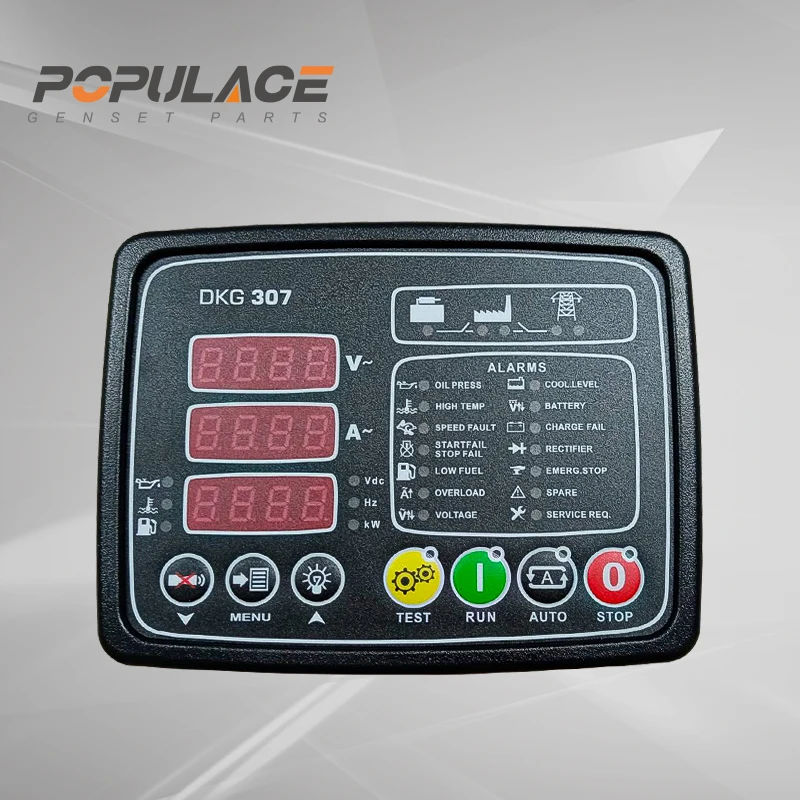
The POPULACE DKG-307 is a compact AMF controller panel module for straightforward standby generator installations, offering reliable mains-failure detection and auto-start sequencing in a manageable form factor.
POPULACE DKG-307 AMF Generator Controller Panel Module
ATS and Load Management Modules
ATS (Automatic Transfer Switch) logic governs the physical transfer of load between utility and generator supply. In many modern designs, AMF and ATS functions are combined in a single controller. The controller detects mains failure, starts the engine, and switches the load once generator output is stable.
Some installations require a layer of load management on top of basic transfer switching. A kohler load shed module enables priority-based control: when the generator is operating near rated capacity, the kohler load shed module activates to disconnect non-essential circuits and protect critical loads and the generator itself. When specifying auto start controller solutions for distribution, confirm whether the end installation requires load shedding relay outputs alongside the main transfer logic.
The wkpbn30 is a specific transfer switch controller module used in residential and light commercial genset installations for switching coordination and status signaling. Understanding where the wkpbn30 fits — its switching interface, rated capacity, and signal handshake with the main controller — is useful context when distributing transfer switch accessories alongside genset control modules. The wkpbn30 is commonly specified alongside AMF controllers in systems that require external transfer confirmation or remote status signaling rather than fully integrated ATS logic.
Manual Start Controllers
Manual start configurations give the operator direct control of engine start, stop, and load transfer. Protection monitoring stays active, but no automatic sequencing occurs. These configurations suit prime power applications, construction sites, and locations where an operator is consistently on-site. For distributors, manual start modules represent the entry tier of the control module range: lower cost, simpler wiring, and fewer configuration parameters than AMF or digital auto start units.
Digital Controllers vs. Analog: The Practical Difference
Traditional analog genset control relied on relay logic and fixed-threshold analog sensing. Reliable, but with minimal visibility: no event logging, no remote access, and no parameter adjustment without hardware changes. Fault diagnosis meant working from symptoms without data history.
The shift to digital genset controls has reshaped what buyers expect from a control module. The Generac Evolution 2.0 controller brought integrated display, fault history, and Wi-Fi remote monitoring to residential standby generators — demonstrating what buyers now expect from a digital auto start module. The generac evolution 2.0 approach, combining real-time status display with remote access via smartphone, has redefined the minimum acceptable feature set in the controller market.
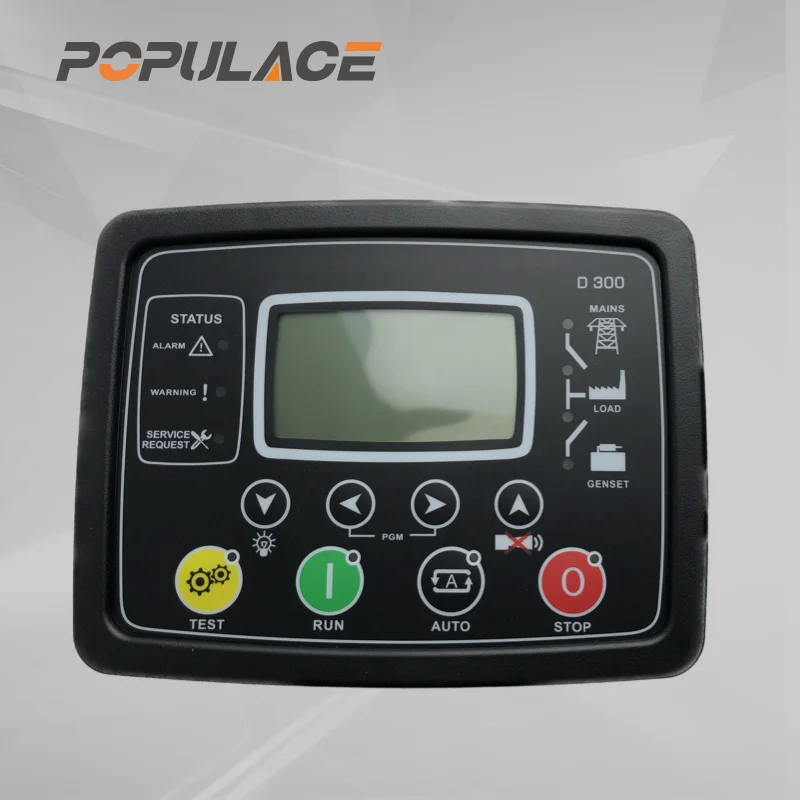
In the industrial and commercial segment, the DATAKOM D-300-MK3 is a digital genset controller that covers AMF and ATS modes, configurable load shedding outputs, J1939 CANBUS for electronic engines, RS-485 and Ethernet communication, and full parameter configuration via PC software. The DSE5110 offers comparable digital control capability with an established aftermarket ecosystem.
For wholesale buyers, the sourcing case for digital controllers rests on two practical factors: end customers increasingly require integration with facility management systems and remote access, and digital controllers reduce field support load through on-unit diagnostics and PC-based parameter configuration.
DATAKOM D-300-MK3 Genset Controller
POPULACE DSE5110 Genset Controller
Selection Criteria for Wholesale and Brand Buyers
When sourcing genset control modules, four criteria drive the right decision:
- Auto start mode: Does the installation require unattended AMF operation, operator-managed manual start, or ATS load transfer with external load shedding? This determines the engine generator controller type from the outset.
- Engine interface: Mechanical engines use standard digital I/O wiring. Electronic engines with ECUs need J1939 CANBUS support. An engine generator controller without the right interface will not function correctly on a given engine — confirm before ordering at volume.
- Remote monitoring and communication: If the end user requires SCADA integration or remote access, specify a digital controller with RS-485, Ethernet, or Wi-Fi. The generac evolution 2.0 set the benchmark for this in residential; industrial buyers expect equivalent capability in an engine generator controller for commercial installations.
- Configurability: Controllers with adjustable parameters and structured documentation reduce commissioning errors. PC-based configuration software — available on digital engine generator controller platforms like the DATAKOM D-300-MK3 — simplifies initial setup and parameter verification for installation teams.
Installation and Commissioning Notes
For distributors supplying control modules to installation teams, providing basic commissioning notes alongside the product reduces support calls. Digital controller units need rated voltage, frequency, and protection thresholds set on first installation — factory defaults are starting points. AMF units should have mains sensing thresholds adjusted to local utility tolerance ranges to prevent nuisance starts. For systems with external load switching accessories — a kohler load shed module, a wkpbn30 transfer module, or a custom relay board — verifying the signal interface with the main controller before load transfer testing prevents commissioning surprises and return requests.
Summary
The auto start module category within the engine generator controller market covers manual start panels, AMF auto start units, ATS transfer modules, and advanced digital controllers with full communication capability. For wholesale and brand buyers, the selection framework starts with operating mode requirements and moves through engine compatibility, communication needs, and configuration support. Whether your customers are specifying a residential unit using a generac evolution 2.0-style interface or sourcing industrial AMF controllers in volume for commercial installations, covering the full range of auto start module types gives downstream buyers the selection they need without unnecessary complexity.






