
 EN
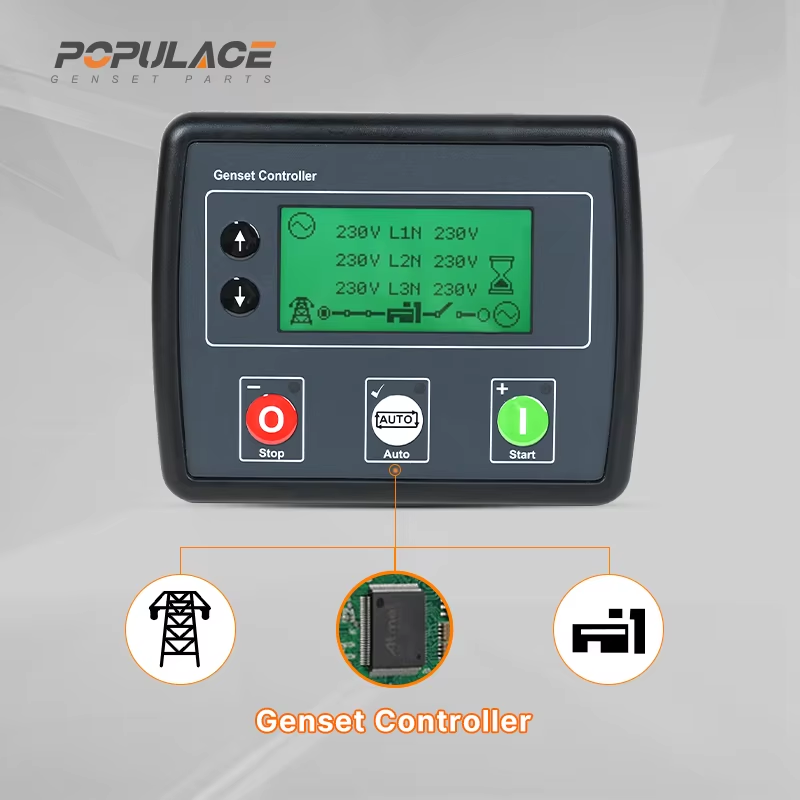
Deep Sea Controller: Genset Module Buyer’s Guide
A deepsee controller is usually evaluated when a genset needs dependable automatic operation, clear alarms, and a practical path from standby duty to more advanced synchronising applications. For an integrator, the decision is not simply “which screen fits the panel?” It is whether the controller’s inputs, outputs, sensing arrangement, engine interface, and transfer sequence match the entire generating system.
Deep Sea Electronics (often shortened to DSE) is widely recognised in generator controls. Its product families cover compact single-genset duty as well as controllers intended for parallel operation. That range is why the phrase deep sea electronics generator controller often appears in specifications for backup-power panels, retrofit work, and OEM builds. This guide explains what to compare before purchasing, where AMF and ATS responsibilities meet, and how DSE-style modules compare with SmartGen HGM alternatives.
What a deepsee controller does in a genset
At its core, a deepsee controller supervises the generator set rather than replacing the engine or alternator controls. It reads electrical and engine-related signals, commands starting and stopping sequences, presents operating status, records or annunciates faults, and can operate breaker or transfer logic when the application requires it. The exact I/O count, communications options, protections, and operating modes depend on the chosen model, so the current model manual remains the authority for a build.
In a typical diesel standby installation, the controller coordinates a sequence: detect a start demand, crank the engine, verify that the set is running and producing acceptable electrical conditions, command the appropriate switching equipment, monitor the load, and return the set to cooldown and stop when normal supply is restored. The controller also connects to adjacent components. A generator tachometer or speed signal helps confirm running speed; a diesel governor controls engine speed; and alternator sensing feeds voltage and frequency information back to the logic.
AMF and ATS: separate functions that must work together
AMF means automatic mains failure. An AMF-capable controller monitors the normal utility source and can initiate the generator sequence after a verified loss or unacceptable condition. ATS means automatic transfer switch. The ATS is the power-switching assembly that moves the load between sources. In some panel designs, the controller provides transfer commands while an external ATS performs the switching. In others, the controller and switching hardware are supplied as a coordinated panel solution.
The important buying question is not whether a module is labelled AMF or ATS capable. It is: what does this controller command, what does the switchgear execute, and what feedback proves the position? Specify mains sensing, generator sensing, breaker/contactor control, auxiliary feedback, interlocking, delays, cooldown, and retransfer behaviour before ordering. That prevents an AMF controller from being expected to perform functions that belong to the transfer equipment or its safety interlocks.
For examples of inventory that can be discussed against a real application, review the POPULACE DSE7320 MKII AMF Generator Control Module and the DSE4520 MKII Auto Mains Failure Control Module AMF Generator Controller DSE4520. Confirm the project’s required I/O and switching scheme against the applicable documentation rather than assuming interchangeability.
When synchronising changes the controller class
A single standby set normally needs dependable start, protection, and transfer coordination. Parallel generators add a different layer: voltage, frequency, phase relationship, load sharing, and breaker sequencing must be managed as a system. That is where a generator synchronization panel and a controller intended for synchronising/load-sharing work become relevant.
Do not select a parallel-capable model merely because a future expansion is possible; define the expansion path. Will sets parallel with each other, with mains, or both? Which devices own load sharing and breaker close permissives? Is there a common communication architecture? For projects in this category, the DSE8610 MKII Synchronising Load Sharing Auto Start Control Module DSE8610 is a relevant inventory reference, but the complete panel design still needs an engineering review of switchgear, protections, CT orientation, and commissioning procedures.
DSE-style modules versus SmartGen HGM series
A DSE/Deep Sea option and a SmartGen HGM-series option should be compared as application platforms, not as brand slogans. Both may offer controller families suited to generator monitoring and automatic operation, yet model-level features vary. Use a common comparison sheet:
- Operating duty: manual/auto start, AMF, remote start, or synchronising/load sharing.
- Electrical architecture: single- or three-phase sensing, CT requirements, mains and generator measurement, and required breaker control.
- Engine interface: hardwired start/stop, speed sensing, alarms, and any required electronic-engine communication support.
- Expansion: digital and analogue I/O, remote monitoring, communication protocol, and panel-space constraints.
- Serviceability: availability of the correct model, configuration-file control, labelled wiring documentation, and after-sales technical response.
If an existing fleet is standardised on a DSE configuration tool, common spares, and a known panel drawing set, retaining that ecosystem can reduce commissioning friction. If an HGM model precisely fits the required I/O and support environment, it can be a reasonable alternative. The correct answer is driven by the application, compatibility evidence, and support workflow—not by a blanket claim that one family is universally preferable.
Wiring and configuration checks before energising
Most commissioning problems are traceable to a missed interface detail, not the display itself. Before power-up, use the approved wiring diagram and perform these checks:
- Identify and label utility and generator voltage-sensing circuits; verify phase order and protective fusing as required by the design.
- Confirm CT location, ratio, polarity, and phase association. Incorrect CT orientation can corrupt load readings and any load-sharing logic.
- Trace every start, fuel/run, preheat, shutdown, breaker, and feedback contact from the deepsee controller to the field device. Verify whether each circuit is normally open or normally closed.
- Validate the speed-signal source and scaling. A generator tachometer input, magnetic pickup, or alternator-frequency method must match the configured source; coordinate this with the diesel governor and engine documentation.
- Set timers and thresholds from the approved functional description, then test manual mode, auto start, mains-failure response, transfer permissions, alarm shutdown, cooldown, and restoration under controlled conditions.
- Save the final configuration file, panel revision, and test record with the project documentation. This is essential for replacement modules and later troubleshooting.
Do not bypass protective interlocks to speed up a commissioning test. For synchronising work, use qualified personnel and an approved method statement because a generator synchronization panel introduces additional breaker and phase-matching hazards.
Supply and support questions for buyers
For wholesale buyers and system builders, a good controller source is more than a catalogue listing. Ask for the exact module title, availability status, clear photos, compatible panel information, and a process for confirming the required revision before purchase. Fujian Kaiyue Electronics Co., Ltd. supplies generator control components and related generator parts under the Populace and Doopser portfolio, with support aimed at wholesale and brand buyers across international markets. The listed DSE7320 MKII, DSE4520 MKII, and DSE8610 MKII references give procurement teams a starting point for AMF and synchronising categories.
Buyer’s checklist
- Define the duty: single set, AMF standby, ATS coordination, or parallel operation.
- Match sensing, I/O, engine interface, and switchgear feedback to the panel drawing.
- Decide whether the project needs a compact AMF module or a controller designed for a generator synchronization panel.
- Compare DSE and SmartGen HGM alternatives on documented model-level requirements and service workflow.
- Keep the approved configuration, wiring schedule, and commissioning record with the genset.
A deepsee controller becomes a strong choice when its documented capabilities fit the generator, transfer equipment, and operating plan. Start with the system design, verify the exact model, and make configuration discipline part of the procurement decision.






