
 EN
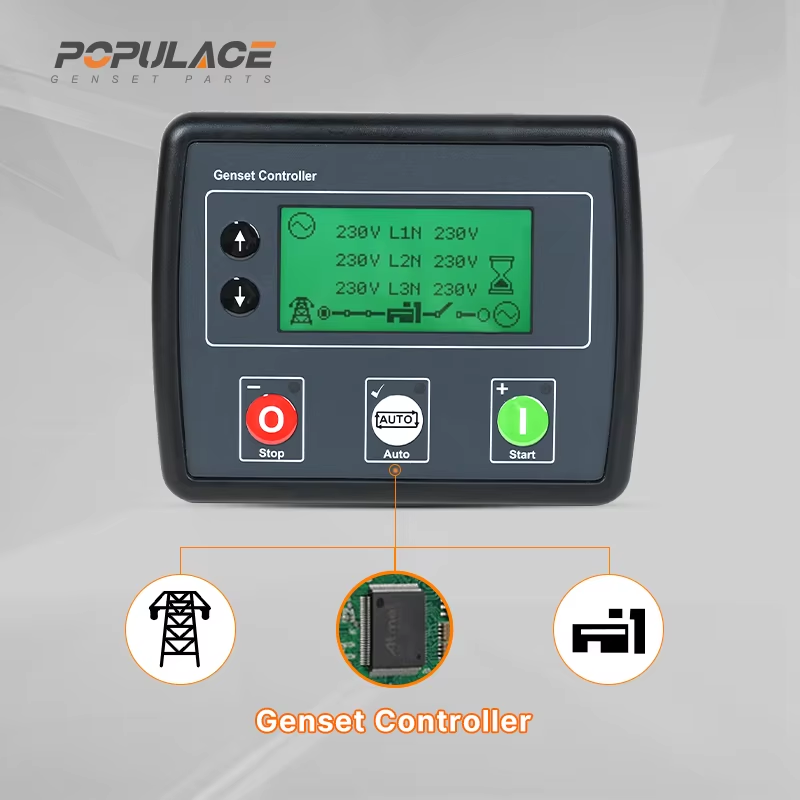
Deep Sea Control Panel: Wiring and AMF Module Setup
A deep sea control panel is the decision layer between a generator engine, the alternator, utility sensing, and transfer equipment. It is more than a screen with start and stop keys. The controller must see the correct electrical state, make a safe start decision, and command the intended switching sequence. For installers, the sound approach is to define the operating mode, separate low-voltage control wiring from power switching, and prove every signal before an automatic transfer test.
Deep Sea Electronics (DSE) controller families cover simple auto-start work through Auto Mains Failure (AMF), ATS control, synchronising, and load-sharing applications. A controller is not automatically an ATS: it supplies logic and outputs, while rated changeover equipment, breakers or contactors, protection, and interlocks handle power transfer. Keeping that boundary clear prevents dangerous assumptions during panel wiring.
What a Deep Sea Control Panel Does
In manual mode, a deep sea control panel starts the engine and presents configured engine and electrical information. In auto mode, a remote start demand or schedule can initiate a sequence. An AMF configuration also watches the utility supply. After it confirms a sustained mains failure, it starts the generator, waits for voltage and frequency to stabilise, and requests transfer to the generator source. When the utility is stable again, it can return the load, cool down the set, and stop it.
Those timers and thresholds must fit the site; they should not be copied blindly. A feeder with brief disturbances may need ride-through time, while a critical load may require another transfer approach. The controller should receive real position feedback from the mains and generator switching devices. A command output is not evidence that a contactor actually closed.
AMF, ATS, and Auto-Start Scope
- Auto-start starts and stops a generator from a remote demand. It fits applications where switching is manual or handled elsewhere.
- AMF monitors utility conditions and automates the generator response to a qualified mains failure.
- ATS control coordinates a transfer mechanism through configured outputs and position feedback. The physical ATS still needs correctly rated, mechanically and electrically interlocked equipment.
The POPULACE DSE7320 MKII AMF Generator Control Module is relevant when utility-failure automation is central to the brief. For a compact AMF category, see the DSE4520 MKII Auto Mains Failure Control Module. Where a project explicitly calls for synchronising and load sharing, the DSE8610 MKII Synchronising Load Sharing Auto Start Control Module is a product listing to review as part of the wider system design.
Wiring a Deep Sea Control Panel Safely
Begin with the exact current wiring drawing for the installed model. Do not borrow terminal numbers, fuses, or input types from another DSE family. Isolate all energy sources and use a qualified generator-control electrician. Then organise the panel by function.
- DC and engine circuits: install the protected battery supply, emergency-stop path, fuel/run output, and starter output as the model documentation specifies. Prove the safety circuit before enabling auto mode.
- AC sensing: wire generator and, for AMF duty, mains sensing through the prescribed protection and isolation arrangement. Confirm phase identification and nominal system configuration before energising.
- CTs and analog signals: check CT polarity and phase association, and handle CT secondaries safely. Incorrect orientation can create misleading power readings. Match oil pressure and coolant senders to the configured input type.
- Transfer commands and feedback: route generator-close and mains-close outputs through the engineered interlock scheme. Return auxiliary feedback for both source positions. Test that a failed device cannot establish an unintended parallel source.
- Remote I/O: label field wires and document the final I/O map. Accurate drawings make later troubleshooting substantially faster.

Configuration and Commissioning
Before a live transfer test, verify sensing values at rest and while running. Check battery voltage, frequency, phase rotation, mains-healthy thresholds, start delay, warm-up, transfer delay, return delay, and cool-down. Validate each digital input at the field device rather than assuming its normal state. Exercise alarms with safe test methods and document shutdown behaviour under controlled conditions.
Keep a record of the software version, configuration revision, CT ratio, sensing arrangement, output assignments, and witnessed test results. This matters when a vr6 voltage regulator or a 10kva automatic voltage regulator shares the generator package. The controller monitors and commands system logic; the AVR regulates alternator excitation. They are coordinated components, not replacements for one another, so voltage-related changes require the current documentation for both devices.
DSE and SmartGen HGM: Compare the Application
DSE and SmartGen HGM controllers can both appear in generator specifications. Compare the system requirement rather than the front-panel appearance: manual/auto-start, AMF, ATS interface, or parallel operation; available I/O; sensor compatibility; communications; expansion; configuration workflow; documentation; service support; and the availability of a matching spare. For a standby set, the strongest selection is usually the controller that cleanly fits the existing wiring, protection plan, and maintenance process.
Also distinguish generator control panel price from total installed cost. A low module price may exclude engineering, harness changes, transfer-device feedback, commissioning, spares, and documentation. Conversely, buying unused parallel functions does not improve a single-set AMF application. Define the functional acceptance test first, then compare like-for-like controller, panel, and support scope.
Supply and Final Checklist
Integrators can reduce downtime exposure by holding a model-specific spare, provided it is configured and tested for the application. A specialist source covering generator controls, governors, and AVR categories can simplify sourcing, but the project engineer must still confirm compatibility. Provide the generator model, battery system, alternator sensing arrangement, transfer-device type, and current controller configuration when requesting support.
A dependable deep sea control panel installation rests on documented sensing, safe interlocking, verified feedback, deliberate timers, and a witnessed automatic test. Match the controller to the duty, follow the current manufacturer drawing, separate controller logic from power-switchgear design, and retain the commissioned configuration. These practices turn AMF and ATS functions into a reliable site sequence.





