
 EN

AVR for Synchronous Generators: Excitation Guide
An avr for synchronous generator is the small control unit that keeps a generator’s terminal voltage usable while load, temperature, and engine speed change. For a buyer replacing a failed board or stocking generator parts, the useful question is not simply “which AVR looks similar?” It is whether the regulator matches the alternator’s excitation arrangement, sensing supply, field-current demand, and protection settings.
In service work, an avr for synchronous generator should be treated as part of an excitation system, not as an isolated spare. The controller measures output voltage, compares it with its setpoint, and changes DC current to the rotor field. More field current generally raises generator voltage; less field current lowers it. That feedback loop is why an avr for synchronous generator can recover voltage after a load step, provided the prime mover and alternator are otherwise healthy.
What the AVR controls—and what it cannot fix
A correctly selected avr for synchronous generator helps hold rated voltage as reactive and resistive loads move on and off the set. It may also provide stability adjustment, voltage trim, and under-frequency roll-off (UFRO). UFRO deliberately reduces excitation when engine speed falls below its intended threshold, helping prevent over-fluxing. A low-voltage reading therefore does not automatically prove that the regulator is defective: low speed, loose sensing leads, a field-circuit fault, or lost residual magnetism can produce a similar symptom.
For a small standby unit, a 3kw avr search term is only a starting point. Generator kW does not define compatibility by itself. Confirm phase, nominal sensing voltage, excitation source, field resistance or current range, frequency, and connector or terminal layout before choosing a replacement.
A practical selection method by generator range
For compact brushless sets, the selection of an avr for synchronous generator often centers on a simple self-excited regulator with the correct sensing and field-output range. A 3 kW to light-duty set may use a compact board, but the board must still suit the alternator winding and supply arrangement. Do not substitute by enclosure size alone.
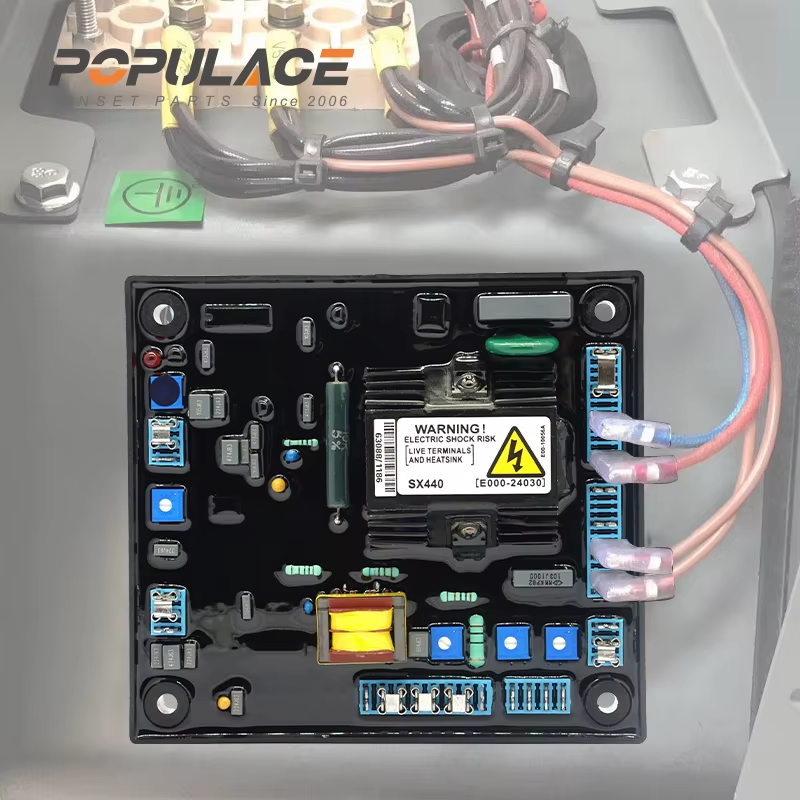
For common industrial brushless alternators, SX440, SX460, and AS440 are frequently considered in different control configurations. An avr for synchronous generator in this group should be matched against the original manual or alternator data sheet: verify whether it is self-excited or PMG-supported, whether droop or parallel capability is needed, and whether the sensing inputs and trim connections agree. SX460 and AS440 are not interchangeable simply because both appear on brushless generator applications.
For medium-duty and OEM-style applications, R120 and R450 selections require the same discipline. The correct avr for synchronous generator is the one whose supply, sensing, field output, and adjustment features correspond to the alternator design. A model comparison table is helpful for shortlisting, but it cannot replace a wiring diagram or original part reference.
| Check before ordering | Why it matters |
|---|---|
| Excitation source | Self-excited, auxiliary winding, and PMG systems use different regulator arrangements. |
| Sensing voltage and phase | Incorrect sensing prevents accurate regulation or can damage the board. |
| Field current capability | The regulator must supply the alternator field without sustained overload. |
| Frequency and UFRO setting | Speed-related protection must suit the 50 Hz or 60 Hz application. |
| Terminal map and options | Remote trim, droop CT, and stability terminals must match the intended system. |
Wholesale compatibility, life, and replacement cost
For distributors, an avr for synchronous generator program should group stock by verified electrical compatibility, not by a long list of untested “replaces” claims. Record alternator family, regulator reference, supply voltage, field range, terminal drawing, and any required accessories. This reduces returns when a purchaser asks for a cat vr6 voltage regulator or a mecc alte uvr 8172 tc equivalent: both are reference-specific enquiries that need data confirmation before a compatibility statement is made.
Service life depends heavily on heat, vibration, moisture, wiring quality, and overload events. A lower initial replacement cost can become expensive if an unsuitable AVR causes repeated commissioning visits. Compare total replacement cost: board price, verification time, shipping, field labor, and the risk of alternator damage from incorrect excitation. For suitable current-regulator options, see the R120 generator AVR listing and the GAVR-8A exciter control unit listing.
Installation and wiring checks
Before installing an avr for synchronous generator, isolate the set, lock out starting, and photograph the original terminals. Compare every lead with the approved alternator diagram; do not transfer wires by color alone. Keep sensing leads separate from high-noise wiring where the alternator design permits, confirm earth connections, and inspect connectors for heat discoloration or corrosion.
- Set the voltage adjuster and stability control to documented initial positions.
- Verify engine speed and frequency before raising voltage settings.
- Start unloaded and measure terminal voltage with a calibrated meter.
- Apply load gradually while watching voltage stability and field behavior.
- Stop immediately if voltage rises uncontrollably, hunting is severe, or the AVR overheats.
Fault checks before condemning the board
When an avr for synchronous generator appears to fail, begin with the mechanical and electrical basics. Check engine speed, breaker position, sensing fuses, terminals, field continuity, and alternator windings according to the manufacturer’s test procedure. Confirm that the regulator receives its specified supply and that its voltage setpoint has not been disturbed. If voltage is low only under load, investigate speed governor response and load balance as well as the AVR.
For an avr for synchronous generator replacement, document the before-and-after readings: no-load voltage, frequency, loaded voltage, stability observations, and final adjustment position. That record makes repeat orders safer and gives wholesale teams a defensible compatibility trail. If the original is unavailable, share alternator nameplate data, terminal photos, and the old board’s markings with the supplier rather than selecting an apparent match from a photograph.
Conclusion
The right avr for synchronous generator protects voltage quality by managing excitation, but it must be selected as part of the complete alternator system. Use electrical compatibility first, verify wiring before energizing, and diagnose speed, sensing, and field faults before replacing a regulator. This approach is more reliable for a 3kw avr enquiry, an industrial SX-series comparison, or a reference-specific request such as a cat vr6 voltage regulator or mecc alte uvr 8172 tc.





