
 EN
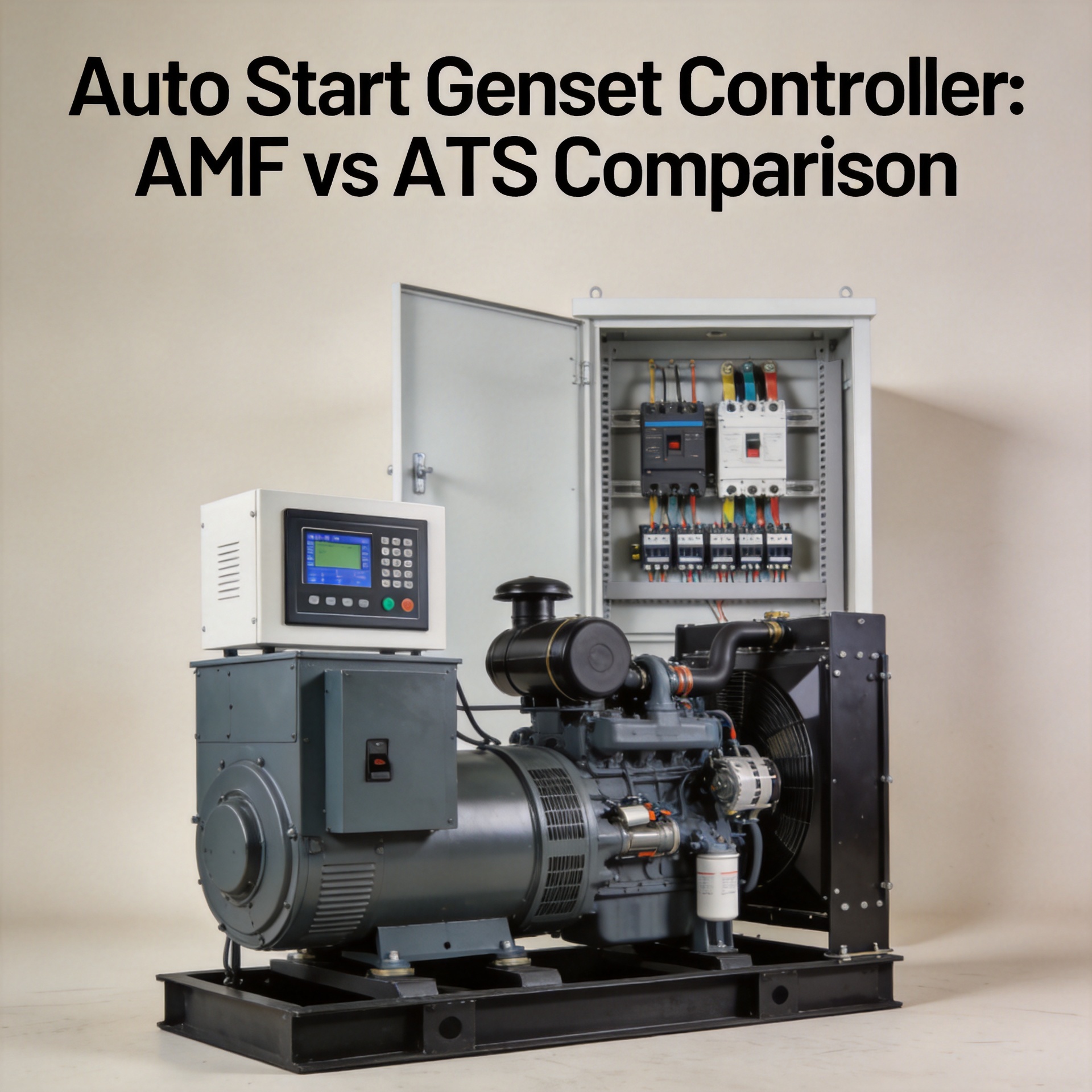
Auto Start Genset Controller: AMF vs ATS Comparison
When a facility loses mains power, the speed and reliability of generator startup can mean the difference between a minor inconvenience and a critical operational failure. At the center of that response is the auto start genset controller — the module that monitors conditions, initiates the crank sequence, controls the generator starter motor, manages load transfer, and shuts the genset down when mains power returns.
For wholesale buyers and brand merchants sourcing genset controllers, one of the most common technical questions is whether a given application needs AMF control, ATS control, or something more capable. The answer is not immediately obvious, and selecting the wrong configuration is one of those mistakes that typically surfaces during commissioning rather than when reviewing a catalog spec.
What Does an Auto Start Genset Controller Do?
A basic auto start genset controller handles three core functions:
- Automatic start and stop: Monitors the mains voltage and frequency. When the supply drops below threshold, the controller activates the generator starter motor and manages the crank cycle, including pre-glow for diesel applications, crank attempts, and crank rest intervals.
- Protection monitoring: Tracks engine parameters including oil pressure, coolant temperature, battery voltage, and alternator output. Initiates alarm or shutdown if any parameter exceeds safe operating limits.
- Load transfer management: Coordinates the transfer of load from the mains supply to generator output and back again, with configurable delay timers to prevent false starts and unstable transfer events.
These three functions form the basis for distinguishing AMF from ATS configurations — both modes share some capabilities but differ in scope.
AMF Controllers: Mains Failure Detection with Full Engine Supervision
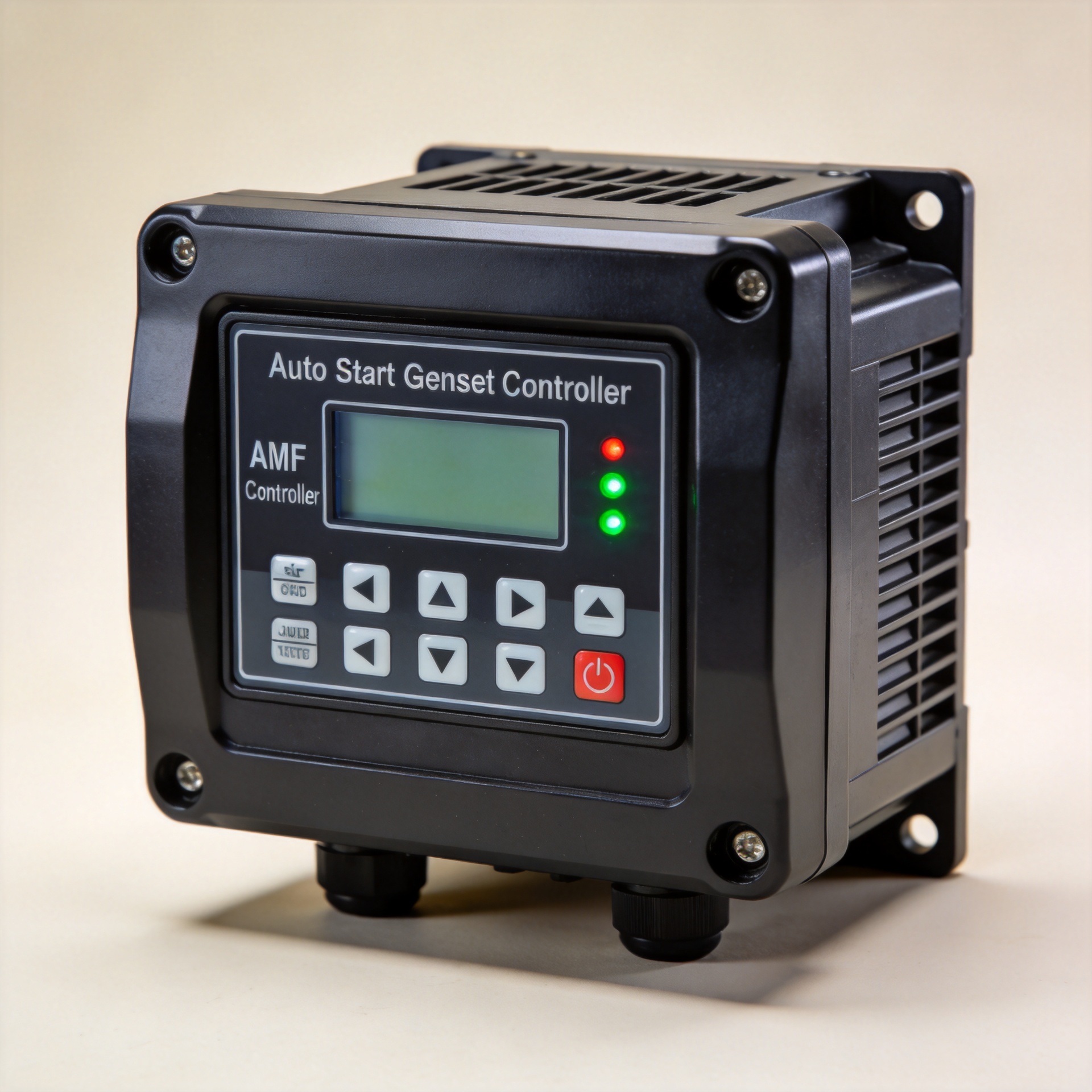
AMF stands for Automatic Mains Failure. An AMF auto start genset controller monitors the mains supply and, when it detects failure, initiates the full start sequence independently. This includes activating the generator starter motor, verifying engine speed, confirming output voltage and frequency, and then executing load transfer.
The defining characteristic of AMF control is that it owns the entire start-to-transfer process. The controller handles cranking, monitors running parameters, and manages the return-to-mains sequence without external input. AMF is the appropriate choice for applications where:
- The genset is unattended and must start automatically without operator presence
- Engine protection monitoring — oil pressure, coolant temperature, overspeed — is required
- Full event logging and alarm outputs are needed for maintenance records
- The generator does not have its own separate start control module
Digital AMF controllers, including modules compatible with the architecture used in products like the POPULACE DSE3110 Generator Auto Start Control Module, add configurable protection thresholds, LCD fault readout, and communication outputs that analog relay-based controllers cannot provide.
ATS Controllers: Transfer Switch Focus Without Deep Engine Control
ATS stands for Automatic Transfer Switch. An ATS manages the switching of load between two power sources — mains and generator — but relies on a separate signal or external controller to start and stop the genset. The ATS provides the volt-free contact signal that triggers the generator's own start control, rather than managing the crank sequence directly.
ATS control is appropriate when:
- The generator already has its own built-in auto start module that only needs a dry contact start signal
- Deep engine protection monitoring is handled by the generator's onboard controls
- The primary requirement is reliable power source switching rather than comprehensive genset management
The key distinction — and the one that catches out buyers most often — is that AMF and ATS are not interchangeable terms. Specifying "ATS" when full engine supervision and starter motor control are actually needed can result in a controller that sends a start signal but does not monitor whether the engine has started, reached stable speed, or triggered a protection fault.
AMF vs ATS: Side-by-Side Comparison
| Feature | AMF Controller | ATS Controller |
|---|---|---|
| Mains failure detection | Yes | Yes |
| Generator starter motor control | Direct (multi-attempt crank sequence) | Via dry contact to external start module |
| Engine protection monitoring | Yes (oil, temp, speed, battery) | Depends on generator's own controls |
| Load transfer switching | Integrated or via external contactor | Primary function |
| Fault logging and display | Yes (digital models) | Limited |
| Typical application | Standalone unattended genset backup | Generator with existing start control |
Why Digital Controllers Outperform Analog Relay Designs
Older analog relay-based auto start genset controllers handle the basic start-stop sequence well for straightforward installations. The limitations emerge in applications requiring adjustable timing parameters, multi-engine paralleling, remote monitoring, or detailed fault diagnostics.
Digital controllers from manufacturers including Deep Sea Electronics, SmartGen, and Datakom — and platforms like the DATAKOM D-300-MK3 Genset Controller — offer configuration flexibility that analog boards cannot match:
- Configurable crank attempt count and rest intervals tailored to engine type
- Adjustable protection thresholds with independent alarm and shutdown setpoints
- Event log storage for maintenance review and fault tracing
- RS-485 or Modbus communication for SCADA or building management integration
- LCD or LED display for real-time parameter readout without external metering
Buyers comparing advanced controller platforms may use the Woodward EasyGen 3000 series as a reference point in digital genset management, particularly for parallel operation and synchronization applications. Understanding what features are standard at that level helps calibrate expectations for mid-range digital AMF modules in terms of configuration depth.
Selecting the Right Controller for Your Application
The selection question most wholesale buyers face is not simply "AMF or ATS." It comes down to which feature set matches the protection requirements, monitoring expectations, and communication needs of the end application.
For distributors supplying commercial standby installations where the generator is unattended and engine protection must be fully automatic, an AMF controller with digital parameter display and configurable protection thresholds is the starting point. A product like the POPULACE DKG 307 AMF Controller Panel addresses this profile, providing AMF control in a panel-ready format suitable for integration into generator enclosures or standalone switchgear panels.
If the application involves a generator with existing onboard start controls and only load transfer switching is needed, an ATS-type module may be sufficient — provided the generator's own control handles protection monitoring. Products in the category of the Reliance Protran 2 interlock kit take a different approach: they provide a manual transfer mechanism between utility and generator circuits without automatic start sequencing, appropriate for manual-start residential or small commercial applications rather than unattended commercial standby use.
Installation and Commissioning Notes
For wholesale buyers supplying controllers to installation teams or engineering contractors, a few commissioning points are worth communicating alongside the controller:
- Generator starter motor compatibility: Confirm that the controller's crank output relay rating matches the starter motor draw current. Undersized relay outputs can fail under repeated starting cycles.
- Protection threshold calibration: Factory default settings are conservative starting points. Oil pressure and temperature thresholds should be adjusted to the specific engine's operating parameters to avoid nuisance shutdowns.
- Transfer delay settings: Allow adequate warm-up time before load transfer and verify return-to-mains delays are configured to prevent cycling back too quickly on unstable utility supply.
- Mains sensing voltage range: Confirm the controller's sensing input matches the site supply voltage — mismatched sensing inputs are a common configuration error that causes false starts or failure to detect actual mains failure.
Summary: Matching Controller Type to Application Requirements
Choosing between AMF and ATS control for an auto start genset controller comes down to whether the application needs the controller to directly manage the generator start sequence and engine protection, or only needs to manage load transfer between power sources. Most unattended commercial and industrial standby installations require AMF-level control with digital protection monitoring. ATS is appropriate when a capable genset controller is already onboard and only transfer switching is needed.
For wholesale buyers and brand merchants sourcing controllers across multiple installation types, stocking AMF-capable digital modules covers the widest range of applications and provides the configuration flexibility that distributors increasingly require. To explore available options, contact our team at kygenpower.com or reach us at [email protected].






