
 EN
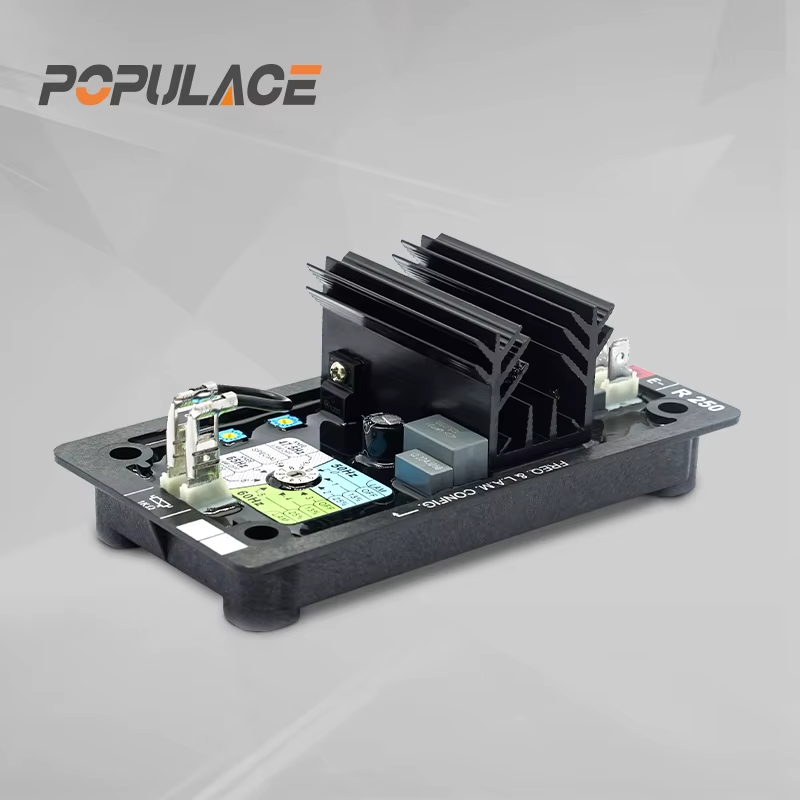
What Is the Role of an Alternator AVR in Preventing Voltage Fluctuations?
An alternator AVR is the control device that helps a synchronous generator hold its intended terminal voltage as load conditions change. In a brushless alternator, it does not create electrical power by itself. Instead, it measures output voltage, compares that reading with a target, and changes excitation so the alternator can correct a rise or dip. That feedback task is why a healthy regulator matters to lighting, motors, battery chargers, electronic controls, and other connected loads.
From a maintenance perspective, voltage complaints are rarely solved by swapping a board without checking the surrounding circuit. When a standby generator fails to regulate properly, the first thing I check is whether the regulator is the original specification or a substitute. A mismatched unit, loose sensing lead, incorrect adjustment, or engine-speed problem can all look like an AVR fault. The practical value of an alternator AVR is therefore both regulation and diagnostic clarity: it gives technicians a controlled path to test.
How an Alternator AVR Controls Generator Voltage
The operating principle of an alternator AVR is a closed feedback loop. The regulator senses AC voltage at the alternator terminals or at a designated sensing point. It compares that signal with its internal reference. If actual voltage falls below the setpoint, the regulator increases DC excitation delivered to the field circuit. A stronger magnetic field supports higher generated voltage. If output voltage climbs above the setpoint, the regulator reduces excitation, allowing output to settle back toward the target.
That sequence happens continuously, not as a one-time correction. Load changes can occur when a motor starts, a compressor cycles, a bank of lights is connected, or a large load is removed. A properly specified alternator automatic voltage regulator responds to the voltage error rather than waiting for an operator to intervene. The response has to be controlled: too little correction leaves a sag, while overly aggressive correction can contribute to hunting or repeated overshoot.
Why Voltage Fluctuations Occur in the First Place
An alternator AVR can compensate for normal variation, but it cannot erase every fault in a generating set. Separating the symptom from the root cause is important before ordering an alternator voltage control module.
- Rapid load changes: Starting current and sudden load rejection change the electrical demand on the alternator.
- Incorrect engine speed: Frequency and speed are linked. If the prime mover is unstable, a regulator may be asked to correct a condition outside its intended scope.
- Loose, damaged, or incorrectly connected sensing wires: The regulator can only react to the voltage it is actually measuring.
- Field-circuit or rotating-component issues: Brushes where applicable, exciter components, diodes, windings, and connections can limit available excitation.
- Unsuitable settings or a mismatched replacement: A regulator designed for a different sensing arrangement, field supply, or alternator configuration may not regulate predictably.
Most buyers go straight for price—well, price is the starting point, but the real cost often appears after installation if the replacement does not match the alternator’s electrical arrangement. An ac generator AVR must be evaluated as part of the excitation system, not as a universal plug-in board.
The Feedback Loop: Sense, Compare, Correct
A useful way to understand an alternator AVR is to follow one load event. Suppose a pump motor starts and terminal voltage briefly falls. The sensing circuit reports a lower value. The regulator interprets the gap between the measured voltage and its reference as an error, then increases field excitation within its design limits. As the alternator output recovers, the error becomes smaller and the regulator eases the correction. The goal is stable operation around the setpoint, while allowing for normal short-term response to changing load.
For a generator owner, this matters because many loads are sensitive to undervoltage or overvoltage. Motors can draw more current when voltage is low; electronic equipment may fault when voltage drifts outside its tolerance; charging systems can behave inconsistently. A stable alternator AVR helps reduce these operational risks by correcting normal voltage deviation quickly and smoothly.
What to Check Before Replacing an Alternator Voltage Control Module
Before confirming a replacement order, gather evidence rather than matching only by appearance. Buyers who have dealt with installation failures tend to reassess wiring diagrams and compatibility documentation as a primary supplier evaluation criterion—not an afterthought. An AVR for brushless alternator applications may look similar to another model while using different sensing, power-input, or field-output arrangements.
- Record the alternator model, generator voltage, frequency, and rated operating configuration.
- Confirm whether the machine is brushless and identify the excitation and sensing terminals from the correct wiring diagram.
- Check the existing regulator’s part number, adjustment functions, and connection labels.
- Inspect wiring, terminals, fuses, grounding, and engine-speed stability before condemning the regulator.
- Ask for dimensional, terminal, and application compatibility information before choosing an alternator automatic voltage regulator.
This check is especially important for wholesalers and brand owners managing inventory. Once you manage a parts inventory long enough, you stop asking only which supplier has the lowest price and start asking which supplier can provide consistent batch compatibility and clear documentation. Fujian Kaiyue Electronics Co., Ltd. focuses on generator control components, including AVRs, controllers, governors, actuators, and related generator parts, which makes application details central to the sourcing conversation.
Signs That Point Toward an AVR or Excitation-System Problem
Symptoms can guide testing, but they are not proof by themselves. Repeated high or low voltage, output that changes with no clear load event, voltage that rises after warm-up, or a unit that fails to build voltage can justify a structured inspection. If an alternator AVR adjustment produces no meaningful response, the cause could be the regulator, but it could also be sensing wiring, the field path, residual magnetism, diodes, windings, or a mechanical speed issue.
For that reason, a technician should use the manufacturer’s procedure and safe isolation practices. Live generator testing introduces electrical and rotating-equipment hazards. If the configuration cannot be confirmed from the available documentation, the sensible next step is to obtain the correct diagram or consult a qualified generator technician rather than making trial connections.
Choosing an AVR for a Brushless Alternator
When selecting an avr for brushless alternator service, compare options against the same criteria: terminal layout, sensing voltage, input supply, field-output capability, frequency setting, adjustment range, protection functions, and the exact alternator application. A compatible alternator AVR should support the machine’s original control method; it should not force the machine into a different wiring arrangement merely because the board physically fits.
There is no universal winner between an original-specification regulator and a compatible replacement. The original-specification route may simplify matching when documentation is complete. A compatible alternative may be appropriate when its electrical and mechanical compatibility can be verified. Whether either choice will work on a specific unit depends on details that a catalog photograph cannot confirm, but those are precisely the questions worth resolving before installation.
Conclusion
The role of an alternator AVR is to keep generator voltage near its setpoint through continuous sensing and controlled field excitation. It reduces ordinary voltage fluctuation caused by changing loads, but it also depends on sound wiring, correct settings, stable engine speed, and a healthy excitation system. Treat the regulator as one part of a connected system. With the right compatibility checks and a methodical diagnosis, buyers and technicians can make a more reliable decision about an alternator voltage control module or an ac generator AVR replacement.






