
 EN
What Is an AVR Automatic Voltage Regulator and Why Do Generators Need It?
Most people who work with generators know the term AVR, but the explanation they get is usually the short version: it keeps the voltage stable. That is accurate as far as it goes. What the short version leaves out is the mechanism behind that stability — and understanding the mechanism is what separates a buyer who selects the right AVR module for a specific generator from one who orders by nominal voltage and discovers the problem only after installation.
An avr automatic voltage regulator is an electronic control component mounted inside or connected to a generator. Its job is to sense the generator output voltage on a continuous basis, compare it against a fixed reference, and automatically adjust the excitation current supplied to the generator field winding to hold the output at the correct level — regardless of changes in load, speed, or temperature. That feedback loop is the entire function of the device.
How the AVR Sensing and Actuation Loop Works
The operating principle of a voltage regulator avr follows a consistent pattern: sense, compare, correct.
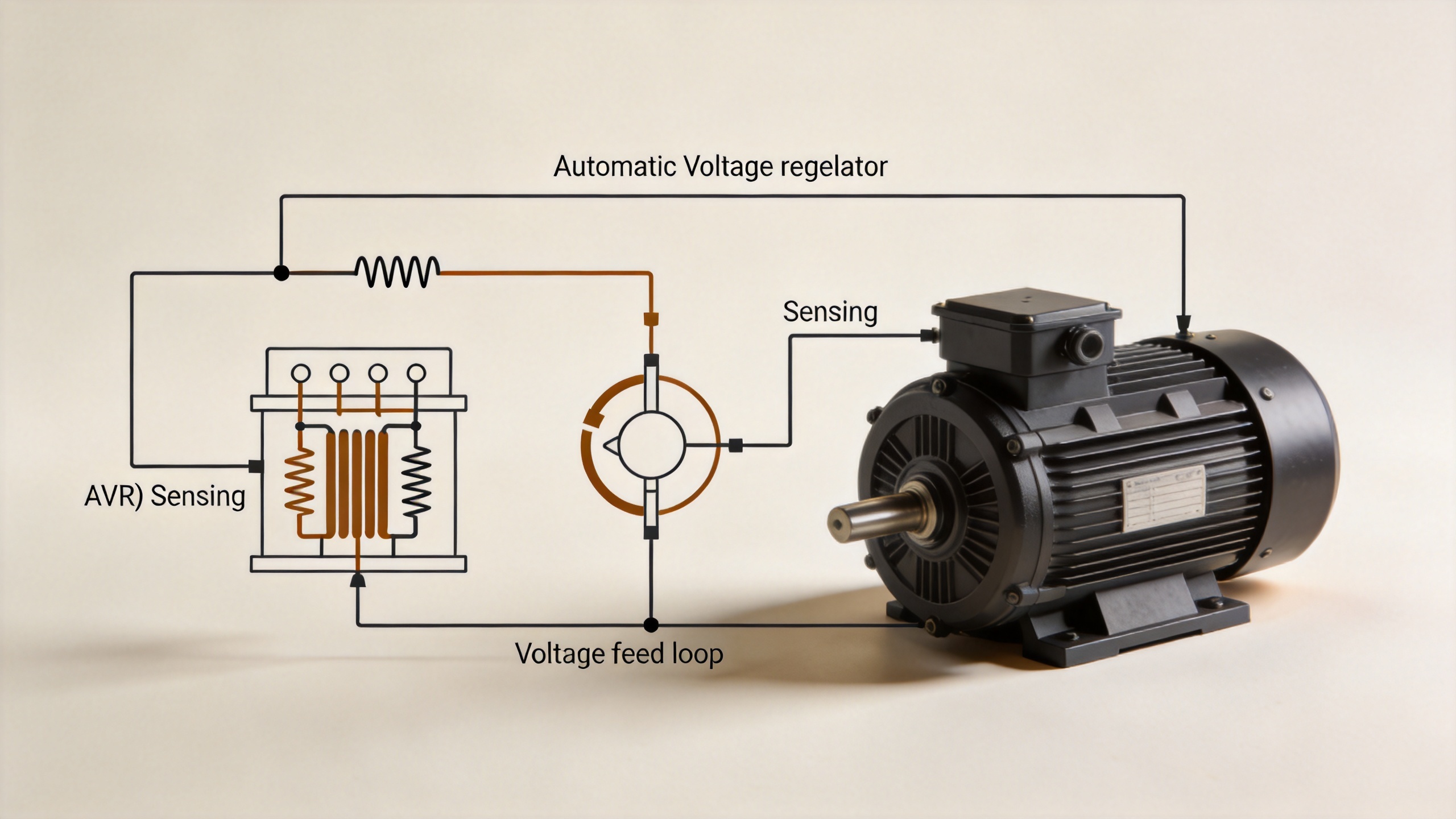
First, the AVR reads a sample of the generator AC output voltage through a sensing input winding — usually a dedicated auxiliary winding on the stator, or a tap from the main output. That sampled voltage is rectified and fed into the AVR internal comparison circuit. The circuit measures it against a preset reference voltage, which corresponds to the desired output level. If the two values match, no correction is required. If they diverge — because load increased and voltage dropped, or because load decreased and voltage rose — the AVR outputs a correction signal.
That correction signal controls the DC current flowing into the exciter field winding. Increasing the excitation current strengthens the magnetic field inside the generator, which increases the output voltage. Reducing it weakens the field and reduces voltage. The loop repeats continuously, which is what allows a properly specified automatic voltage regulator to maintain output within plus or minus 1% to 2% of rated voltage even under dynamic load changes.
In practice, the AVR watches the output, adjusts the magnetic field, and keeps the voltage where it should be — without operator involvement.
Brushless Generators and the Role of the Exciter
In older generator designs, excitation current was delivered to the main rotor field through physical brushes and slip rings. Modern brushless generators eliminate that contact by using a separate exciter alternator mounted on the same shaft. The AVR controls the exciter stationary field winding. The exciter alternator generates AC current in its rotor, which is rectified by a rotating rectifier assembly and fed directly to the main generator rotor field without any brushes.
In brushless designs, the generator avr automatic control path runs entirely through stationary circuitry, while the power delivery to the rotating field happens electromagnetically. The result is a lower-maintenance design — but one where the AVR sensing and correction accuracy matter even more, since there is no direct manual access to the field excitation path during operation.
Why Generators Need an AVR
Without an automatic voltage regulator, generator output voltage would vary in proportion to load. When a large motor starts and draws high current, voltage drops. When the motor reaches running speed and current demand reduces, voltage rises again. Without correction, these swings create problems at several levels.
Sensitive electronics — including computers, medical equipment, communication systems, and variable-frequency drives — have voltage tolerances that are narrower than the natural fluctuation range of an unregulated generator. Voltage swings outside those tolerances cause equipment shutdowns, data corruption, or component damage. Industrial standby generators are commonly specified to maintain output within plus or minus 10% of rated voltage under full load transients; the AVR is the component responsible for meeting that specification.
Voltage instability also reduces generator efficiency. An over-excited generator produces excess reactive power. An under-excited one can lose synchronism with parallel machines or fail to maintain adequate torque margin on motor loads. A properly tuned avr automatic voltage regulator keeps the generator operating close to its designed power factor across the load range, which extends both the generator service life and that of connected equipment.
The Specification That Most Buyers Overlook
Early in the sourcing process, most buyers focus on output voltage and power rating. After a failed installation, the focus usually shifts to sensing input range, interface connector type, and control panel wiring compatibility.
The pitfall that gets overlooked most often with AVR modules is not the output voltage spec — it is the sensing input range, which varies across generator winding configurations and is often omitted from catalog descriptions. A single-phase avr module may sense from a dedicated auxiliary winding at 100 to 120 V, or from a main winding tap at 180 to 250 V. If the installed winding produces 110 V but the replacement AVR expects a 200 V sensing input, the regulation loop operates outside its designed range. The output voltage will be wrong, and the cause is difficult to diagnose unless the sensing specification was verified before ordering.
Confirming the sensing input voltage range from the original AVR datasheet or generator wiring diagram before ordering a replacement is the direct way to avoid this issue. For universal AVR modules with adjustable sensing ranges, verify that the setting range covers the winding output of the specific generator.
Common AVR Models and Their Applications
Across the generator parts market, certain AVR models appear across a wide range of installations. The SX460 is one of the most common, used in medium-power brushless generators. It accepts a sensing input in the range of 95 to 132 V AC (single-phase) and regulates output through a proportional-integral control loop with adjustable voltage trim. The MX321 and MX341 are designed for higher-capacity generators and include additional features such as parallel operation droop control and under-frequency protection. The AS440 covers a wider sensing input range of 95 to 264 V and is frequently used as a retrofit option for generators whose original AVR model is no longer in production.
Whether OEM or aftermarket suits your situation depends on availability, generator model compatibility, and acceptable quality thresholds — there is no single right answer. For buyers managing fleet maintenance across multiple generator brands, having a supplier who stocks multiple AVR types with confirmed compatibility documentation reduces the sourcing complexity considerably.
If your priority is ensuring regulation accuracy under variable loads, the most relevant factor to evaluate is the AVR voltage regulation accuracy specification — not its maximum current output. If your priority is a drop-in replacement for an aging generator, confirm the connector pinout and sensing range match before selecting a substitute model.
Summary
An avr automatic voltage regulator is the component responsible for keeping a generator output at a stable, preset voltage level by continuously sensing output, comparing it to a reference, and adjusting excitation current to correct any deviation. Generators need this function because load changes, speed variations, and temperature shifts all affect voltage in ways that connected equipment cannot tolerate without active correction. Selecting the right AVR means verifying sensing input range and interface compatibility — not just nominal output voltage — before committing to a replacement or upgrade order.






