
 EN
What Is a Generator Auto Start Controller and How Does It Sense Mains Failure?
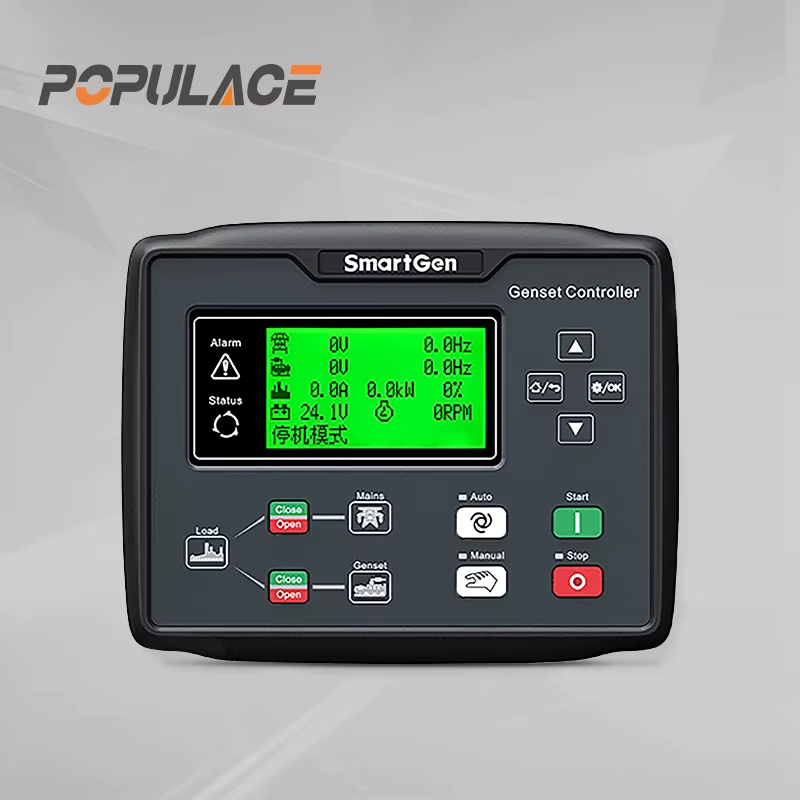
A generator auto start controller is the decision-making device that watches an electrical condition and issues the command to start a genset when that condition becomes unacceptable. In a standby-power installation, its most important input is usually the utility supply. When mains voltage, frequency, or phase condition remains outside the configured limits for long enough, the controller starts the engine and, once the set is ready, allows transfer equipment to move the load.
That distinction matters in procurement and commissioning. A controller starts and protects the generator; an automatic transfer switch (ATS) connects the load to the preferred or emergency source. Some panels combine these functions, but they are still separate control jobs. Treating a generator auto start controller as if it were the transfer switch is a common source of incomplete specifications and unsuccessful site tests.
What the controller actually does
At a minimum, a generator auto start controller manages the start sequence, reads engine and alternator feedback, announces alarms, and stops the set after a controlled return to normal. Depending on the design, it may also provide manual and remote start inputs, event logs, battery-voltage monitoring, programmable digital inputs, and communications.
For a mains-failure application, the controller needs a reliable view of the preferred source. It typically receives sensing conductors from the utility side of the ATS or from a protected sensing point in the distribution system. A three-phase unit may evaluate line-to-line and/or line-to-neutral voltage on each phase, frequency, phase rotation, and phase loss. A single-phase installation needs the matching sensing arrangement rather than a three-phase controller configured by assumption.
An auto start module for generator can also be used for non-mains triggers, such as a dry contact, low battery-bank voltage, tank level, or temperature. Those uses are valid, but they should not be confused with utility-failure duty. The application decides which inputs are enabled and which input has priority.
How mains failure is recognized
The controller continuously samples the sensed supply and compares it with configured limits. A typical logic set may include undervoltage, overvoltage, underfrequency, overfrequency, phase loss, phase-sequence error, and phase imbalance. The exact percentages and time delays are not universal values: they must suit the nominal voltage, utility behavior, load criticality, ATS scheme, and local electrical design.
Most importantly, the controller does not normally start the engine on a single bad sample. A fault must persist through a mains-fail delay. This prevents a brief dip, switching transient, or loose sensing connection from creating an unnecessary start. If your application sees frequent motor starts or a weak utility, that delay and threshold deserve particular review; an aggressive setting may protect availability poorly by causing nuisance starts.
The practical question is not simply, “Does it detect low voltage?” It is: which phases are measured, where are the sensing fuses and terminals, which abnormal conditions are active, and how long must each condition persist? A wiring drawing and parameter export answer that question far better than a generic controller model name.
The automatic sequence from failed mains to load transfer
- Healthy mains state. The controller confirms that the preferred source remains within its configured acceptance window. The generator is stopped or cooling down, and the ATS stays on utility.
- Failure qualification. When a monitored condition crosses its pickup threshold, the mains-fail timer begins. If supply recovers before the timer expires, the controller resets without starting.
- Start command. After the delay, the generator auto start controller energizes the start output. It may execute preheat, crank, rest, and retry cycles while supervising oil pressure, speed, and battery-related alarms.
- Generator-ready qualification. The engine running signal alone is not enough. The controller waits for generator voltage and frequency to stabilize within configured limits, often with a warm-up delay.
- ATS transfer permission. The controller sends a remote-start/available signal or the ATS recognizes the generator as acceptable. The ATS performs the mechanical or electrically interlocked source transfer according to its programmed transition type.
- Return to mains. When utility power returns and remains healthy for the retransfer delay, the ATS returns the load. The controller then runs the engine unloaded for its cooldown period before stopping it.
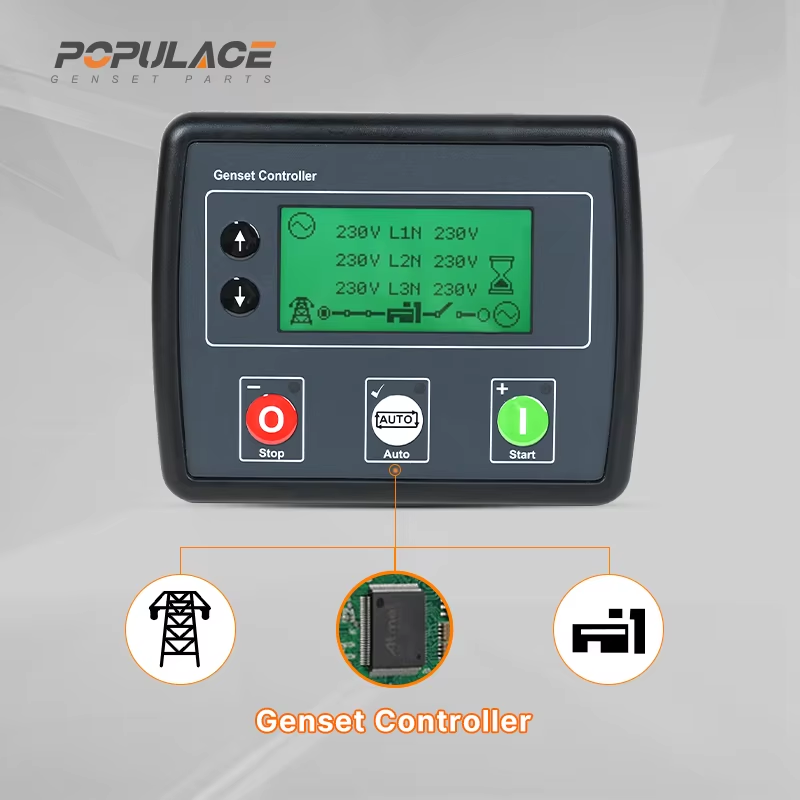
A generator remote start controller must be coordinated with the ATS contacts and logic. Verify whether the ATS supplies a two-wire start, whether that circuit is normally open or normally closed, and whether the controller expects a maintained signal or a pulse. Do not rely on label names alone.
Controller and ATS coordination points
An automatic start controller genset installation is only as dependable as the handoff between sensing, engine control, and transfer equipment. The ATS should not transfer merely because the engine has started; it should transfer only after the emergency source is accepted. Conversely, the controller must continue receiving a valid run request until the ATS has completed its return-to-mains logic.
- Confirm the mains sensing point is on the intended side of the transfer scheme.
- Match system voltage, phase arrangement, frequency, and controller power supply to the site.
- Confirm generator-ready inputs or voltage/frequency acceptance logic at the ATS.
- Set start, warm-up, transfer, retransfer, and cooldown delays as one coordinated sequence.
- Document interlocks for bypass, maintenance, fire-pump, parallel, or load-shed functions where applicable.
For simple standby sets, a packaged auto start kit may be adequate. For critical facilities, parallel systems, or sites with unusual utility quality, specify the sensing channels, I/O count, communications protocol, ATS interface, and test requirements before selecting hardware.
Commissioning checks that reveal real problems
Commissioning should prove the full sequence, not just that the engine cranks. Start with a drawing review: trace the sensing conductors, verify their protective devices, confirm phase identification, and compare terminal numbers with the controller configuration. Then record the programmed thresholds and delays as the baseline for future maintenance.
Next, simulate or safely isolate the preferred source under the approved site procedure. Observe the mains-fail delay, start attempts, oil-pressure inhibit, generator voltage build-up, frequency acceptance, ATS transfer, alarm annunciation, and event log. Restore mains and verify retransfer, cooldown, and stop. A failed test often traces to a missing sensing phase, incorrect nominal-voltage setting, weak starting battery, reversed remote-start contact logic, or an ATS that does not receive an acceptable-source signal.
One useful discipline is to test failure modes separately. A complete loss of utility, a single-phase loss, an undervoltage condition, and an out-of-sequence condition may not produce identical behavior. The configured protection philosophy should decide what is expected.
What B2B buyers should request before sourcing
Compatibility is more important than a familiar enclosure or a low unit price. Request the controller datasheet, wiring diagram, supported sensing voltage and phase arrangement, DC supply range, output ratings, start-contact type, alarm list, configuration software method, and communication options. For replacement work, provide the generator model, alternator data, existing ATS drawing, panel photographs, and terminal schedule.
Ask for documentation before the purchase order, not after shipment. A supplier that can support model-level compatibility review and provide wiring information reduces the chance that a nominally similar controller cannot be commissioned on site. For fleet buyers, also confirm firmware version control, labeling, packaging protection, sample-to-batch consistency, lead time, and after-sales technical response.
In short, a generator auto start controller senses a sustained, configured abnormal condition at the preferred source, runs the genset through a supervised start sequence, and coordinates with—not replaces—the ATS. The right specification turns that logic into predictable standby performance.






