
 EN
What Is a G AVR and How Does It Protect Generator Windings?
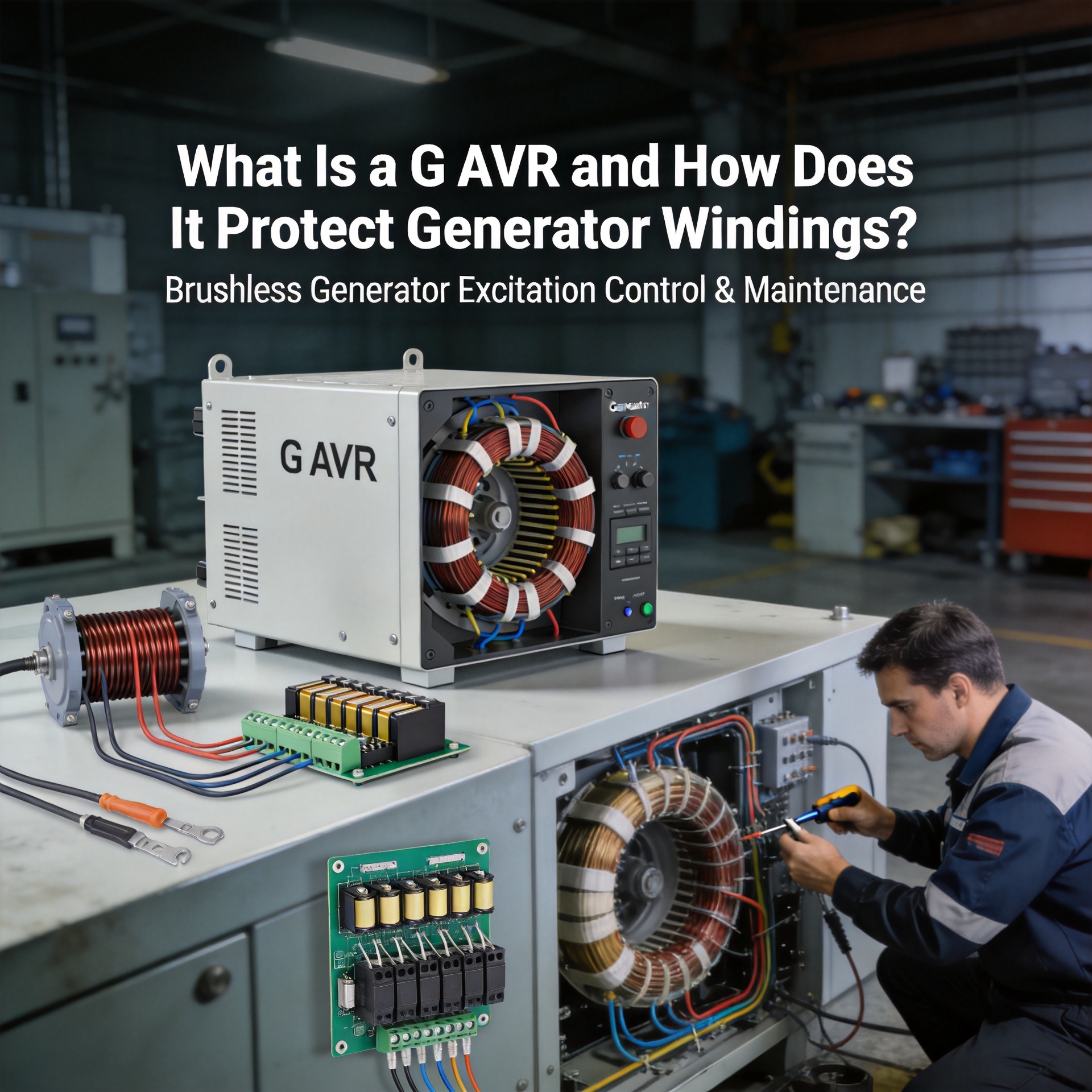
A G AVR is a generator automatic voltage regulator commonly sold in GAVR-style families for brushless alternators. Its job is to sense generator terminal voltage and adjust excitation so voltage stays close to the selected setpoint as load changes. That function matters to winding health, but it has a clear boundary: a regulator can limit harmful excitation conditions only when its own design includes the relevant limits and it is correctly matched. It is not a replacement for every generator protection relay, breaker, or temperature device.
For a maintenance engineer, the practical question is not simply whether a gavr module fits the mounting holes. The safe question is whether its sensing, supply, field-output, frequency behavior, and adjustment range match the alternator and its excitation system.
How a G AVR controls generator voltage
In a brushless generator, the regulator monitors AC voltage from a sensing or supply connection. It compares that measured value with an internal reference. If terminal voltage falls when a load is applied, the G AVR increases DC excitation delivered to the exciter field. A stronger magnetic field supports a higher alternator output voltage. When load is removed and voltage rises, the regulator reduces excitation.
This feedback loop is continuous. The output of a g-avr automatic voltage regulator is therefore not a fixed field current; it is a controlled response to the measured voltage and the regulator settings. Many universal units use adjustable voltage, stability, and under-frequency controls. Some GAVR-family versions also use selectable sensing arrangements, but those details vary by model. Use the diagram and ratings for the exact unit rather than relying on a family name.
Where voltage regulation helps protect windings
Correct regulation reduces several stresses that can contribute to winding problems. By avoiding sustained overvoltage caused by excessive excitation, it helps prevent the alternator from being operated beyond its intended voltage condition. By restoring voltage after ordinary load changes, it also avoids the temptation to keep increasing a manual trim setting until field components run too hot.
The protection is indirect and conditional. A properly selected G AVR can manage excitation within its output capability and may include specific functions such as over-excitation limiting, loss-of-sensing behavior, or under-frequency roll-off. The exact protections, thresholds, and timing are design-specific. Do not assume that a universal generator avr includes all of them just because another GAVR model does.
What a G AVR does not protect by itself
Generator windings can fail from short circuits, insulation contamination, loose connections, overheating, severe unbalance, overspeed, and prolonged overload. A voltage regulator cannot independently detect or clear every one of those conditions. For example, a downstream short circuit normally needs correctly coordinated overcurrent protection. Winding temperature protection requires suitable sensors and a controller or relay that acts on their signal. Overspeed protection belongs in the engine-governor and shutdown system.
This boundary is important during fault finding. Replacing a g avr circuit board may correct unstable voltage, yet it will not cure a damaged rotating diode, an open exciter winding, poor residual magnetism, or a burned stator connection. Treat the AVR as one part of the excitation system, not as a diagnosis for the entire generator.
How to select the right GAVR module
Start with the alternator nameplate, original regulator documentation, and wiring diagram. Compare the following items before ordering or wiring a replacement:
- Sensing and supply voltage: confirm the phase arrangement and nominal voltage the regulator is designed to read.
- Excitation output: verify allowable field voltage and continuous/current limits for the exciter field.
- Frequency and under-frequency behavior: ensure the setting and knee point suit the generator’s 50 Hz or 60 Hz operating speed.
- System topology: identify whether the alternator is self-excited, uses an auxiliary winding, or has a different excitation arrangement.
- Features and terminals: remote voltage trim, droop/parallel inputs, and protection terminals must match the actual application.
“Universal” usually means a module covers several common arrangements, not that it is electrically safe for every generator. A current rating, terminal layout, or dip-switch option that looks similar can still be wrong for a particular alternator.
Installation and adjustment sequence
- Lock out the generator, isolate starting sources, and document the original connections before removing the old regulator.
- Inspect the harness, sensing leads, terminals, exciter field, and rotating components for heat damage or loose connections. Correct those faults first.
- Wire the new G AVR exactly to the confirmed diagram. Keep sensing leads separated from noisy power conductors where the manufacturer requires it.
- Set voltage and stability controls to the documented starting positions; do not begin at maximum adjustment.
- Start at no load, verify frequency is correct, then adjust voltage slowly with a calibrated meter.
- Apply load in controlled steps and observe voltage recovery, stability, and abnormal heating. Stop if hunting, excessive voltage, or field-current concerns appear.
Common troubleshooting clues
If voltage is low, first verify engine speed and sensing supply before turning the voltage trim. If voltage hunts, inspect stability settings, sensing connections, and load behavior. If voltage is high, stop the unit and check sensing wiring, configuration switches, and regulator suitability; do not continue operating solely because the output looks steady. When no build-up occurs, the cause may be residual magnetism, field continuity, an exciter fault, wiring, or the regulator itself.
The most reliable practice is simple: use the exact module documentation, measure before adjusting, and keep generator protection functions coordinated. A G AVR is valuable because it controls excitation precisely. It supports winding life most effectively when that control is correctly specified and supported by the rest of the generator protection system.






