
 EN
What Are the Various Types of AVR for Generators and Their Applications?
When a generator’s voltage drifts as load changes, the cause may not be the alternator itself. Often, the deciding component is the automatic voltage regulator (AVR). For buyers comparing types of AVR for generator systems, the useful question is not simply “which regulator fits every case?” It is which control method and excitation arrangement match the alternator, load profile, and service expectations.
As a technical consultant working with generator control components, I start with compatibility: sensing voltage, input supply, field-current capability, frequency, and connector or terminal arrangement. A replacement that looks similar but does not match these details can produce unstable voltage or fail to control excitation correctly.
What an AVR does in a generator
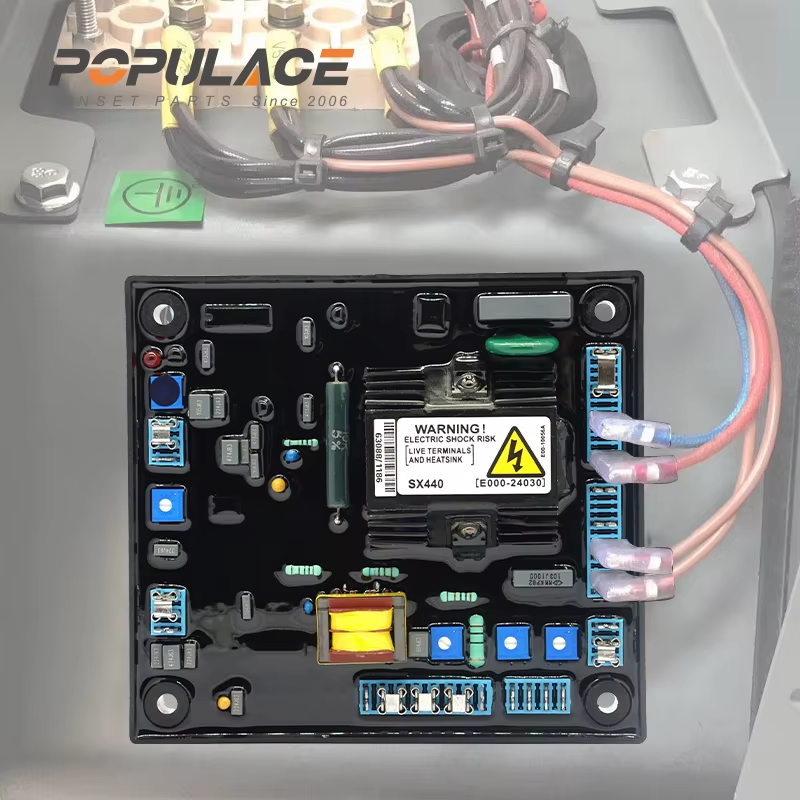
An AVR monitors generator terminal voltage and adjusts excitation to help keep output near the set value. In a brushless alternator, it typically controls power supplied to the exciter stator; the resulting field change is transferred through the rotating excitation system to influence the main rotor. This feedback loop is why AVR selection must be tied to the alternator’s excitation design, not just the engine brand.
Many regulators also provide adjustment points or protection functions, such as voltage trim, stability adjustment, and under-frequency roll-off. Features differ by model, so they should be confirmed in the relevant alternator documentation before a replacement is ordered.
A practical way to classify generator voltage regulator types
The phrase generator voltage regulator types can describe two different things: the regulator’s control technology and the source of excitation it is designed to manage. Looking at both avoids a common purchasing mistake.
1. Electromechanical and servo-controlled AVRs
Older electromechanical regulators use moving contacts, magnetic components, or servo mechanisms to alter excitation. Their main advantage is familiarity in legacy equipment. In modern generator sets, they are less common because moving parts can require more maintenance and response behavior is usually less flexible than electronic control.
Typical application: maintaining or restoring an older generator where the original excitation system is retained and an electronic retrofit is not appropriate.
2. Analog static AVRs
An analog static AVR uses electronic circuits rather than moving contacts. It senses voltage and continuously varies field output using analog control components. For straightforward standby sets with a relatively predictable load, an analog unit can be a practical choice when it is specified for the alternator.
The analog vs digital avr decision should not be reduced to age alone. An analog regulator may be suitable when the required control functions are simple, commissioning is familiar to the maintenance team, and the alternator manufacturer supports that regulator family.
3. Digital AVRs
Digital AVRs use a microprocessor to interpret sensing inputs and apply a programmed control response. Depending on the model, they may offer more configuration options, diagnostics, parallel-operation support, and protective settings. They are often considered for applications with variable loads, tighter voltage-management needs, or a need to document settings during commissioning.
Typical application: prime-power generator sets, installations with motors or changing loads, and systems where technicians need repeatable setup parameters. Digital capability is not a substitute for correct sizing; verify sensing, supply, and field-current limits first.
4. Thyristor-controlled AVRs
A thyristor type avr uses controlled semiconductor switching to regulate excitation. Thyristor control is commonly associated with static excitation systems that need substantial or responsive field control. The right choice depends on the alternator and excitation architecture, not on the expectation that thyristor control automatically improves every small genset.
Typical application: larger or more demanding synchronous-generator excitation systems where the specified regulator and exciter require controlled high-response field supply. Confirm the regulator’s input source and output ratings against the manufacturer’s design.
5. Shunt-excited AVRs
A shunt, or self-excited, AVR takes its supply from the generator’s main output. This arrangement is widely used because it is relatively simple. Its behavior during heavy starting loads depends on the alternator design and available residual voltage, so it is important to assess motor starting and short-duration overload requirements rather than treating all shunt systems alike.
Typical application: general standby power where loads are mostly resistive or where starting demand is within the alternator’s designed capability.
6. PMG-supported AVRs
A permanent-magnet-generator (PMG) excitation supply gives the AVR an independent source of power from a small permanent-magnet generator. The control electronics can remain energized when main terminal voltage is depressed by a demanding transient. This can be valuable for alternators that must support larger motor starts, though the complete alternator package must be designed for PMG operation.
Typical application: generator sets with cyclical motor loads, pumps, compressors, or other loads that create pronounced voltage dips during starting.
7. Brushless generator AVR arrangements
A brushless generator avr is not necessarily a separate control technology. The term usually describes an AVR used with a brushless alternator, rotating exciter, and rotating rectifier assembly. It may be analog, digital, or thyristor-controlled depending on the alternator design. This distinction matters: “brushless” tells you about the excitation path, while “digital” or “analog” tells you about the controller.
Analog vs. digital AVR: how to choose
| Decision point | Analog AVR | Digital AVR |
|---|---|---|
| Setup | Often uses direct trim controls | May provide broader configurable settings |
| Best fit | Specified legacy or straightforward installations | Variable-load or feature-sensitive installations |
| Service approach | Technician familiarity with the supported model | Technician access to the required setup procedure and parameters |
| Non-negotiable check | Match sensing, supply, field output, frequency, and alternator compatibility | |
The table is a starting point, not a universal ranking. A correctly matched analog AVR is preferable to an incompatible digital replacement. Conversely, a supported digital model can be the better fit when the alternator and application need its available functions.
Selection checklist before ordering an AVR
- Identify the alternator make and exact model, not only the generator-set brand.
- Confirm whether excitation is shunt, PMG-supported, or another specified arrangement.
- Check sensing voltage, frequency, phase requirements, and the AVR supply source.
- Compare field-voltage and field-current ratings with the exciter requirements.
- Review terminals, connectors, remote-voltage-trim needs, and protection settings.
- Consider the real load: lighting, electronics, pumps, compressors, welders, or parallel generators impose different demands.
Final takeaway
The main types of AVR for generator applications include legacy electromechanical units, analog static regulators, digital regulators, and thyristor-controlled systems. They may work with shunt, PMG, or brushless excitation arrangements. Start with the alternator’s specified excitation system, then match the regulator’s electrical ratings and application needs. That method is more reliable than choosing by appearance or by a generic part description.






