
 EN
Sourcing ESD5500E Speed Control Units at Competitive Rates for Fleet Maintenance
When evaluating the esd5500e speed control unit price across sourcing channels, fleet maintenance procurement teams quickly discover that quoted prices vary far more than expected. From a procurement standpoint, sourcing ESD5500E speed control units at scale means balancing unit price, minimum order quantities, lead time, and supplier reliability, not just the esd5500e price that appears in a product listing. That variation is not random. It reflects real differences in source authenticity, volume tier, and the hidden costs that surface after the shipment arrives.
Are you sourcing these units as direct replacements for failed components, or building an inventory buffer across multiple generator models? That distinction changes which specification and which pricing structure deserves the most attention when comparing the esd5500e speed control unit price across potential suppliers.
What the ESD5500E Actually Controls — and Why It Matters for Fleet Buyers
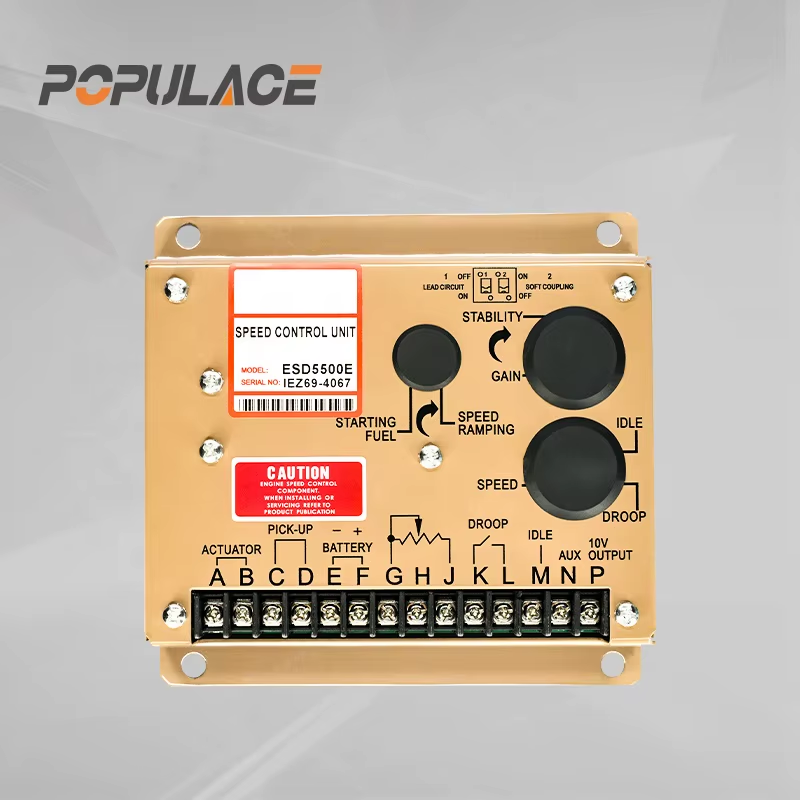
The ESD5500E is an all-electronic speed control unit designed to regulate engine RPM under variable load conditions. Manufactured originally by Governors America Corp. (GAC), the unit supports isochronous, droop, and variable speed operation, with a documented steady-state stability of plus or minus 0.25% or better. It operates across a frequency range of 1,000 to 7,500 Hz and accepts a supply voltage of 12 or 24 Vdc — making it compatible with a wide range of diesel genset configurations, including common Cummins engine variants.
For fleet maintenance programs, this compatibility breadth is an advantage. A single part number can cover multiple units in a standardized fleet, which simplifies inventory planning and reduces the number of SKUs a maintenance team needs to manage. The governor controls engine speed and frequency stability; its failure manifests as visible operational problems — engine hunting, frequency instability, or load shedding — that operators cannot ignore. That urgency explains why the esd5500e speed control unit price query draws such a range of buyer intent.
Five Criteria for Evaluating Competitive ESD5500E Pricing
1. Source Channel and Authenticity
The single largest driver of esd5500e price variation is source channel. Listings from authorized distributors carrying GAC original units reflect a different cost structure than aftermarket-compatible alternatives sourced through B2B platforms. Neither is automatically the right choice, and the decision requires an honest assessment of application criticality. If the generator operates in a standby or prime power role for sensitive loads, the documentation trail and performance consistency of a verified supplier matters more than the unit esd5500e speed control unit price alone.
The assumption that aftermarket necessarily means lower quality often shifts once buyers examine production certifications and compatibility documentation from manufacturers who specialize in this segment. The question to ask before ordering is not "is this cheaper?" but "can the supplier confirm the sensing voltage range and actuator interface match my engine model?"
2. Volume Tier and Minimum Order Quantities
Fleet maintenance programs typically have a purchasing advantage that individual replacement orders do not: volume. Most suppliers price ESD5500E units differently across order tiers, and the breakpoints vary significantly by channel. For buyers sourcing these units in quantities that cover multiple generator assets or build a forward inventory buffer, the real speed control unit cost per unit drops materially at higher volumes — but only if the MOQ structure is negotiated upfront rather than discovered after the quotation is issued.
Once you manage a parts inventory long enough, you stop asking "which supplier has the lowest esd5500e speed control unit price?" and start asking "which supplier can reliably ship within a predictable window and provide consistent batch quality across repeat orders?" That shift in mindset usually comes after one missed maintenance deadline caused by a delivery delay that the quoted unit price did not account for.
3. Compatibility Verification for Mixed-Fleet Applications
If your fleet includes multiple diesel engine variants — different Cummins models, production years, or panel configurations — compatibility verification before purchase is not optional. The ESD5500E is widely listed as Cummins-compatible, but "compatible" can mean different things depending on the engine model serial range and the actuator interface type. A sourcing process that moves quickly to governor esd5500e price discussion without first confirming the engine model and interface specifications is a process that occasionally produces an unusable batch.
If your application runs at a stable load profile with consistent engine variants, the standard ESD5500E specification will usually hold. If the fleet includes units with different control panel configurations or droop settings, you would want to confirm interface type with the supplier before committing to volume.
4. Lead Time Reliability vs. Unit Price
The first order from a new generator parts supplier often ships faster than subsequent ones, because the initial order receives priority handling. Placing a second test order within a reasonable window before committing to full-scale inventory reliance gives a more accurate picture of ongoing supply performance than the first shipment alone.
For fleet maintenance programs where generator downtime has operational consequences, lead time reliability and batch consistency matter as much as the esd5500e speed control unit price. Suppliers who provide specific shipping windows and track record data — rather than only quoted lead times — give fleet buyers the information needed to plan maintenance schedules accurately.
5. Total Landed Cost, Not Unit Price
The choice between OEM and aftermarket speed control units is not a quality question — it is a budget and lead-time question. If the generator is under warranty or the application is safety-critical, OEM sourcing makes more sense. If the unit is out of warranty and the application allows a qualified alternative from a verified manufacturer, aftermarket sourcing is worth serious consideration — particularly when the total landed cost is evaluated rather than the listed governor esd5500e price alone.
For buyers sourcing ESD5500E units in volume, the real speed control unit cost driver is not the unit price but the combination of inbound inspection time, compatibility mismatch resolution, and the carrying cost of inventory that cannot be used until a supplier issue is resolved. Buyers who have dealt with a compatibility-related return tend to reassess supplier documentation and pre-shipment compatibility confirmation as a primary evaluation criterion — not an afterthought.
Where to Source Competitively Without Accepting Unnecessary Risk
For wholesale buyers and fleet maintenance programs evaluating esd5500e for sale listings across channels, the most productive sourcing path combines price transparency with supplier qualification. That means requesting a specification-confirmed quotation, one that confirms the engine model compatibility, supply voltage option, and interface type before the purchase order is issued — rather than ordering from a catalog listing based on esd5500e price alone.
Suppliers who include technical compatibility confirmation as a standard part of the quotation process reduce post-order friction significantly. That service is worth factoring into the total cost comparison, particularly for fleet buyers who cannot absorb the operational delay of a compatibility mismatch across multiple generator units.
B2B generator parts suppliers with direct factory supply and export experience — particularly those serving wholesale buyers and fleet maintenance programs across Asia, Europe, and North America — typically offer esd5500e speed control unit price structures designed for repeat volume rather than single-unit retail. Asking explicitly for a volume quotation with tiered pricing, lead time commitment, and batch quality documentation gives fleet procurement teams the information needed to make a defensible sourcing decision.
A Practical Checklist Before Confirming Your ESD5500E Order
- Confirm the diesel engine model serial range and actuator interface type with the supplier before placing the order.
- Request a specification sheet confirming steady-state stability, frequency range, and supply voltage compatibility with your fleet configuration.
- Ask for volume pricing tiers and MOQ terms — especially if you are ordering for inventory rather than immediate replacement.
- Verify the supplier lead time with a test order before committing to a full inventory replenishment cycle.
- Request batch documentation or quality confirmation for repeat orders, particularly if the governor is going into a standby power application.
- Calculate total landed cost including packaging, freight, and incoming inspection time — not just the esd5500e speed control unit price on the quotation.
Getting the esd5500e speed control unit price right for fleet maintenance is a process, not a single price comparison. Suppliers who can deliver consistent specification confirmation, transparent volume pricing, and reliable lead times are the ones worth building a procurement relationship with — regardless of whether the unit price is the absolute lowest option available.






