
 EN
Sourcing All Parts of Generator for a Complete Genset Assembly Line.
Buying parts of generator for an assembly line is different from buying a replacement AVR or a single service kit. You are building a system whose engine, alternator, controls, fuel path, wiring, structure, and test process must work together. A purchase order can look complete while still missing the connector, sensing lead, mounting bracket, or drawing revision that stops final assembly.
As a genset system integrator, start with compatibility rather than price. That does not mean the most expensive option is automatically the right one. It means every item should trace back to a defined genset configuration, operating duty, and interface document. This approach turns a loose generator spare parts list into a controlled bill of materials (BOM) that your purchasing, warehouse, and quality teams can use.
Build the BOM by system, not by supplier catalog
Most basic lists of generator components name the engine, alternator, fuel system, voltage regulator, cooling system, and exhaust. That is a useful starting point, but an assembly line needs a deeper sourcing map. Divide the BOM into the following system packages and assign a part number, revision, approved supplier, and acceptance record to each line.
- Prime mover package: engine, starter, charging alternator, filters, mounts, hoses, belts, exhaust manifold interfaces, and engine-side sensors. For engine parts for generator, confirm the exact engine model, serial range where relevant, speed rating, mounting arrangement, and sensor connector type.
- Power-end package: alternator, rotor and stator-related service items, bearing arrangement, terminal box, coupling components, and excitation connections. The alternator frame, voltage class, frequency, phase arrangement, and coupling interface must align with the intended engine and control scheme.
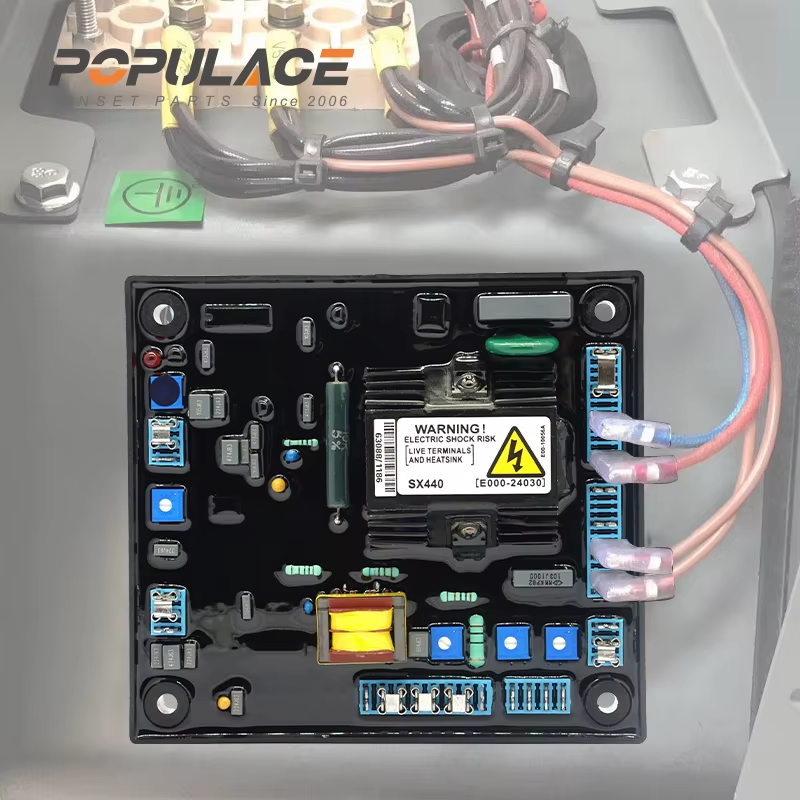
- Control and regulation package: controller, AVR, speed governor or actuator where applicable, sensors, meters, emergency-stop circuit, battery charger, relays, breakers, and communication accessories. These alternator parts and controls should be checked as an interface set, not as independent catalog selections.
- Fuel, cooling, and exhaust package: tank or base-tank interfaces, fuel lines, valves, filters, radiator, fan guard, coolant hoses, silencer, flex section, and clamps.
- Structure and enclosure package: base frame, anti-vibration mounts, coupling guard, canopy panels, doors, locks, sound-attenuation materials, lifting points, fasteners, and weather seals.
- Electrical integration package: wiring harness, terminal lugs, glands, connectors, cable markers, grounding hardware, control-panel backplate, and schematic labels.
The practical shift is simple: a component category is not a purchase specification. For example, “AVR” is not enough. The BOM should identify sensing method, excitation arrangement, terminal layout, connector or lead style, environmental expectation, and the drawing or manual used to verify the match.
Set a compatibility file before issuing RFQs
Send suppliers a controlled compatibility file with the RFQ. At minimum, include the genset rating and duty, engine model and speed, alternator model and electrical configuration, controller model, wiring schematic revision, GA drawing, mounting dimensions, and required connector or terminal details. Add the required quantities for pilot build, production, service stock, and quality samples.
Documentation is a value signal. A supplier that can identify what is still unknown before quoting is usually easier to work with than one that simply confirms everything. Ask for a datasheet, outline drawing, wiring diagram, cross-reference basis where an alternative is proposed, packing specification, and revision control statement. If the project needs safety-document review, ISO 8528-13:2016 is one reference point for reciprocating internal-combustion-engine-driven generating sets up to 1,000 V; it is not a substitute for validating your specific design.
Qualify suppliers with a component-specific scorecard
Use one scorecard, but weight it differently for mechanical, electrical, and control items. Price and lead time matter, of course. The more useful question is whether the supplier can repeatedly deliver the approved configuration with supporting records.
| Qualification area | What to request | Why it matters |
|---|---|---|
| Identification | Part number, revision, photos, label format, and traceability method | Prevents mixed variants reaching assembly. |
| Fit and interface | Drawing, connector layout, mounting data, and wiring reference | Confirms physical and electrical compatibility before receipt. |
| Process control | Incoming-material, in-process, and final-inspection approach | Helps assess batch consistency rather than a one-off sample. |
| Commercial control | MOQ, lead time, packaging, change-notice process, and warranty terms | Supports planning and protects service continuity. |
For control components, a sample should be reviewed against the intended schematic and bench-test plan. For structural parts, verify dimensions, finish, weld areas, and fit-up points. For engines and alternators, the acceptance plan should define the documents and checks appropriate to the configuration rather than assuming brand names establish compatibility.
Use incoming inspection to protect the assembly schedule
Incoming inspection should mirror the BOM risk. A low-value cable gland can still hold up a canopy build if its thread or sealing range is wrong. Start each receipt with PO-to-label matching, quantity, packaging condition, and visible damage checks. Then apply item-specific checks: dimensional verification for frames and panels; connector and terminal comparison for harnesses; drawing and label checks for controllers and AVRs; and document review for engines and alternators.
Packaging deserves attention too. Long-distance transport can damage terminals, panels, or electronic units even when the outer carton looks acceptable. Record photos, lot numbers, and nonconformities at receipt. When an item fails, quarantine it by lot and notify the supplier with the approved drawing or inspection criterion—not a vague statement that it “does not fit.”
Plan inventory around production and service demand
A complete generator spare parts list should separate production consumption from after-sales demand. High-run items such as harness consumables, fasteners, filters, and common relays may need reorder points. Slow-moving but assembly-critical items—an unusual controller variant, a specific canopy door latch, or a matching AVR—may justify a protected buffer after you weigh cash flow against downtime.
Once you manage inventory for a while, the question changes from “Which vendor has the lowest quoted price?” to “Which sourcing plan keeps the approved configuration available?” Consolidated purchasing can reduce freight coordination and paperwork, but do not consolidate merely because a supplier offers many categories. Keep the approval status visible at item level. One supplier may be approved for controls and another for structural fabrication; the BOM must preserve that distinction.
Run a pre-production readiness review
Before the line starts, hold a short cross-functional review with engineering, procurement, quality, warehouse, and assembly. Confirm that every BOM line has an approved source, current document revision, incoming-inspection method, storage location, and escalation owner. Review open substitutions separately. A substitute can be reasonable, but only after its interfaces, documents, and trial result are recorded.
The result is a sourcing system, not simply a collection of parts of generator. By organizing the BOM by system, validating interfaces before RFQ, inspecting by risk, and balancing consolidated orders with approved-source control, a genset assembler can reduce late-stage surprises and build a more repeatable supply line.
Use a release checklist for every approved part family
For every recurring order of parts of generator, attach the approved drawing, label example, inspection points, and change-control contact to the PO. This makes parts of generator sourcing repeatable when buyers or factories change. Keep the same evidence with the generator spare parts list so a service order does not accidentally introduce an unapproved variant.
Review generator components as connected groups. The engine package and engine parts for generator must match the mechanical speed, sensor set, and mounting arrangement. The power-end package and alternator parts must match the electrical configuration and excitation arrangement. Then confirm that the controller, AVR, and harness connect to both groups as documented.
Questions to close before a consolidated order
- Which parts of generator are production items, and which are service stock?
- Does the generator spare parts list identify the current revision and traceable supplier for every line?
- Have the selected generator components been checked against the latest wiring schematic and GA drawing?
- Do alternator parts include the correct terminals, sensing leads, coupling items, and protection accessories for this build?
- Are engine parts for generator verified by model, configuration, and interface—not by a general engine brand reference?
Use this release checklist on the first order and on any substitution. It is a small administrative step, but it prevents parts of generator from becoming a pile of individually acceptable items that cannot be assembled into one approved genset. If conditions change, update the generator spare parts list, re-check the affected generator components, and record the result before shipment.






