
 EN

How to Explain the Function of a Voltage Regulator on a Generator to Customers?
When customers reach out about their generator setup, one of the most common sources of confusion is the voltage regulator. They know it matters — usually because a technician told them so — but they often do not know what it actually does or why replacing it affects performance. As a sales representative or technical support specialist, being able to explain the generator voltage regulator function clearly can be the difference between a confident purchase decision and a stalled conversation.
This guide walks through how to present the role of a voltage regulator on a generator in a way that connects with customers at different levels of technical knowledge, and how to handle the questions that come up most often.
Start with the Simplest Explanation
Before getting into circuit diagrams or excitation theory, it helps to have a one-sentence answer ready. A voltage regulator on a generator keeps the electrical output at a consistent, stable level regardless of how much load is connected. That is the job — nothing more, nothing less.
One analogy that tends to land well with most customers: think of the automatic voltage regulator as a dimmer switch for the generator's magnetic field. When the generator needs to produce more voltage — say, when a large load is switched on — the AVR strengthens the magnetic field inside the alternator. When the demand drops, it pulls back. The result is a steady output voltage, even as conditions change.
For customers who are not especially technical, that explanation is usually enough to move the conversation forward. They understand intuitively that fluctuating power is bad for equipment, and once they see the AVR as the component responsible for preventing that, the value proposition becomes clear.
How Automatic Voltage Regulator Working Actually Looks in Practice
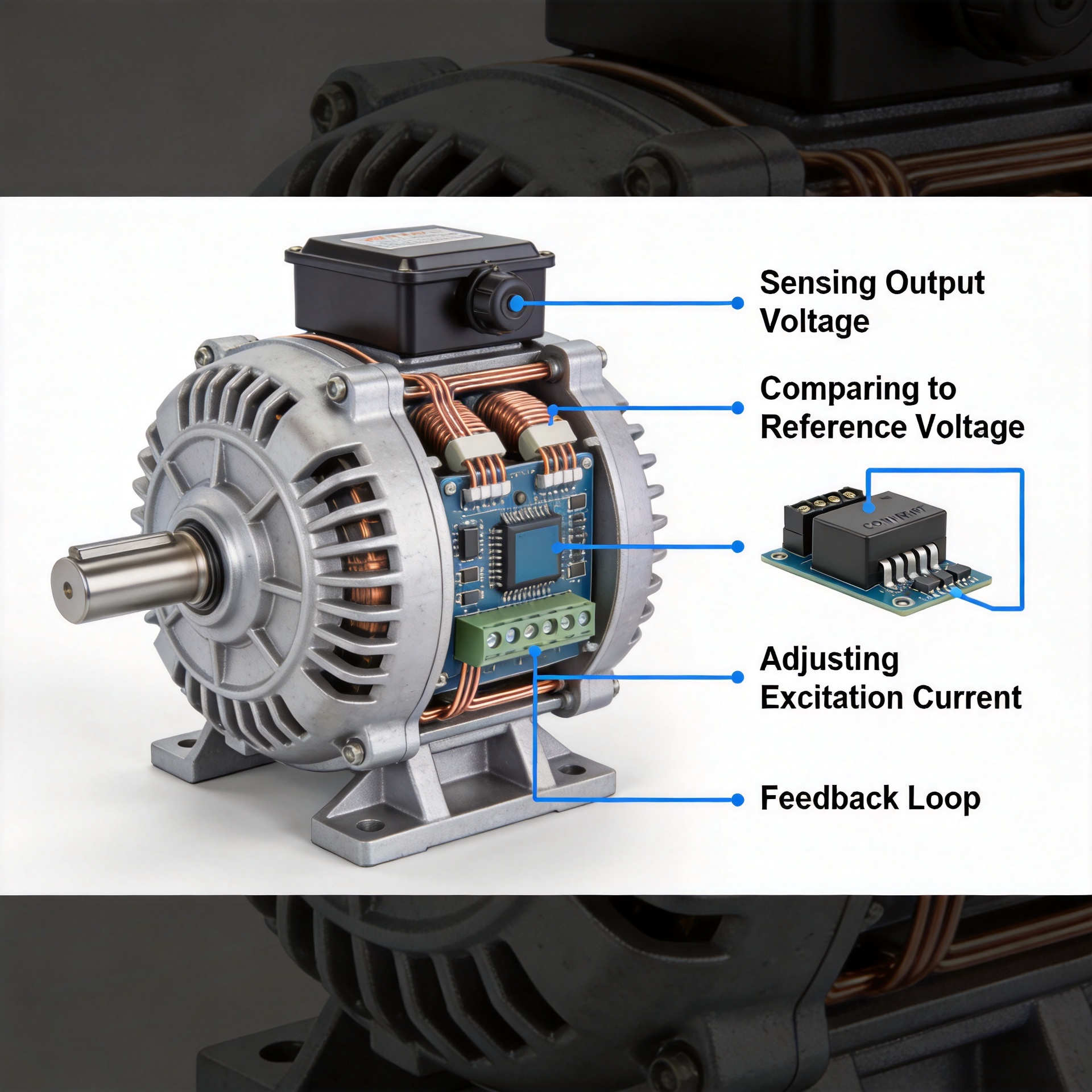
For customers who want more detail — distributors, maintenance managers, or buyers sourcing parts for critical applications — explaining the mechanism a bit more precisely tends to build confidence. The automatic voltage regulator working cycle follows three basic steps:
- Sensing: The AVR continuously monitors the generator's AC output voltage. It compares this real-time reading against an internal reference target — typically the nominal output voltage the system is designed to deliver.
- Comparing: If the measured voltage is lower than the target (which happens under heavy load), the AVR detects the difference.
- Correcting: The AVR adjusts the DC excitation current flowing to the rotor winding inside the alternator. More excitation current means a stronger magnetic field, which in turn increases the output voltage. Less current reduces it.
This feedback loop runs continuously and automatically. Standard industrial AVRs can typically maintain output voltage within ±1% to ±2.5% of the nominal value under steady operating conditions. That level of precision matters when customers are protecting sensitive electronics, industrial controls, or medical equipment connected to a standby generator.
Why Voltage Control in Generators Actually Matters to the Customer
Here is where the conversation often gets more practical. Customers do not necessarily ask "what does the AVR do" — they often ask "why should I care about it specifically?" That framing shift helps you meet them where they are.
The clearest angle is equipment protection. Without stable voltage control in generators, connected equipment is exposed to voltage spikes, sags, and fluctuations. Sensitive electronics can be damaged. Motor loads may overheat or trip protection circuits. Lighting systems can flicker. For any commercial or industrial customer running critical loads off a generator, that is a real and costly risk.
A second angle is generator longevity. An AVR that is functioning correctly also prevents the alternator from being overexcited or underexcited, which reduces thermal stress on the windings. When customers ask whether the AVR is "really that important," it bears mentioning that a failed AVR is one of the most common causes of generator voltage instability — and that replacing it proactively is significantly less expensive than repairing alternator winding damage after the fact.
Generator AVR Operation: Answering the Questions Customers Actually Ask
Once a customer understands the basic function, a few follow-up questions tend to surface. Here is how to handle the most common ones:
Does every generator have a voltage regulator?
Most modern brushless generators include an AVR as a standard component. The AVR controls the DC exciter field power that drives the brushless alternator's self-excitation system. Some older or simpler designs use capacitor excitation instead, but for any commercial-grade standby or prime power genset, an AVR is almost certainly present. If a customer is unsure whether their unit has one, the answer is yes in the vast majority of cases for any generator sold through commercial channels in the last twenty years.
Can the generator still run without a working AVR?
Technically yes, but not in any useful way. Without a functioning AVR, the generator may still produce voltage, but that voltage will be unregulated. It will rise and fall based on load changes, engine speed fluctuations, and ambient conditions. Equipment connected to an unregulated output is at risk of damage. Most customers, once they hear this, understand that "running without an AVR" is not a real operating scenario for anything they actually care about protecting.
How do we know when an AVR needs replacing?
The clearest symptom is voltage that cannot be stabilized — output voltage that runs high and stays high, runs low under load, or fluctuates visibly. In some cases, the generator may shut down on over-voltage or under-voltage protection. A voltage rating mismatch can also appear when an incorrect replacement AVR is installed: the generator may run, but the output may not settle at the correct nominal level. That is a good moment to bring up the importance of confirming the AVR's sensing voltage range and output rating against the alternator's specification before making a purchase.
What is the difference between a quality AVR and a standard one?
This is where you can introduce supplier quality signals without over-claiming. A quality AVR holds voltage within a tighter tolerance under load change, handles thermal stress better in high-ambient environments, and behaves predictably on startup. Voltage regulation accuracy within ±1% to ±2.5% is a meaningful benchmark to share with technically-minded customers. Beyond that, availability of technical documentation, compatibility confirmation, and post-sale support are the differentiators that experienced buyers learn to ask about.
Key Points to Reinforce When Closing the Conversation
After walking a customer through the AVR explanation, a few reinforcement points help consolidate the conversation:
- Compatibility matters more than price alone. An AVR that is technically correct for the alternator model — matching sensing voltage range, output current, and excitation type — will outperform a mismatched unit at any price point.
- Availability of documentation is a supplier quality signal. A reliable supplier should be able to confirm the AVR's compatibility with the customer's specific alternator before the order is placed.
- Pre-sales technical support reduces post-installation risk. Customers who confirm the AVR specification with the supplier before shipment encounter far fewer installation issues than those who order based on model name alone.
For customers evaluating AVR options for wholesale purchase or parts stocking, framing these points as part of a standard sourcing checklist helps position them as practical steps rather than abstract advice. The core message is that the voltage regulator on a generator is not a commodity purchase — it is a specification-critical component where the right match matters as much as the part itself.
If your customer has a specific alternator model or generator configuration they are sourcing for, reaching out for a compatibility confirmation before ordering is typically worth the extra step. It prevents the most common post-delivery problems and gives both sides a cleaner transaction.






