Detailed Product Description
An automatic transfer switch sits at the decision point of every backup power system. When the utility fails, the ATS smart controller must recognize the event, signal the diesel generator to start, verify that generator output has stabilized, and then transfer the load—all within a timeframe that critical equipment can tolerate. The 100A/160A 4 pole ATS controller described here is built around that sequence, with a microprocessor core that continuously samples both source voltages and makes switching decisions based on user-configurable thresholds.
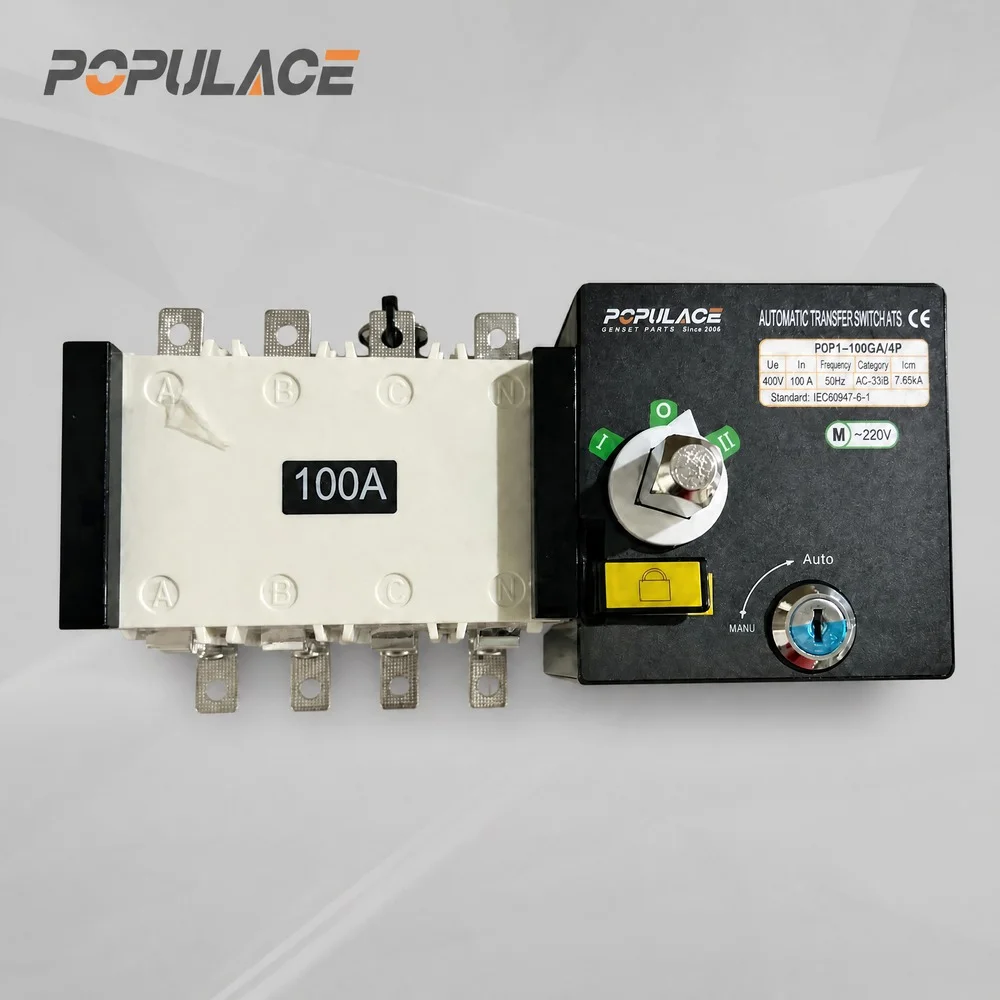
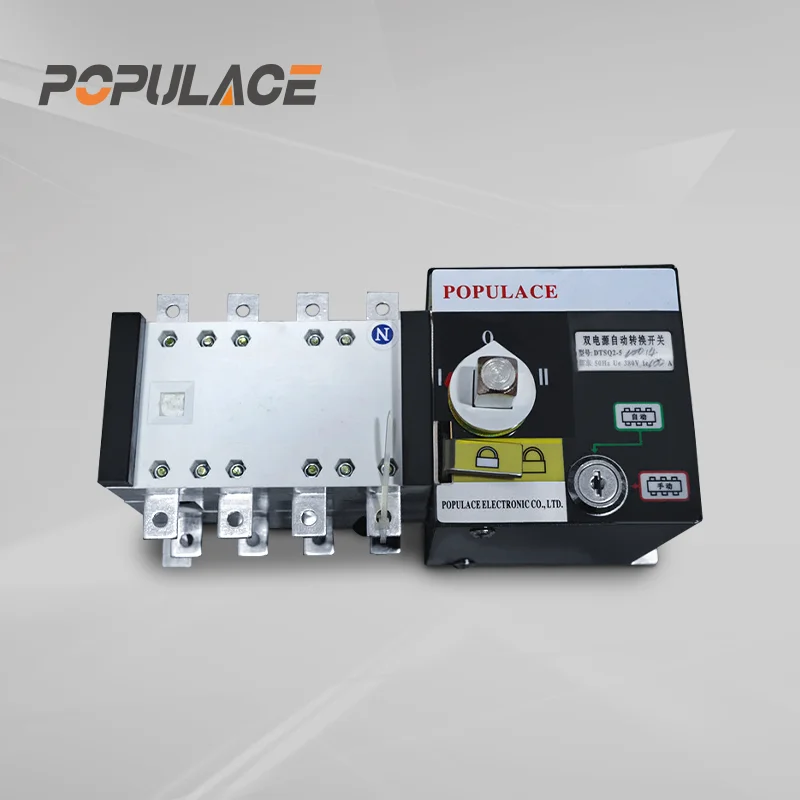
The 4-pole architecture is a deliberate design choice, not an upsell. In installations where the diesel generator is configured as a separately derived system—meaning the generator neutral is bonded to ground at the generator frame—a 4-pole ATS is required to switch the neutral along with the three phase conductors. This breaks the neutral path between the utility and generator sources, avoiding parallel neutral-to-ground paths that can cause circulating currents and interfere with ground fault protection coordination . For panel builders and specifying engineers, this distinction determines whether a 3-pole or 4-pole device is appropriate; the 4-pole configuration here addresses the SDS topology directly.
The controller’s voltage sensing covers three-phase inputs on both sources. When the mains voltage drops below the adjustable under-voltage setpoint or rises above the over-voltage threshold, the controller initiates a transfer sequence. The same logic applies to phase loss conditions: if any phase on the utility side is lost, the controller recognizes the fault and proceeds with the transfer protocol . Phase sequence detection is also incorporated, comparing the rotation of both sources and inhibiting transfer if the sequences do not match—a safeguard against connecting the generator to loads with reversed phase rotation .
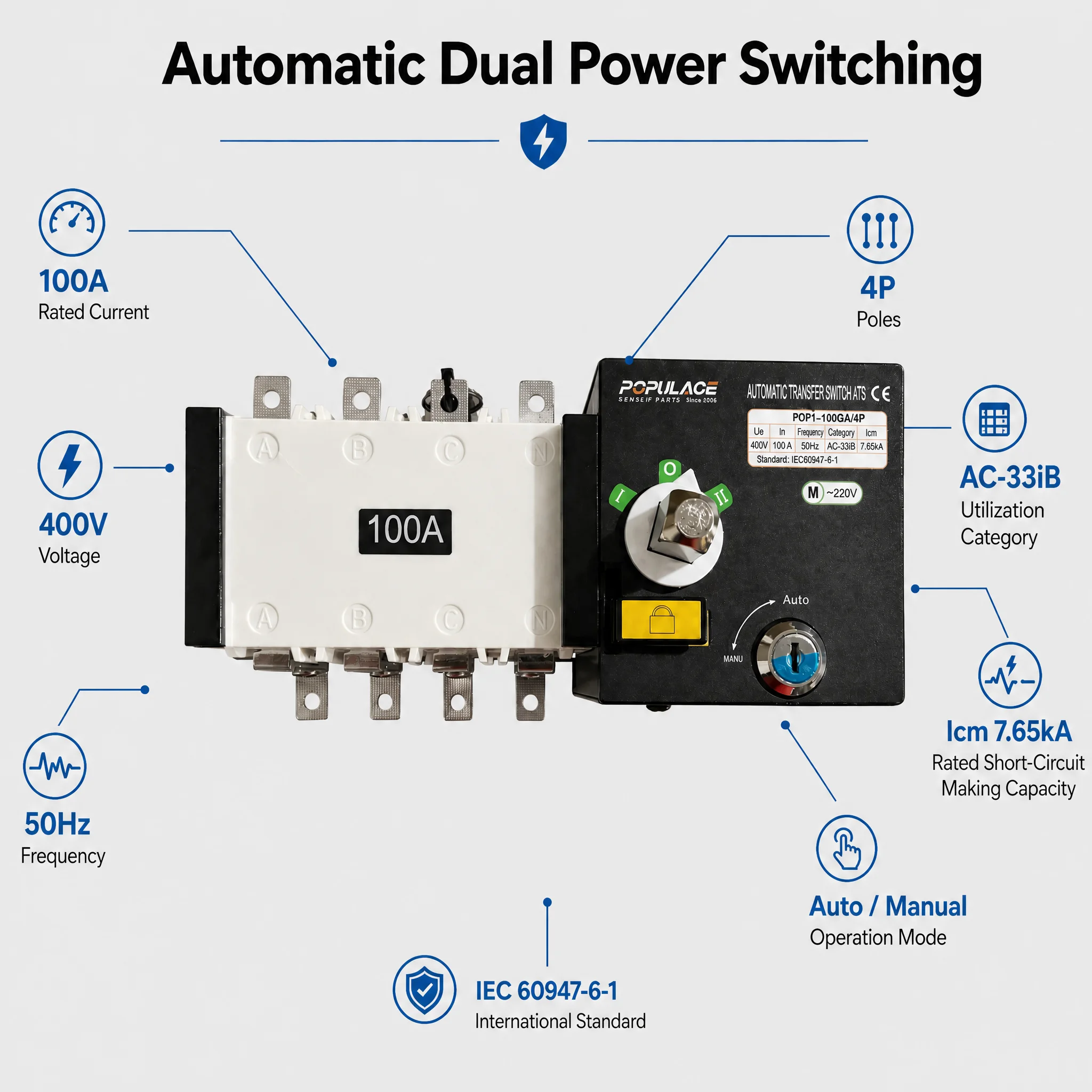
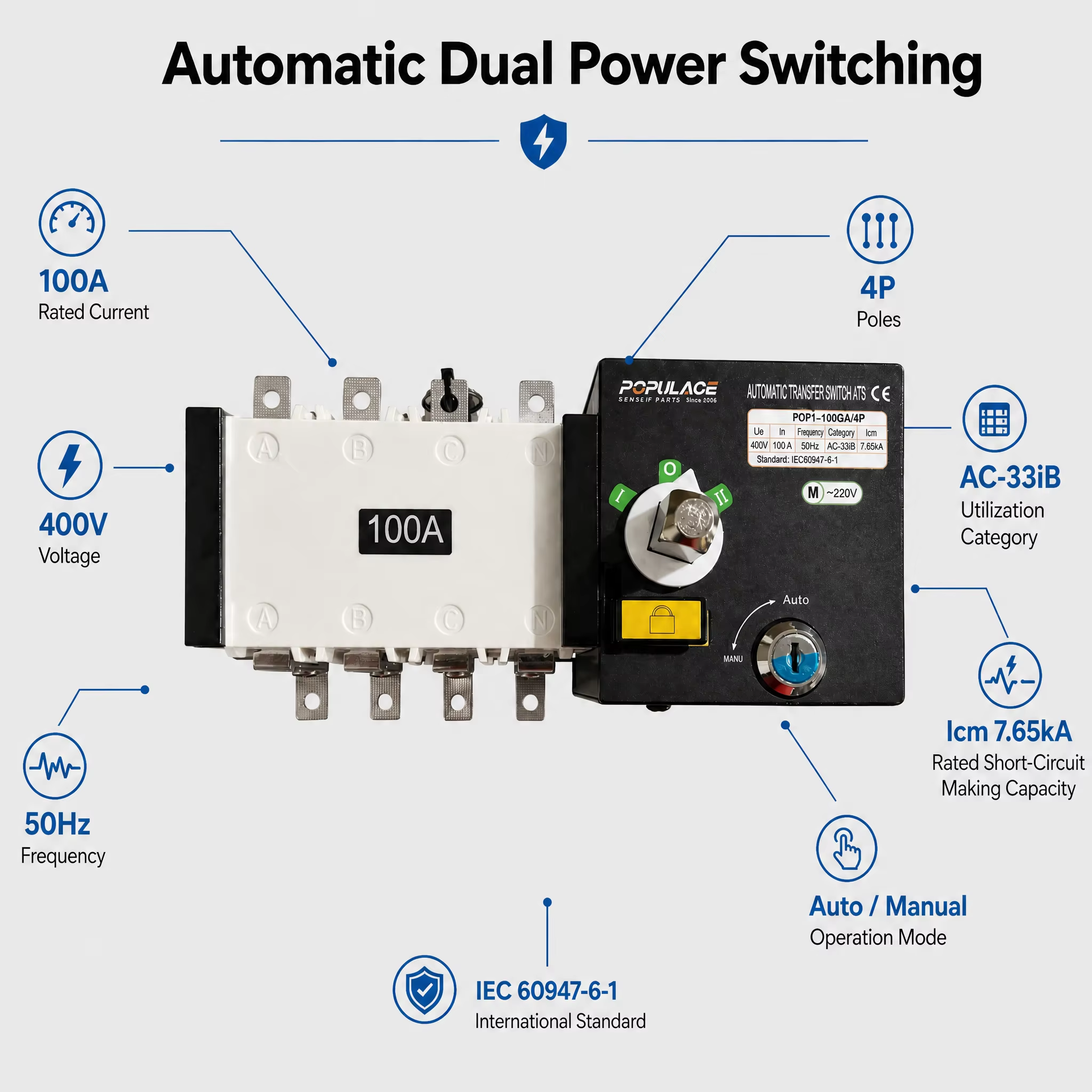
For 220VAC systems operating at 50Hz or 60Hz, the controller’s sensing circuits are calibrated to the corresponding frequency, with the 50/60Hz selection available at configuration. The 100A and 160A current ratings cover a practical range of diesel generator sizes, from small standby units serving telecom shelters or small commercial facilities to mid-range gensets supporting industrial equipment or agricultural operations. The device is designed for panel mounting, with front-accessible terminals and a controller interface that presents source status, switch position, and fault indications to the operator.
Technical Specifications
| Brand Name |
POPULACE |
| Model Number |
100A |
| Type |
Dual power ATS |
| Pole |
4 Pole |
| Warranty |
13 months |
| Feature |
Stable and reliable quality |
Technical Advantages
Phase Sequence Verification Before Transfer. The controller does not transfer blindly. It compares the phase rotation of the utility and generator sources before closing the generator-side contacts. If the sequences do not match, the transfer is inhibited—a decision that protects three-phase motors, compressors, and other rotation-sensitive loads from the consequences of reverse phase sequence . This is a level of protection that simple voltage-sensing ATS units do not provide.
Neutral Switching for Ground Fault Integrity. The 4-pole design addresses a failure mode that 3-pole switches cannot: parallel neutral paths in separately derived systems. When the generator neutral is bonded to ground independently, a 3-pole ATS leaves the neutral connected between sources, creating a parallel return path for neutral current and potentially desensitizing ground fault sensing . The 4-pole configuration breaks that path during transfer, maintaining the integrity of the grounding scheme.
Configurable Thresholds for Local Conditions. Utility voltage quality varies by region and installation point. The controller’s adjustable under-voltage and over-voltage setpoints allow commissioning technicians to match the ATS response to actual site conditions, rather than accepting a fixed factory threshold that may cause nuisance transfers or delayed response .
Separation of Control and Power Circuits. The controller operates on a low-voltage control circuit, isolated from the main power path. This separation supports safe troubleshooting and maintenance—technicians can diagnose sensing and logic functions without exposure to the phase conductors .
Compatibility with Standard Generator Start Circuits. The controller provides a dry contact start signal compatible with the two-wire start inputs common on diesel generator controllers. This interoperability reduces installation complexity when pairing the ATS with gensets from different manufacturers.
Applications
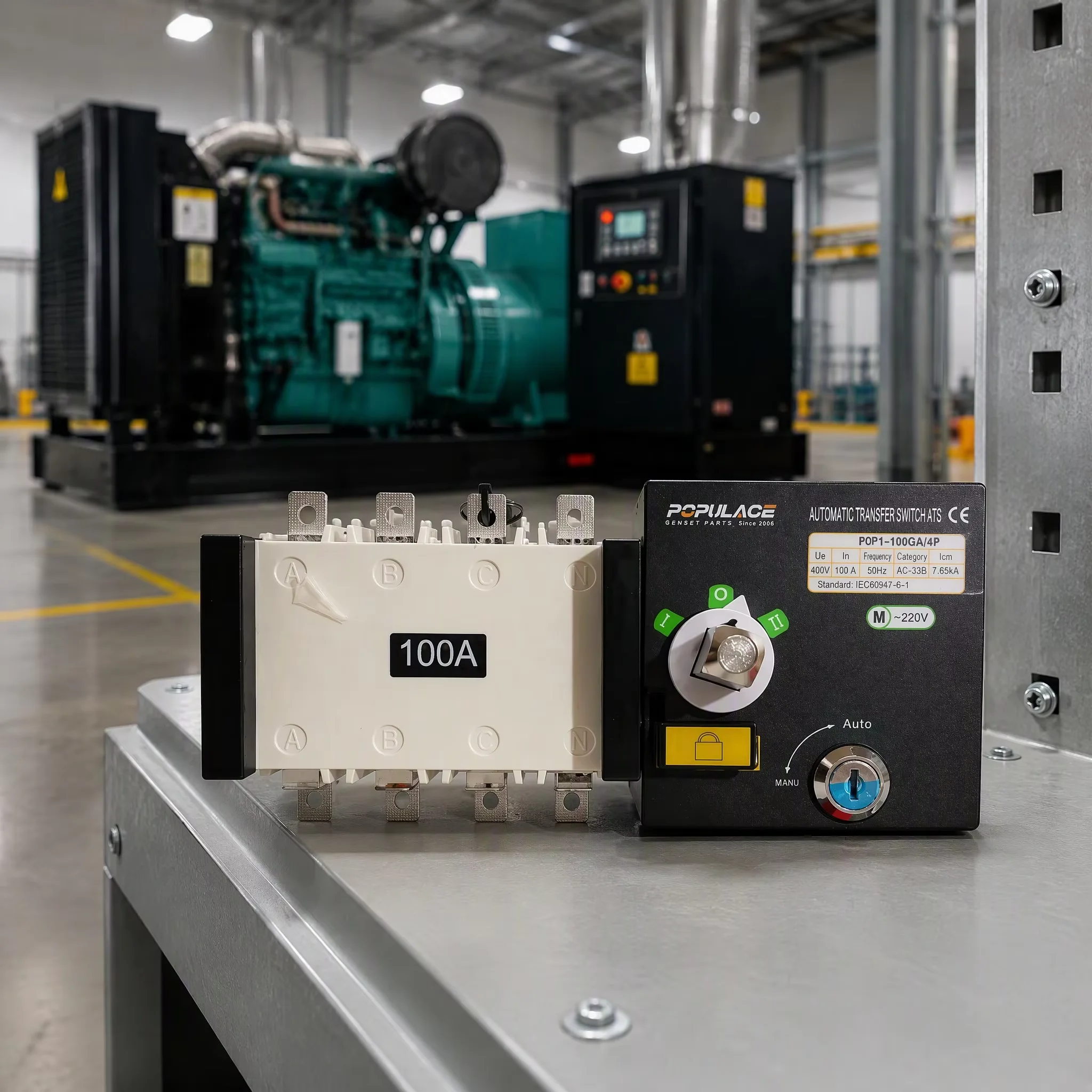
Standby Diesel Generator Systems. Commercial buildings, telecom sites, and light industrial facilities rely on ATS-mediated transfer to maintain power during utility outages. The 100A and 160A ratings cover generators in the 20kW to 100kW range, depending on voltage and power factor.
Separately Derived Generator Installations. When the generator is configured with its own neutral-to-ground bond at the source—a common practice for large gensets with integral circuit breakers—the 4-pole ATS provides the neutral switching required for proper grounding and ground fault protection .
Panel Building and OEM Integration. Generator assemblers and control panel fabricators can incorporate the ATS smart controller into packaged genset solutions. The 220VAC three-phase configuration aligns with common low-voltage distribution systems in many regions.
Facilities with Rotation-Sensitive Loads. Motors, pumps, and compressors are vulnerable to phase reversal. The phase sequence detection function adds a layer of protection for facilities where such equipment constitutes a significant portion of the load .
Remote and Unattended Sites. The automatic transfer logic reduces the need for on-site intervention during outages. Combined with generator auto-start functions, the ATS enables unmanned operation at telecom towers, pumping stations, and remote monitoring installations.
FAQ
Q: What is the difference between a 3-pole and 4-pole ATS?
A: A 3-pole ATS switches only the three phase conductors, leaving the neutral continuously connected between utility and generator. A 4-pole ATS switches the neutral along with the phases. The 4-pole configuration is required when the generator is a separately derived system—meaning its neutral is bonded to ground at the generator—to avoid parallel neutral paths and maintain ground fault protection coordination .
Q: Can this ATS controller be used with a single-phase generator?
A: This model is configured for three-phase sensing and switching. Single-phase applications would require a different configuration. KYGENPOWER can advise on suitable alternatives for single-phase gensets.
Q: What happens if the generator voltage is unstable when the ATS attempts to transfer?
A: The controller monitors generator output and will not complete the transfer until voltage and frequency are within acceptable ranges. The adjustable delay on transfer allows the generator to stabilize before load is applied . If the generator fails to reach acceptable parameters, the transfer is inhibited.
Q: Does the ATS provide generator starting signals?
A: Yes. The controller includes a dry contact output compatible with standard two-wire generator start circuits. When utility failure is detected, the ATS closes this contact to initiate generator startup.
Q: Is manual operation possible if the controller fails?
A: The ATS includes manual operation capability, allowing the switch to be positioned without the motor drive. This provides a fallback path during controller maintenance or in emergency conditions .
Q: What maintenance does the ATS require?
A: Periodic inspection of terminal connections for tightness, verification of voltage sensing accuracy, and testing of transfer operation under load are recommended. The controller’s event and status indications assist in identifying drift or fault conditions before they affect operation.


 EN